Two-hour Trump-Putin call ends without ceasefire

Add Axios as your preferred source to
see more of our stories on Google.
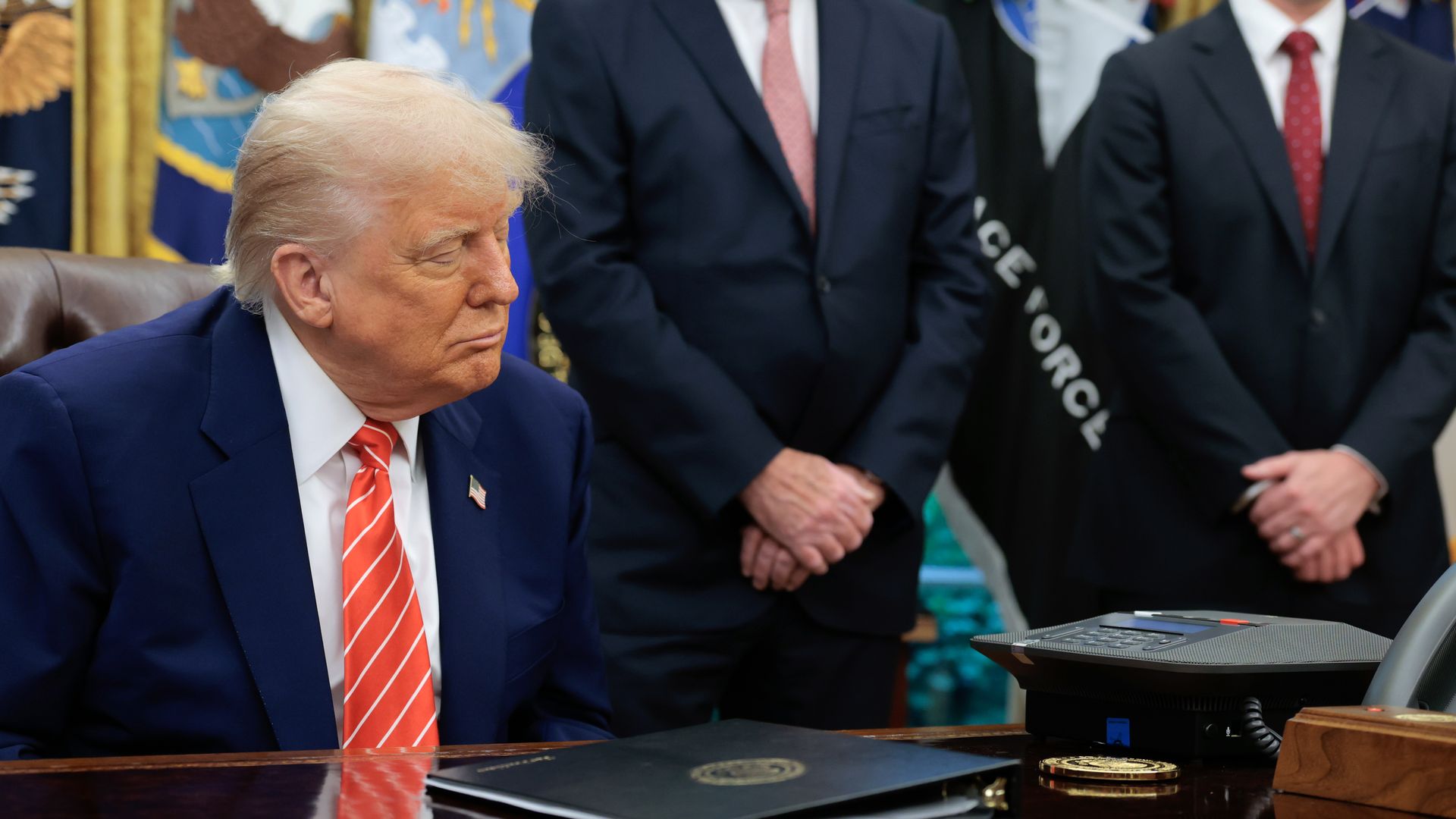
Trump on a call in the Oval Office. Photo: Anna Moneymaker/Getty Images
President Trump and Russian President Vladimir Putin spoke for around two hours on Monday, after which Trump announced that Russia and Ukraine would "immediately start negotiations toward a ceasefire" and an end to the war.
Why it matters: Trump previously argued his personal involvement would be crucial to achieving any deal, but walked back from any mediator role on Monday and said the talks would be only between the two countries. He added that Pope Leo XIV "would be very interested in hosting" talks in the Vatican.
- A first round of ceasefire talks already took place on Friday in Istanbul, with no major breakthroughs. Putin initially proposed a leader-level summit, then declined to attend.
- Trump's statement that the U.S. won't play a role in talks going forward reflects the Russian position that the U.S. should not mediate the dispute. The Russians refused to allow State Department official Michael Anton to attend Friday's talks.
Friction point: Ukraine, NATO allies and Trump himself have demanded that Russia agree to an immediate and unconditional ceasefire. Trump's statement suggests Putin convinced him of the need for negotiations over the terms of any ceasefire.
Between the lines: Trump has threatened to impose sanctions on any party that obstructs a deal, but has not imposed any penalties on Russia thus far for opposing a swift ceasefire.
- On Friday, he said in an interview with Fox News that he will use his leverage on Putin if he thinks it's needed.
- On Sunday, Trump held a conference call with the leaders of U.K., France, Germany and Italy who urged him to sanction Russia if Putin doesn't agree to an immediate and unconditional ceasefire during their call.
- Trump spoke to a those four European leaders plus the leaders of Finland and the European Commission on a conference call Monday immediately after his call with Putin.
- While Putin did not agree to a ceasefire, Trump described the tone of the call as "excellent."
What they're saying: The Kremlin said the call was "meaningful, frank and very useful" and that Russia was "ready to work with Ukraine on a memorandum on a future peace treaty, which may also include a ceasefire and principles for resolving the conflict."
- Putin adviser Yuri Ushakov said Trump and Putin didn't discuss timetable for a ceasefire but said Trump stressed he want it to happen "quickly."
- Trump told Putin the U.S. Senate is preparing possible sanctions against Russia but stressed he prefers to reach an agreement and not use sanctions, Ushakov claimed.
Trump called Zelensky ahead of the call with Putin and spoke to him for a few minutes, according to a source familiar.
- Zelensky wrote on X ahead of the call that Ukraine insists on the need for a "full and unconditional ceasefire" in order to establish the necessary foundation for diplomacy.
- "Such a ceasefire must be long enough and include the possibility of extension. Our proposal is 30 days. We are also prepared for a meeting at the level of leaders to solve the key issues. Ukraine is not afraid of direct talks with Russia, and it is important that the Russian leadership not prolong the war," Zelensky wrote.
The intrigue: Hosting negotiations would be a very high profile first act of international diplomacy for the American-born Pope Leo XIV.
What to watch: Vice President Vance reiterated ahead of the call that the U.S. was "more than open to walking away" from the peace process if it didn't show results.
- Vance admitted the talks between Russia and Ukraine are at "a bit of an impasse" and stressed that "one open question is whether Vladimir Putin is serious about negotiating peace."
This story was updated throughout after the call.
