North Carolina's foreign-born population is booming

Add Axios as your preferred source to
see more of our stories on Google.
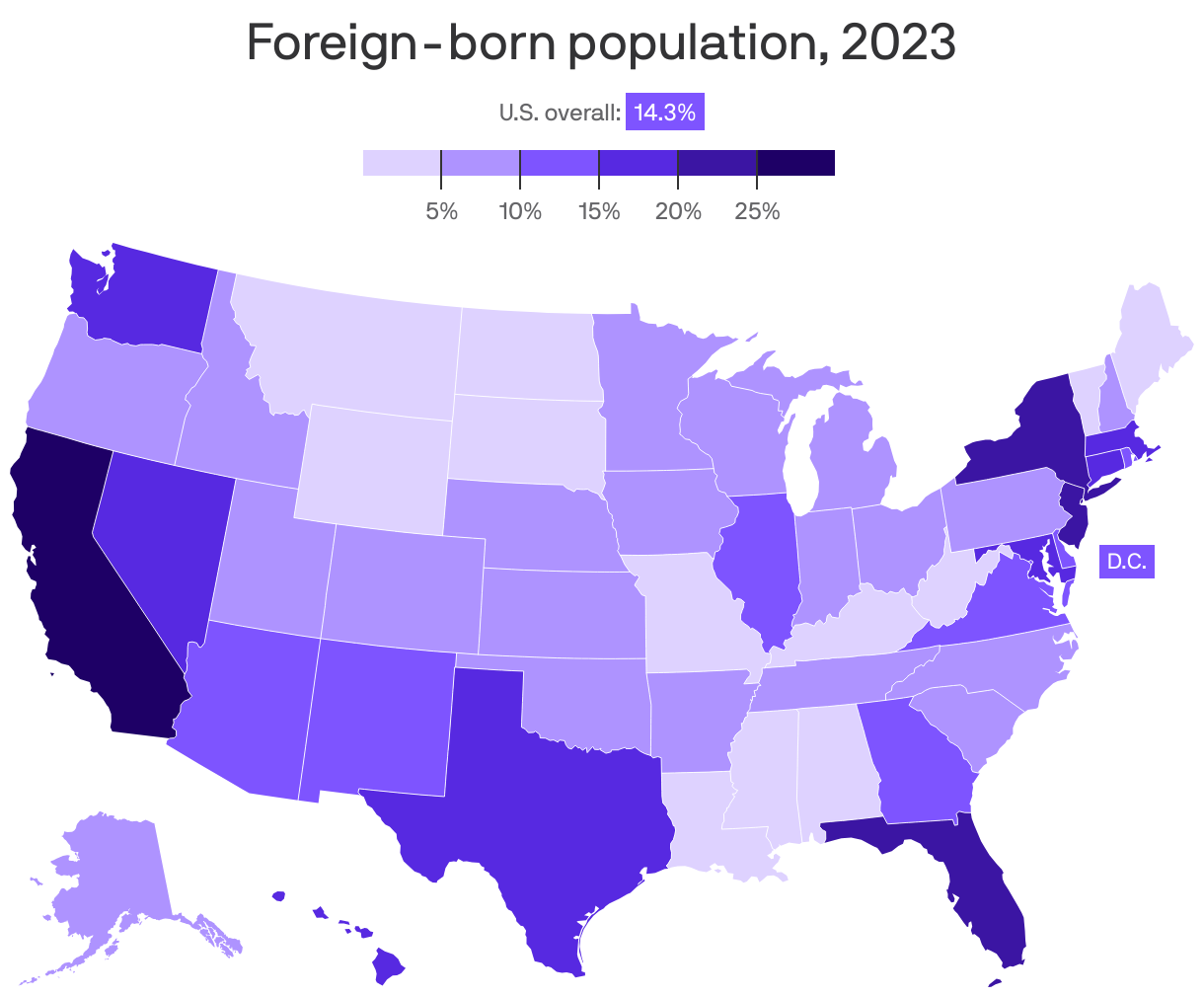
North Carolina's foreign-born population surged 32% over the last decade, census data show.
Why it matters: Foreign-born residents in North Carolina are a growing and important part of the state's economy — supporting sectors from healthcare to tech to agriculture — while shaping what the state looks like politically and culturally.
By the numbers: North Carolina's foreign-born population in 2023 was 995,127, comprising 9.18% of the state's overall population, per census data.
- That includes 443,000 naturalized citizens, plus 562,000 who are not citizens.
- In 2013, the foreign-born population here was 749,426, making up 7.6% of the state's overall population. That included 239,232 naturalized citizens plus 510,194 noncitizens.
Between the lines: Not all noncitizens are undocumented, per UVA's Weldon Cooper Center, Axios Richmond reported.
- They can also be lawful permanent residents, students or workers on temporary visas and refugees.
Zoom out: The growth of North Carolina's foreign-born population has outpaced what's happening nationally. In 2023, 14.3% of the U.S. population was foreign-born, up from 13.1% a decade prior.
Flashback: The foreign-born population in North Carolina has increased eightfold since 1990, according to the Office of State Management & Budget.
- Immigration began to increase significantly following the Immigration Reform and Control Act of 1986, says Nathan Dollar, director of Carolina Demography.
- Around that time, poultry and hog-processing actively moved to the rural South, where labor was cheaper and unions were scarce, Dollar added.
- Those industries recruited workers from Latin America and Mexico, he said, driving substantial immigration.
- But in the last 12 years or so, immigration from India has been especially fast-growing, Dollar added, in part due to demand in industries like technology.
What they're saying: These days, people move here from other countries for similar reasons they move here from other states — including favorable climate, tax reasons, low cost of living and job opportunities, says Michael Cline, a state demographer for North Carolina at the Office of State Budget.
- What's more, he added, people are often "pushed out of their own countries by wars or instability, plus demographic factors that pressure them to move here."
Details: North Carolina's largest urban counties — Mecklenburg, Wake, Guilford, Durham and Forsyth — are home to most of the state's foreign-born populations, according to the state's OSMB.
- In those counties, they work in a variety of industries, including construction, services, manufacturing, education, medical care and advanced technology.
- Rural counties also are home to "sizable" foreign-born populations who work in industries like agriculture and related fields, including the manufacturing of agricultural goods (i.e. food processing, forest products milling, etc.), per OSMB.
Fun fact: Today, one in five children in North Carolina has at least one foreign-born parent, according to Dollar of Carolina Demography.
The big picture: In North Carolina, and in the U.S. overall, the native-born population — Baby Boomers in particular — is aging, and there's been a long-term decline in fertility, Cline added.
- "The U.S. is becoming more dependent on international migration for its growth," he said.