Why AI is no substitute for human teachers

Add Axios as your preferred source to
see more of our stories on Google.
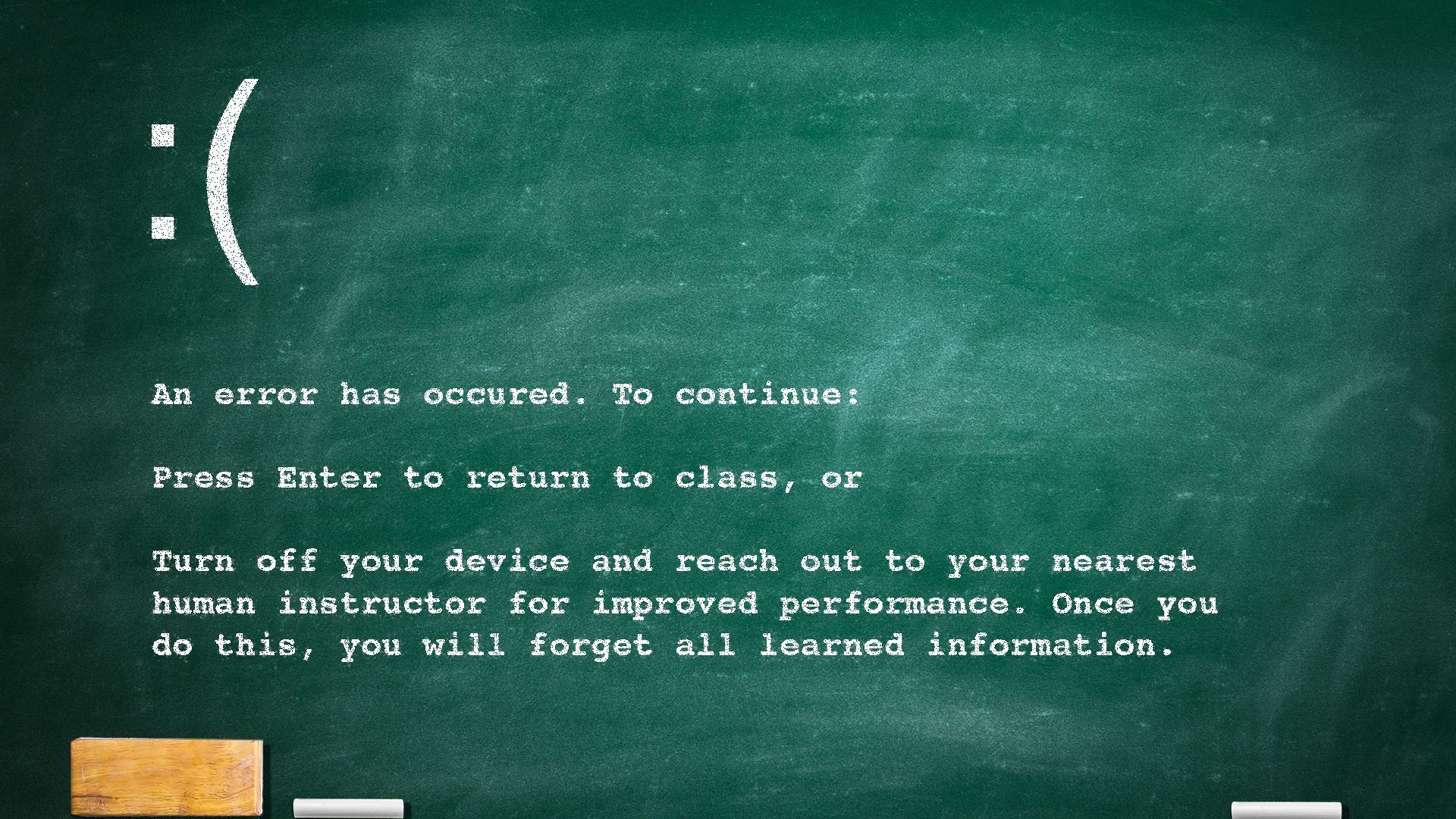
Illustration: Aïda Amer/Axios
High school students who use generative AI to prepare for math exams perform worse on tests, where they can't rely on AI, than those who didn't use the tools at all, a new study shows.
Why it matters: A "personal tutor for every student" is one of the rosy scenarios AI optimists paint, but AI-driven learning still has many hurdles in its way.
Catch up quick: Since ChatGPT was released nearly two years ago, educators have struggled to find the best ways to incorporate genAI into the classroom.
- Many immediately feared ChatGPT would create a "flood" of cheating that would likely go undetected.
- Some schools banned these tools outright, while others allowed students to use them as long as they disclose their use.
In response to theories that genAI works best as a tutor, Khan Academy founder Sal Khan began piloting a genAI tutor called Khanmigo last year.
- The company says that the tool is designed not to give students answers, but to help them solve the problems on their own.
- Elementary school teachers in Newark, the largest public school system in New Jersey, volunteered to test Khanmigo last year — and their feedback was mixed.
- One teacher told the New York Times that the genAI tutor was useful as a "co-teacher," but others were frustrated by the bots' tendency to give away answers, sometimes wrong ones.
- During the last school year, 65,000 students and teachers piloted Khanmigo in classrooms in Newark and across the U.S. The second year of the pilot program is about to begin.
Driving the news: A new report from the Wharton School found that access to genAI tutors can improve student performance on practice math problems.
Yes, but: Students who used these tools performed significantly worse on exams, where they can't use AI.
- These students are likely to use genAI to copy and paste answers, which leads them to engage less with the material.
What they did: The researchers tested three groups of students preparing for a math exam. Nearly 1000 9th-, 10th- and 11th-grade students participated in four 90-minute sessions.
- One group used textbooks. A second group used a genAI tutor designed to mimic a standard chatbot interface. The third group used a specially prepared chatbot prompted by teachers to offer step-by-step guidance on solving problems instead of giving the answer.
Hamsa Bastani, an associate professor at the Wharton School who led the study, said it shows we need to deploy genAI cautiously to ensure that students continue to learn critical skills.
- "If you just give unrestricted access to generative AI, students end up using it as a crutch," Bastani told Axios. "Even though they don't seem to realize that they're using it as a crutch, [they] end up performing a lot worse."
- Kristen DiCerbo, chief learning officer at Khan Academy, agrees. "Our AI pilot has shown us that students need guidance on how to use AI tools," DiCerbo wrote in an email to Axios.
- "We've found that even small changes to the prompt given to the model — for example, directing the model to act in ways that good human tutors do — improve student interactions," DiCerbo wrote.
What they're saying: "In some cases, AI may serve as a teaching assistant, but students will need teachers to help them create a bridge between prior knowledge, new knowledge, and shared knowledge," the National Council of Teachers of Mathematics says.
- But Bastani says it's not yet clear how to execute this effectively in the classroom.
The other side: GenAI tutors can be helpful in places where trained teachers aren't available.
- Bastani says the technology could be used in less-developed countries with teacher shortages.
- "I think there is a democratizing effect of these technologies," Bastani admits. "But we need to find ways to motivate students to engage with the material rather than do this copy and pasting."
- Last year Khan told Axios' Ina Fried that for all of genAI's flaws, it still offers personalized learning opportunities for more kids in both rich and developing countries.
The bottom line: GenAI in schools, as in so many other environments, is best used in coordination with humans.
