U.S. exit from the WHO may hamstring global health

Add Axios as your preferred source to
see more of our stories on Google.
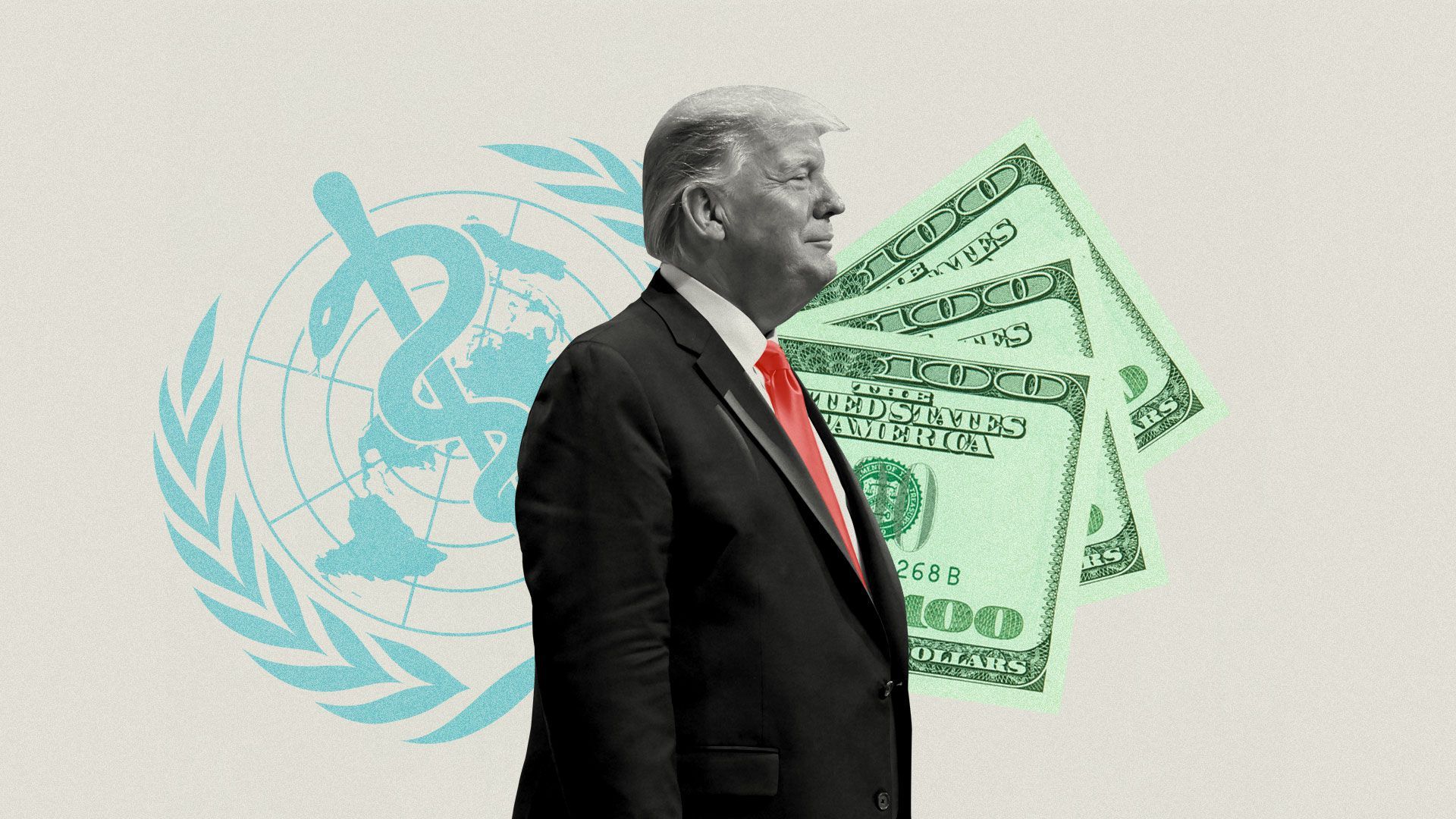
Photo Illustration: Eniola Odetunde/Axios. Photo: Noam Galai/Getty Images
President Trump's decision to start withdrawing the U.S. from the World Health Organization puts global health programs in a serious financial squeeze just as disease threats are multiplying.
Why it matters: Trump's reluctance to pay the freight for the global health partnership could come back to bite him if surveillance efforts break down and a regional outbreak turns into another pandemic.
- Leaving WHO "could put the U.S. at a disadvantage if the U.S. is not at the table, not being privy to all the cooperation and information that others may be getting," said Jennifer Kates, senior vice president and director of the Global Health & HIV Policy Program at KFF.
Where it stands: Public health experts acknowledge that another worldwide pandemic is a "when," not an "if." And there are myriad other concerns.
- Tuberculosis is having a resurgence and now is the world's leading infectious disease killer. Climate change could put billions of people at risk for malaria. And while the H5N1 bird flu isn't yet a threat to the general public, that could quickly change.
- WHO issues alerts on disease outbreaks around the world almost weekly. It mobilizes the response to crises like Ebola in West Africa and "prequalifies" medical products for safety and efficacy before they're bought and distributed in developing countries.
Containing public health threats requires intergovernmental coordination — and money.
- The U.S. is the WHO's largest financial backer, providing 14.5% of WHO's total funding for the year, as of November 2024.
- Trump's executive order kickstarting withdrawal from WHO cites "unfairly onerous payments from the United States." But required dues from member countries are calculated mainly based on GDP.
- In fiscal 2023, the U.S. gave $481 million to WHO, a tiny fraction of the $6.2 trillion the federal government spent that year. Of that, $109 million was in required dues — the rest came in voluntary contributions for a range of specific WHO activities.
- WHO officials said in a statement on Tuesday that they "look forward to engaging in constructive dialogue to maintain the partnership."
Between the lines: There have been persistent questions and accusations about WHO's management of the initial outbreak of COVID, and whether it hasn't held China to account on origins of the pandemic.
- But some public health experts say the U.S. should use its leverage to push reforms at WHO instead of leaving the group, and caution that leaving could wind up giving China more influence over global health.
- "WHO is a pretty essential organization — and with America's withdrawal, it creates a political vacuum that only one country can fill — and that is China," Ashish Jha, dean of the Brown University School of Public Health, told CNN.
The U.S. leaving WHO won't change anything immediately, said Amesh Adalja, senior scholar at the Johns Hopkins Center for Health Security. For starters, it'll take a year to fully exit the organization.
- But eventually, the move will "really constrain the ability of the United States to have good situational awareness of infectious disease outbreaks happening all over the world," he said.
- Other countries notify WHO in the event of an infectious disease outbreak. The Centers for Disease Control and Prevention and the Department of Defense have their own global health monitoring systems, but WHO enhances those efforts, Adalja said.
- The U.S. withdrawing from WHO will also weaken the organization's ability to mitigate health threats across the world, since U.S. funding has become so crucial to its operations.
What we're watching: The executive order indicates that Trump will still keep a close eye on global health trends. It directs officials to establish coordination within the National Security Council to "safeguard public health and fortify biosecurity."
- Public health experts are dubious that will be enough.
- "There's a lot the U.S. can do on its own, but there's no replacement for WHO at this time," KFF's Kates said.
