House GOP hears crypto firms on Operation Choke Point 2.0

Add Axios as your preferred source to
see more of our stories on Google.
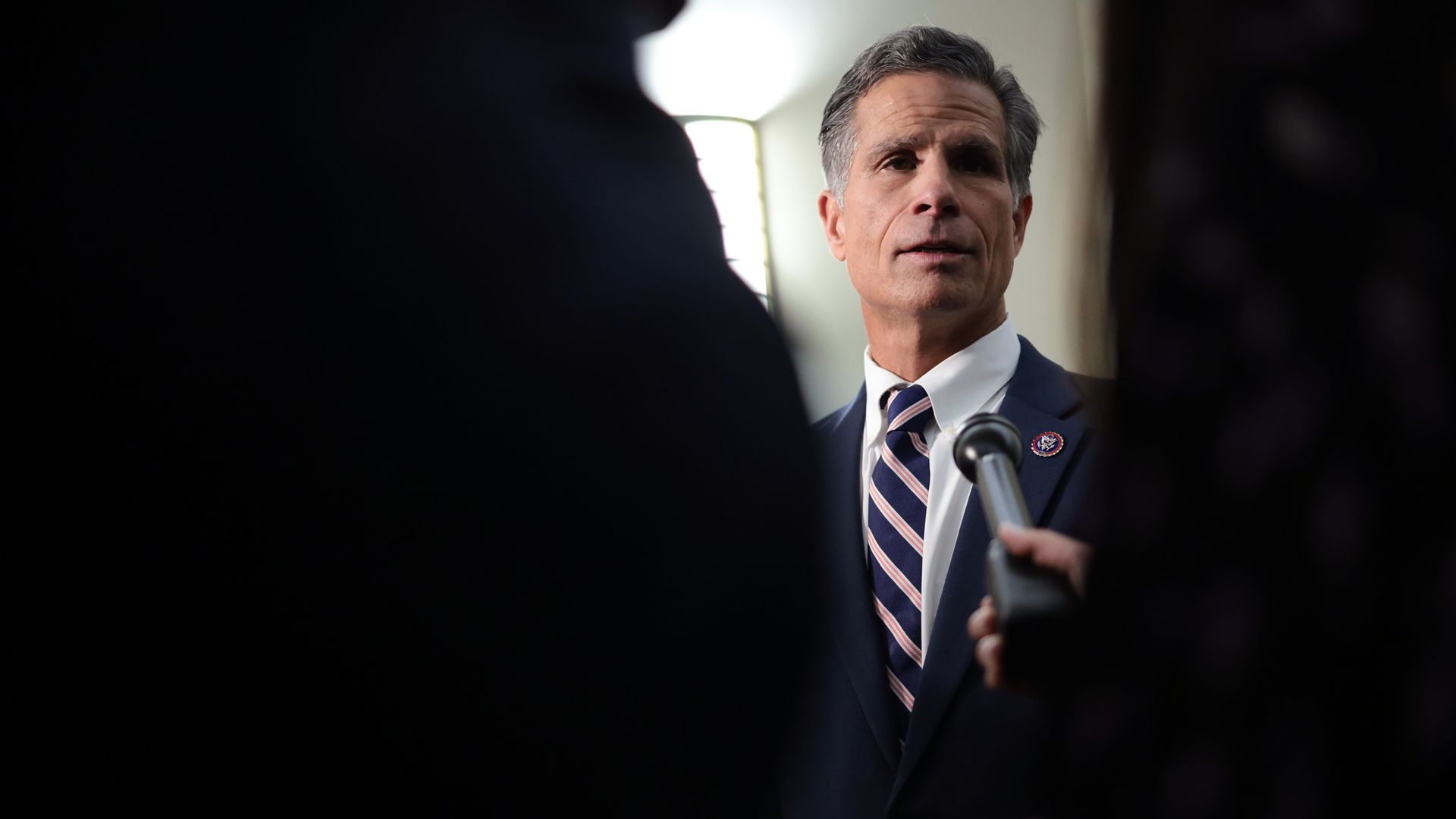
Rep. Dan Meuser (R-Pa.), House Financial Services Subcommittee on Oversight and Investigations chair. Photo: Win McNamee/Getty
A regulator doesn't have to explicitly say "don't do something" in order to tell entities it regulates to not do that something, witnesses testified Thursday at a House subcommittee hearing on the debanking of legal digital-asset companies.
Why it matters: Allegations of unfair treatment against multiple businesses in a disfavored but legal industry raise concerns about the subjectivity and opacity in banking regulation.
Friction point: "The Biden administration's Operation Choke Point 2.0 was carried out by the prudential regulators to target, and in fact, debank the digital-asset ecosystem," the chair of the House Financial Services Subcommittee on Oversight, Rep. Dan Meuser (R-Pa.) said in his opening remarks.
- "Operation Choke Point" is a reference to an Obama-era program that used banking regulation to restrict certain industries, such as payday lenders and firearms companies. The crypto industry has been alleging similar treatment from regulators for the past two years.
Zoom in: Paul Grewal, attorney to the U.S.'s largest crypto exchange, Coinbase, drew attention in his testimony Thursday to the FDIC's pause letters to regulated institutions.
- He argued that the agency didn't have to ever say "no" to banking crypto companies. Instead, it simply asked them to "pause" operations, without ever unpausing.
- "What the pause letters show, over and over again, is that banks were subject not to regulation by examination, but regulation by exhaustion," Grewal said.
The other side: Another witness argued that regulators were justified in warnings of risks to the banking system.
- "If the crypto industry had followed the law like almost every other financial firm in the U.S., then it would not be crosswise with the regulators who are mandated to enforce the law and protect consumers, investors and financial stability," Shayna Olesiuk, director of banking policy at the advocacy organization Better Markets, said in her spoken testimony.
- In 2022, there were major economic disruptions out the blockchain industry, which culminated in the unraveling of the crypto exchange FTX, whose founder, Sam Bankman-Fried, was ultimately criminally convicted on multiple charges.
"We're somewhat twisted around here, in that the regulators took the stance that, because some actors in a space are bad, we will therefore debank all of the actors in a space," Austin Campbell, CEO of WSPN USA, a digital payments company, countered during the hearing.
- In his testimony, Campbell clarified that debanking means being denied basic services, such as checking accounts, so that companies can pay leases and employees.
- It doesn't mean, for example, asking for loans secured by cryptocurrency.
- This is just the business of taking dollar deposits until a customer needs to spend that money, Campbell explained in his written testimony. "Fundamentally, taking deposits is not risky."
The big picture: On balance, the Democrats on the subcommittee defended the Biden administration and Republicans seemed to want to set new limits on regulatory authority going forward, so that the guidelines come from Congress.
- "If you take issue with an industry, you can always pass a law," Rep. Troy Downing (R.-Mont.) said during the hearing.
- The ranking member, Rep. Al Green (D.-Tex.) argued that regulators have to stand in the gap sometimes. "For Congress to act, you have to have an act of congress. Congress hasn't been able to act," he said. "The regulators are in a tough position."
Read more: Crypto firm's debanking story reaches the Senate.
