When to expect flight delays to end after the shutdown is over

Add Axios as your preferred source to
see more of our stories on Google.
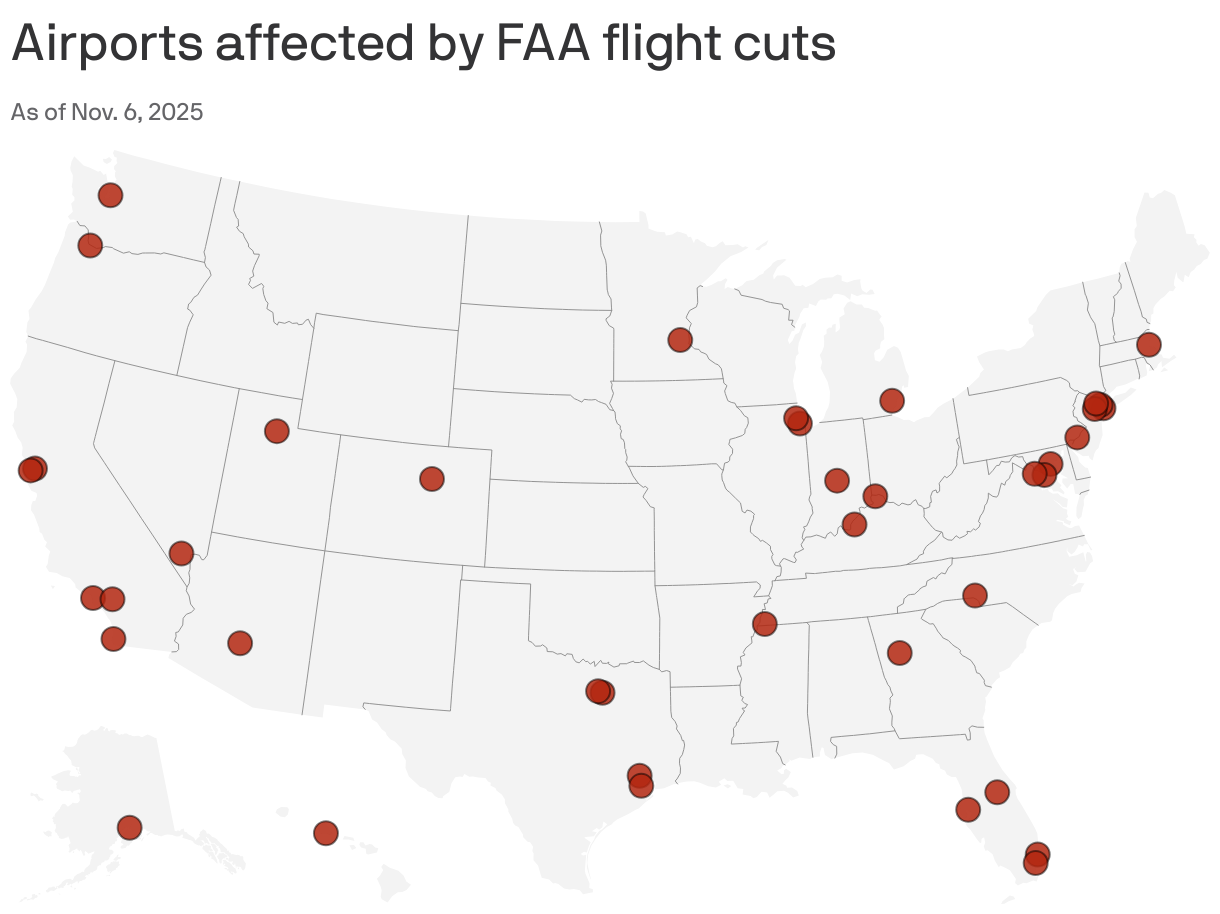
Even after the record-long federal government shutdown ends, flight delays will persist for at least a few days, if not longer.
The big picture: The Federal Aviation Administration started cutting 4% of air traffic at 40 "high-traffic" U.S. airports last week, with the number increasing to 6% on Tuesday and set to reach 10% on Friday.
- As of Wednesday morning, more than 850 U.S. flights had been canceled, according to the flight tracking website FlightAware, with more than 890 flights delayed.
Driving the news: Transportation Secretary Sean Duffy warned on Tuesday that if the shutdown doesn't end soon, "we're not going to get to Thanksgiving."
- Many air traffic employees have been working without pay and travelers have endured weeks of flight disruptions as some workers have called out sick.
What they're saying: Duffy also said the FAA won't lift its restrictions until enough air-traffic controllers are back to work.
- "We're going to wait to see the data on our end before we take out the restrictions on travel that we have right now," he said.
"Airlines' reduced flight schedules cannot immediately bounce back to full capacity right after the government reopens," Airlines for America, a trade group that represents the largest passenger and cargo airlines, said in a statement on Monday.
- "It will take time, and there will be residual effects for days."
Steve Olson, senior vice president of system operations and airports for JetBlue, told The Wall Street Journal that the airline has had to use its reserve crews to continue operating as scheduled.
- He said the airline needs to assess, however, whether there are enough pilots and flight attendants for the Thanksgiving travel period.
- "We have to be cognizant of making sure that we've got a comfortable level of reserves and a healthy level of resilience in our system as we go into that Thanksgiving time period," he said, adding that the airline needs to be prepared for winter storms and other disruptions.
Zoom out: Airlines need at least a few days to assemble their crews before flight schedules can resume normally.
- Carriers cancel flights days in advance to give customers notice and to make sure that crews and planes are ready ahead of time.
Flashback: It took nearly three months for controllers to receive all of their compensation after the government shutdown in 2019, Nick Daniels, president of the National Air Traffic Controllers Association labor union, said at a press conference this week.
Our thought bubble: Controller staffing, training and pay were issues even before the shutdown, which certainly didn't help matters, Axios' Colin Demarest said.
- Even as airlines get their schedules back in order, those underlying problems will persist to one degree or another.
By the numbers: About 6.3% of flights from the U.S. between Nov. 6 and the morning of Nov. 12 have been cancelled, according to aviation-data provider Cirium.
