Nvidia CEO Jensen Huang: $1 trillion in chip sales coming

Add Axios as your preferred source to
see more of our stories on Google.
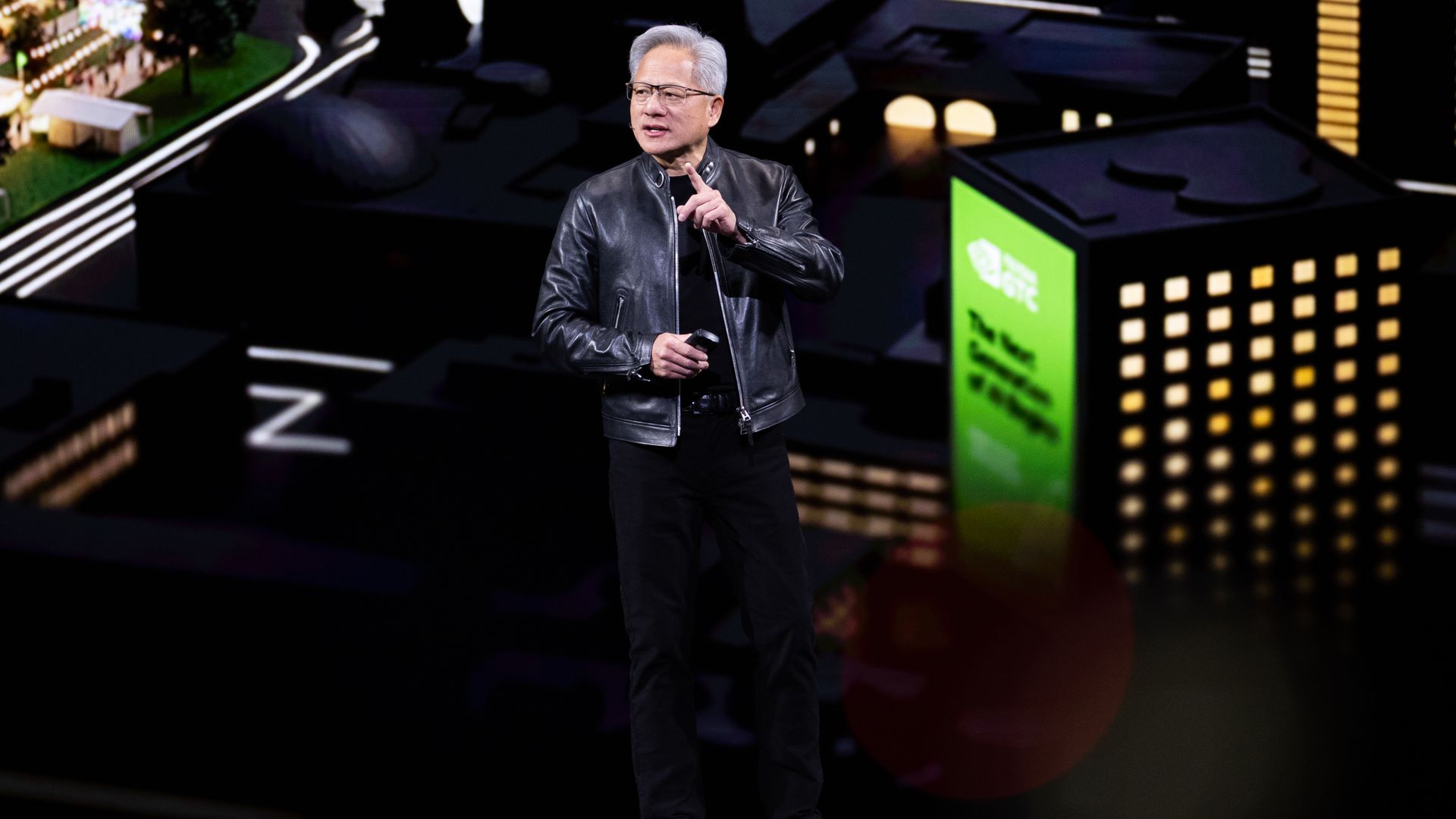
Jensen Huang gives the keynote address March 16 at the Nvidia GTC conference in San Jose, Calif. Photo: Benjamin Fanjoy/Getty Images
Nvidia CEO Jensen Huang said Monday that he expects the company to reap "at least" $1 trillion in revenue from its newest AI chips through 2027.
Why it matters: The company is operating at the center of the AI universe, providing the critical processing infrastructure that powers models like OpenAI's ChatGPT and Anthropic's Claude.
Driving the news: Huang said at Nvidia GTC 2026 in San Jose that he anticipates the revenue benchmark from sales of the company's current Blackwell chips and its next-generation Vera Rubin chips through 2027.
- And "I am certain computing demand will be much higher than that," Huang said.
- He said in October 2025 that the company had $500 billion in AI chip orders through 2026.
State of play: The AI economy is transitioning to inference models, having moved beyond the training phase, bolstering demand for complex chips.
- "Finally, AI is able to do productive work, and therefore the inflection point of inference has arrived," Huang said.
- He said, for example, that all of Nvidia's software engineers are using AI coding assistants, such as Anthropic's Claude Code and OpenAI's Codex.
- Nvidia will combine its new Vera Rubin chips with storage, inference accelerator and Ethernet racks to form what the company is calling an "AI supercomputer" designed to deliver a "generational leap" in agentic AI solutions.
The onslaught of agentic AI has accelerated in recent months due to the introduction of a new open-source AI agent called OpenClaw, made by developer Peter Steinberger.
- Huang heaped praise on OpenClaw, calling it "profound" and saying it's the most popular open-source project "in the history of humanity," topping Linux "in just a few weeks."
- He unveiled Nvidia NemoClaw, which uses an agent toolkit to interact with OpenClaw, allowing users to operate their agents with additional security controls.
- "Every single company" needs an "OpenClaw strategy," he said.
What's next: Software as a service (SaaS) companies — which investors have worried will be damaged by AI agents — will become "AaaS" companies, or "agentic AI as a service," Huang predicted.
- Instead of selling software, they'll sell agents that help clients build software.
Editor's note: This story has been updated with additional details.
