Mobility's new Big Three: Tesla, Waymo and Uber

Add Axios as your preferred source to
see more of our stories on Google.
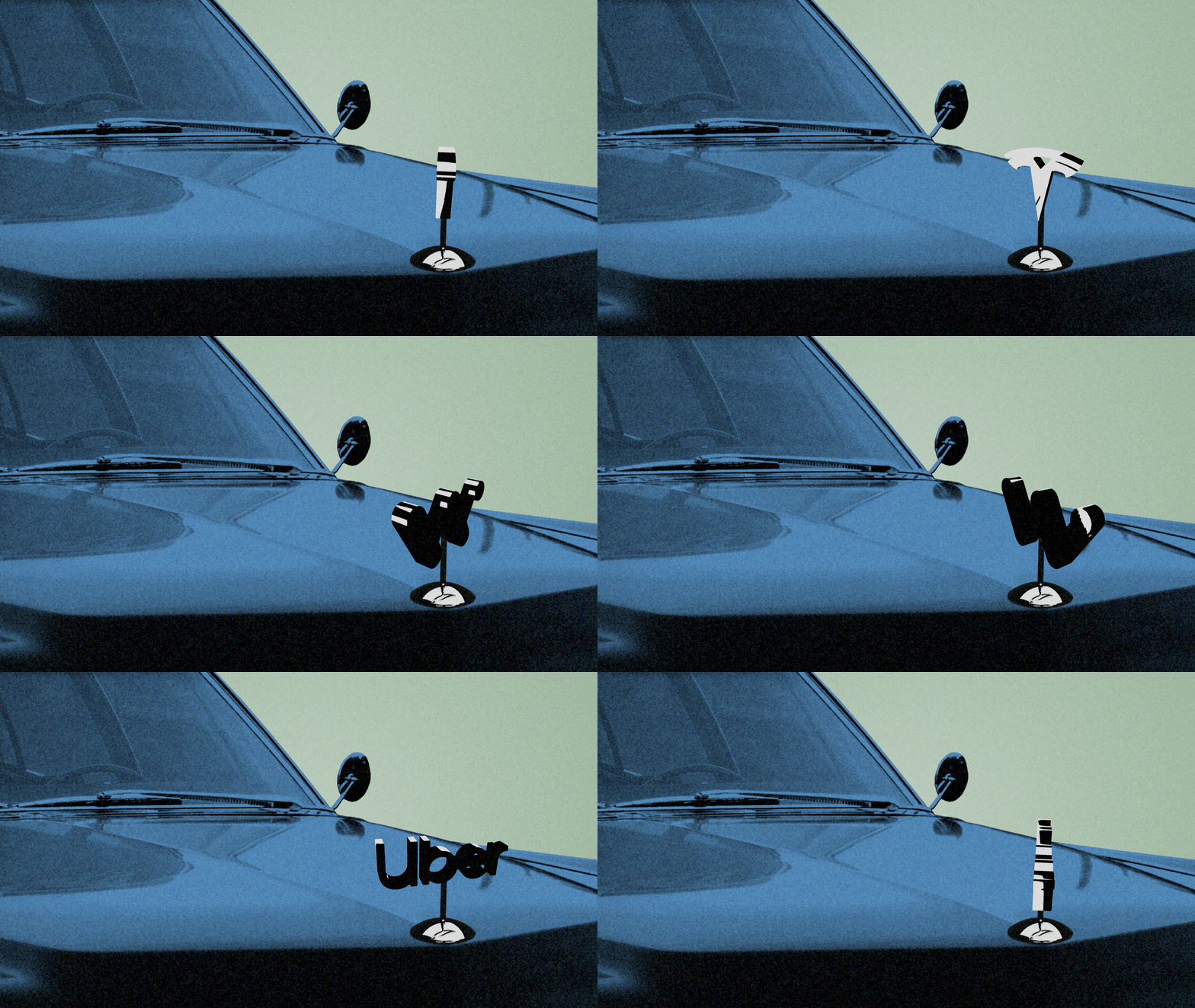
Illustration: Brendan Lynch/Axios. Stock: Getty Images
As the race toward autonomy unfolds, a new U.S. "Big Three" in mobility is emerging: Instead of GM, Ford and Chrysler, it's Waymo, Tesla and Uber.
Why it matters: Automotive and tech giants, along with many well-funded startups, are vying for a slice of the self-driving future.
The big picture: Autonomous driving technology is no longer science fiction. It's here.
- Robotaxis are operating in about a dozen cities — with tests underway in many more — and driverless semi trucks are hauling loads across Arizona and Texas.
- But safely deploying AV technology is only the start — the next phase of the AV race is about who can operate networks at scale.
This will require building the infrastructure and large-scale operations needed to support a viable robotaxi service.
- That means depots for charging, cleaning and vehicle maintenance, plus route optimization technology to deploy vehicles efficiently to meet fluctuating demand.
Between the lines: Waymo, Tesla and Uber already have distinct advantages in these areas that will make it hard for others to catch up.
- Each has bet their stakes on an autonomous future, although with different paths to get there.
- And while none of them possess all the pieces needed for a successful AV business, each has a solid foundation and the resources to do so better and faster than others.
Waymo
Waymo is the clear robotaxi leader, with operations in 11 cities and 500,000 paid trips per week. It's already racked up 200 million fully driverless miles in the real world.
- It has $16 billion in fresh capital, much of it from parent Alphabet, to keep spreading across America, as well as to London and Tokyo.
- "Waymo is probably less than a year from becoming a verb," says Grayson Brulte, founder of The Road to Autonomy.
Yes, but: The company's a tech supplier, not an operator — its product is the Waymo driver, the hardware and software suite added to vehicles so they can drive themselves.
- Nor does it build cars. Instead, it buys them from other manufacturers.
- And while it has experience running depots in San Francisco, it mostly relies on fleet management partners for cleaning and maintenance.
Uber
Uber — definitely a verb — has a superpower that standalone AV companies don't: a sophisticated tech platform that's been efficiently matching riders and vehicles for 15 years.
- Rather than a threat to its ride-share business, CEO Dara Khosrowshahi sees robotaxis as an opportunity to capitalize on that experience.
- On the infrastructure side, it's spending $100 million to develop new AV charging hubs in San Francisco, Los Angeles and Dallas.
Its challenge, though, is that it needs carmakers and tech companies to supply the robotaxis, and other operators to clean and charge them.
- Uber is partnering with every AV developer under the sun — even investing in a few of them — to ensure there's a healthy mix of players besides Waymo.
- Most of those AV tech companies are still a couple years behind Waymo though.
Tesla
Tesla's advantage is the data collected by nearly 3.2 million Tesla vehicles driving around the U.S. every day, including 1.1 million subscribers to its FSD (Supervised) hands-free driver assistance package.
- That enables the company to continually improve its autonomous technology.
- The company's vast Supercharger network and low manufacturing costs will also be big advantages as it scales a robotaxi service.
But for all the hype about FSD (which stands for full self-driving), the technology still requires human supervision — and Tesla has not yet deployed a meaningful fleet of robotaxis.
- It launched a modest ride-hail service (with in-car safety monitors) last summer in Austin, Texas, and only recently unleashed a handful of fully driverless cars.
- Nor has Tesla sought regulatory approval for its much ballyhooed Cybercab, a two-seater with no steering wheel or pedals.
What we're watching: Tesla FSD differs from self-driving tech used by Waymo and others because it doesn't use lidar or radar sensors to complement the car's built-in cameras.
- While some Tesla critics are skeptical that its technology will ever work, most investors are bullish that Elon Musk's company is on the cusp of full autonomy.
- If Tesla manages to get over the current hump on FSD, it could be game over.
Zoom out: Traditional automakers that have dominated the mobility landscape for decades are focused on closer targets: selling more cars and trucks to today's buyers while gradually adding automated-driving features.
The bottom line: The U.S. race to autonomy has only just begun, but its new Big Three are well out in front.
