Scoop: U.S. considers $20 billion cash-for-uranium deal with Iran


Add Axios as your preferred source to
see more of our stories on Google.
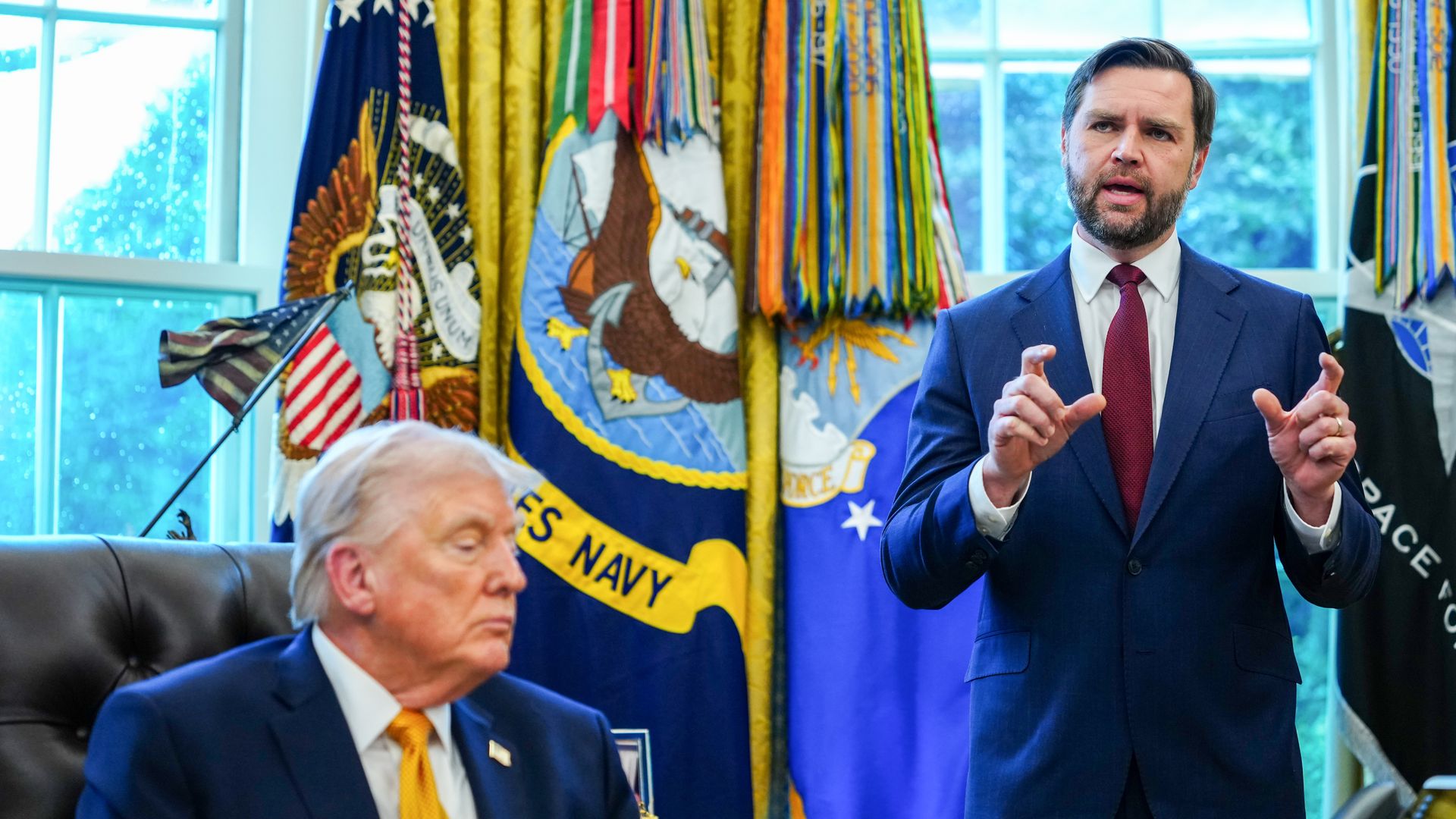
President Trump and Vice President Vance in the Oval Office last month. Photo: Aaron Schwartz/UPI/Bloomberg via Getty Images
The U.S. and Iran are negotiating over a three-page plan to end the war, with one element under discussion being that the U.S. would release $20 billion in frozen Iranian funds in return for Iran giving up its stockpile of enriched uranium, according to two U.S. officials and two additional sources briefed on the talks.
Why it matters: There has been steady progress in the talks this week, though significant gaps remain. A deal on these terms would bring the war to a close, while potentially generating backlash from Iran hawks.
- President Trump said Thursday that U.S. and Iranian negotiators would likely meet this weekend for a second round of talks to try to seal the deal.
- The talks are expected to take place in Islamabad, likely on Sunday, according to a source familiar with the mediation efforts.
- Pakistan is mediating the negotiations, with behind-the-scenes support from Egypt and Turkey.
Breaking it down: A top priority for the Trump administration is ensuring Iran can't access the stockpile of nearly 2,000kg of enriched uranium buried in its underground nuclear facilities, in particular the 450kg enriched to 60% purity.
- The Iranians, meanwhile, need money.
- The parties are negotiating over what will happen to the stockpile, and how much of Iran's assets will be unfrozen. They are also discussing the terms on which Iran could use that money.
Update: Trump wrote on Truth Social after this story published that "no money will change hands," though he didn't refer specifically to the idea of unblocking Iranian funds.
Zoom in: According to two sources, the U.S was ready in an earlier stage of the negotiations to release $6 billion for Iran to purchase food, medicine and other humanitarian supplies. The Iranians demanded $27 billion.
- The latest number discussed by the U.S. and Iran is $20 billion, the sources said. One U.S. official said that was a U.S. proposal. The other U.S. official described the cash-for-uranium concept as "one of many discussions."
- Meanwhile, the U.S. asked Iran to agree to ship all its nuclear material to the U.S., while the Iranians only agreed to "down-blend" it inside Iran.
- Under a compromise proposal now under discussion, some of the highly enriched uranium would be shipped to a third country, not necessarily the U.S., and some of it would be down-blended in Iran under international monitoring.
The intrigue: The three-page memorandum of understanding (MOU) the two sides are negotiating over also includes a "voluntary" moratorium on nuclear enrichment by Iran.
- The U.S. demanded in the last round of talks that Iran agree to a 20-year moratorium. Iran countered with five years. The mediators are still trying to close the gap.
- As part of the MOU, Iran would be allowed to have nuclear research reactors for the production of medical isotopes, but would pledge that all of its nuclear facilities would be above ground. The existing underground facilities would remain out of commission.
The MOU also deals with the Strait of Hormuz, though the sources said there are still significant gaps on that issue.
- It's unclear if the MOU refers to Iran's ballistic missiles and its support for regional proxies.
- Israel and Republican hawks in Washington have previously demanded that those topics be on the table in any negotiations with Iran.
- Republicans and Trump himself also lambasted President Obama for releasing tens of billions in Iranian funds under the 2015 nuclear deal. The Trump administration may insist on limiting how the unfrozen assets can be used.
What they're saying: "Iran has moved. But not far enough. What it takes to make them move forward, we will see," the second U.S. official said.
- "Iran clearly wants the $20 billion — and a lot more. They clearly want to sell oil at free-market rates without sanctions. They want to participate in the global financial system. But they also want to have this nuclear weapons program. They want to fund terrorists like Hamas. And they don't want to give that up enough to get the things we're offering," the official added.
- White House spokesperson Anna Kelly said talks had been "productive" but the U.S. would "not negotiate through the press," adding: "Anonymous sources who claim to know about sensitive diplomatic discussions have no idea what they are talking about."
- Sen. Lindsey Graham (R-S.C.) told Fox News that Trump had negotiated spoken directly with the Iranians and that things got "sporty" on a recent call.
Trump told reporters on Thursday that Iran had agreed during the negotiations to commit to "a very, very powerful statement... that they will not have nuclear weapons."
- He also said Iran agreed to give the U.S. "the nuclear dust," referring to the enriched uranium stockpile.
- "We are very close to making a deal. If no deal, fire resumes," Trump said.
- He made clear he was willing to extend the ceasefire beyond its April 21 expiration if needed.
What to watch: On Friday, the Pakistani, Egyptian and Turkish mediators will hold a meeting a "quad" meeting with Saudi officials on the sidelines of a diplomatic forum in Turkey.
- The meeting will focus on the efforts to broker a deal between the U.S. and Iran.
