Spirit Airlines shutting down, canceling all flights

Add Axios as your preferred source to
see more of our stories on Google.
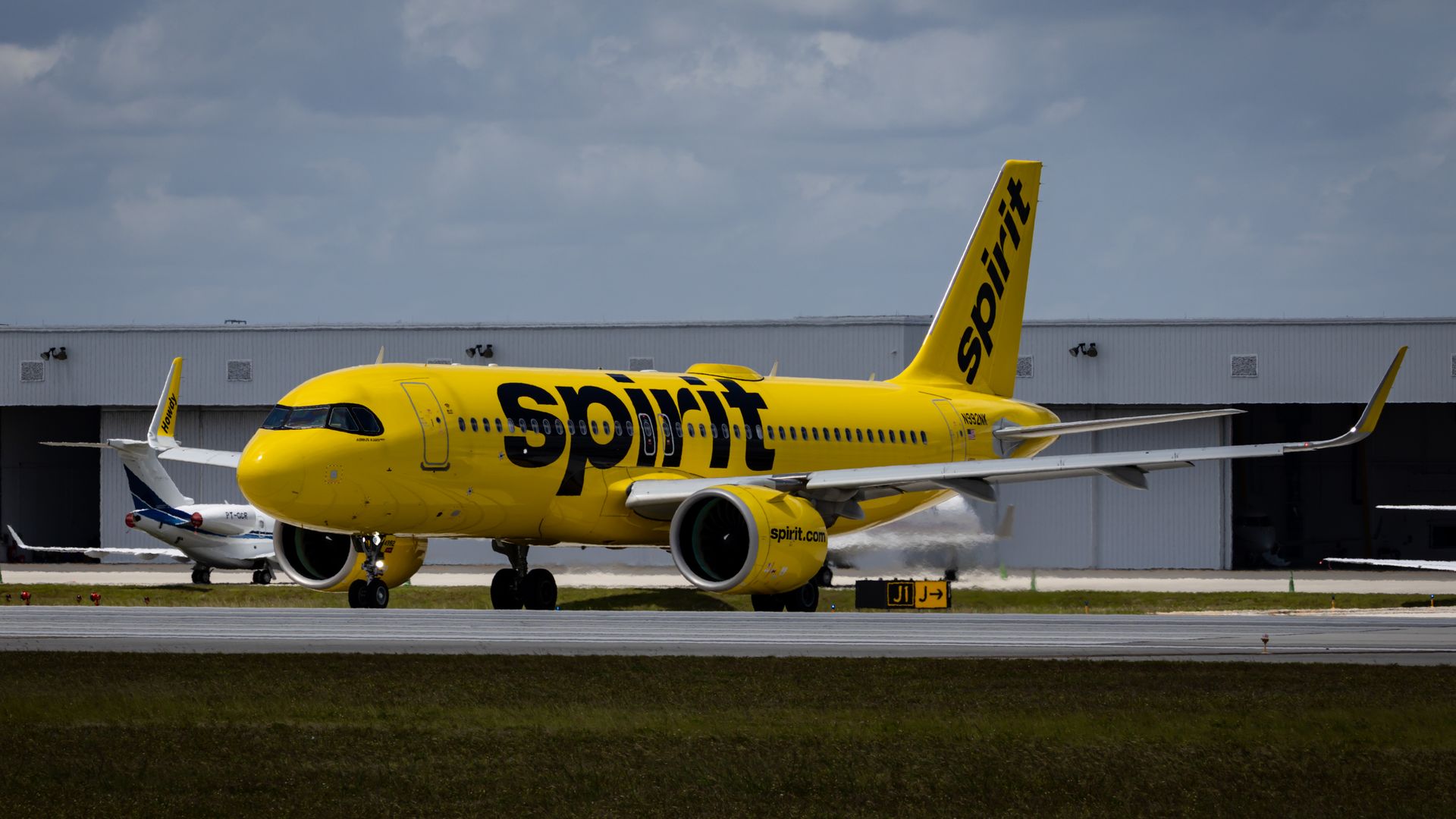
A Spirit Airlines plane in Fort Lauderdale. Photo: Eva Marie Uzcategui/Bloomberg via Getty Images
Spirit Airlines is going out of business, canceling all of its flights and stranding current travelers — marking the end of the runway for a company that offered cheap flights to America's budget travelers.
Why it matters: The company's demise — which comes after two bankruptcies and a failed attempt to secure a government bailout — marks the first death of a major U.S. airline in decades.
Zoom in: Spirit — which has about 17,000 employees and contractors — announced early Saturday that it will immediately wind down.
- The company said passengers who booked flights with credit cards or debit cards will automatically get refunds.
- "Guests who booked flights via a travel agent should contact the
travel agent directly to request a refund," the company said in a statement." - But for anyone who bought their flight via "voucher, credit" or Free Spirit points, any compensation "will be determined at a later date through the
bankruptcy process." - Affected passengers can visit SpiritRestructuring.com for more information.
"For more than 30 years, Spirit Airlines has played a pioneering role in making travel more accessible and bringing people together while driving affordability across the industry," Spirit CEO Dave Davis said in a statement.
- "However, the sudden and sustained rise in fuel prices in recent weeks ultimately has left us with no alternative but to pursue an orderly wind-down of the Company. Sustaining the business required hundreds of millions of additional dollars of liquidity that Spirit simply does not have and could not procure. This is tremendously disappointing and not the outcome any of us wanted."
- The company thanked the Trump administration for considering providing emergency financing.
Several major airlines said Friday that they'd aid Spirit customers if the budget carrier goes out of business.
- That included United, American and Frontier.
- Southwest Airlines announced early Saturday that it will provide special fares at Southwest ticket counters at the departure airport for affected Spirit ticketholders: $200 for flights of 1 to 500 miles, $300 for 501 to 1,000 miles and $400 for 1,000+ miles.
The impact: The company's demise is expected to lead to an uptick in ticket prices at a time when travelers are already dealing with higher prices due to the Iran war.
- Indeed, the spike in jet fuel prices from the war was the last straw for Spirit, which had announced a deal to exit bankruptcy days before the war began.
- "What I would expect is in the markets where Spirit competed fiercely, you will see fares rise because that competition will no longer be there," Georgetown University business professor and aviation executive Shye Gilad told Axios late Friday.
By the numbers: Spirit flew about 1 in 33 domestic miles in the 12-month period ending in February, according to the Bureau of Transportation Statistics.
- It was the eighth largest U.S. carrier during the period, ranking just behind Frontier and ahead of SkyWest.
Flashback: Founded in 1964 as Clippert Trucking Company in Michigan, the company eventually operated as a charter airline in the 1980s.
- It later became a passenger carrier and changed its name to Spirit Airlines in 1992.
- The company moved its headquarters to Florida in 1999 and soon converted to an ultra-low-cost carrier model, offering extremely low fares without the bells and whistles associated with mainstream carriers.
What we're watching: It remains to be seen what happens to Spirit's assets, including the airport gates it controls and the aircraft it owns or leases.
- The company leased 166 single-aisle Airbus planes and owned 48 as of August, when it filed its second bankruptcy, according to a court filing.
- Their average age was 5.5 years with an average monthly rent payment of $326,000.
- The company's remaining assets will likely be offloaded as part of its unwinding, Gilad said. "It'll create more opportunities for those that are left standing."
Friction point: The company's demise has revived debate over the Biden administration's decision to block Spirit's merger with JetBlue — a deal that fell apart in early 2024, nearly two years after it was announced.
- The Biden administration argued that the deal was anti-competitive.
- The Trump administration has blamed the Biden decision for Spirit's collapse.
Reality check: Spirit has been troubled for years, dealing with excess capacity, rising labor costs and competitive pressures, including low-cost options offered by mainline carriers.
- The company lost nearly $5.9 billion from 2020 through 2025, having last turned a profit in 2019.
- "Unfortunately Spirit's demise is just another signal that the ultra-low-cost model is under real pressure because costs have risen across the board and the pricing umbrella that once made this work has really changed significantly," Gilad said.
The bottom line: "What a sad end to a pioneering airline," Kyle Potter, editor of Thrifty Traveler, said on X. "Combined with fuel prices, we're entering a new era of higher fares."
