U.S. wants to start implementing Gaza plan in areas outside Hamas control

Add Axios as your preferred source to
see more of our stories on Google.
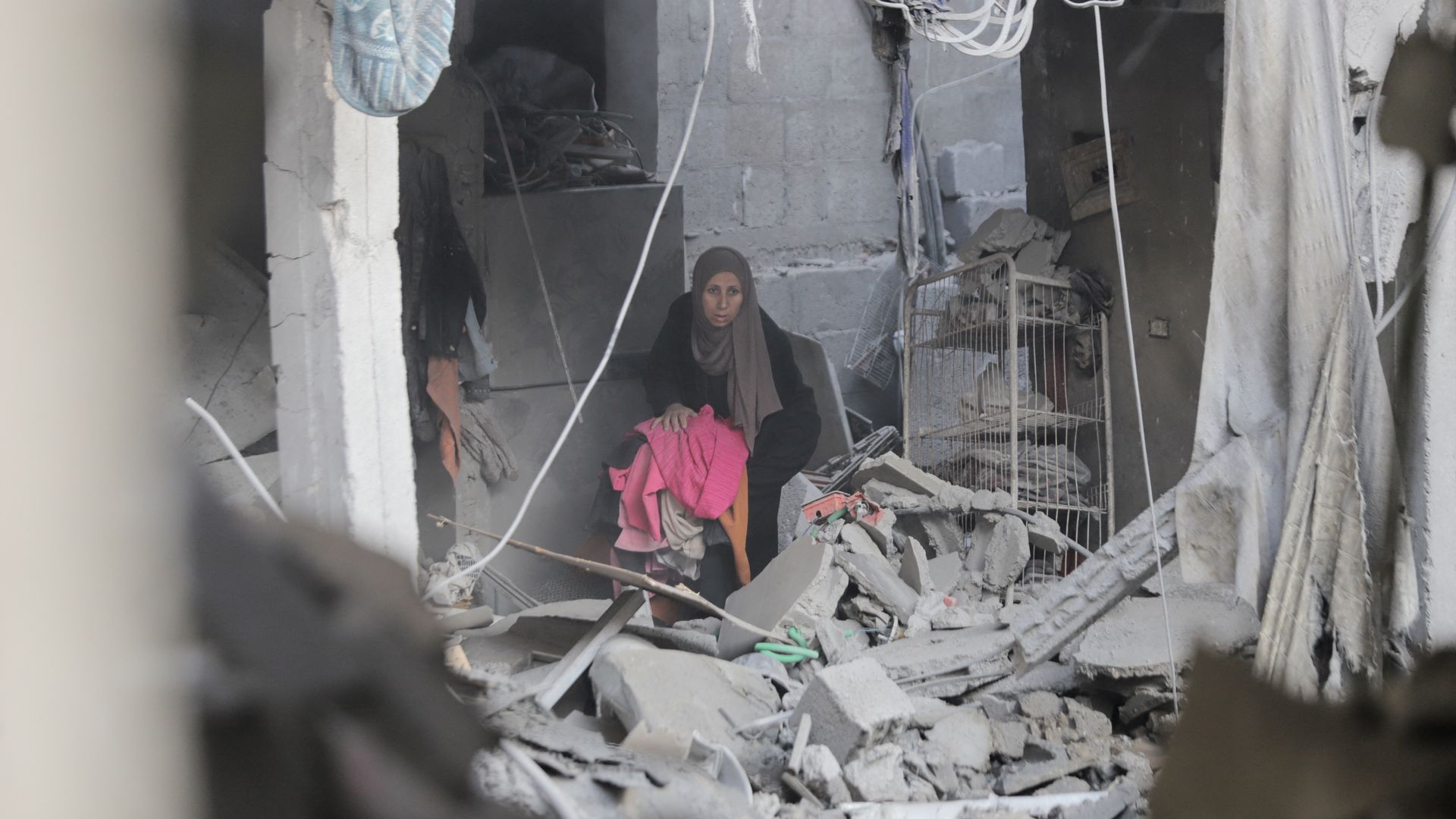
The aftermath of an Israeli airstrike in Gaza City last week. Photo: Ahmed Al Arini/Middle East Images/AFP/Getty
The U.S.-led Board of Peace wants to start implementing its Gaza governance and reconstruction plan in the parts of Gaza that are not under Hamas control, according to a Board of Peace official and two other sources briefed on the issue.
Why it matters: The decision to trigger a contingency plan in Gaza took place after the effort to convince Hamas to give up its heavy weapons reached a deadlock. Now the U.S. and the Board of Peace want to move forward without Hamas.
The big picture: The implementation of President Trump's 20-point peace plan hinges on disarming Hamas, but months of talks with the group have shown little progress.
- The U.S. has told Israel it does not support a resumption of the war in Gaza as a way to resolve the stalemate, a U.S. official said.
- Trump's plan includes a provision that would allow it to move forward in areas outside Hamas' control if the militant group rejects or delays the deal's terms.
- The Israel Defense Forces still control more than half of Gaza's territory.
Zoom in: The negotiations with Hamas over demilitarization have involved the high representative of the Gaza Board of Peace, Nickolay Mladenov, U.S. diplomats, and Qatari, Egyptian and Turkish mediators.
- The plan envisioned Hamas giving up its heavy weapons and tunnel system as a first stage. The next stages envisioned decommissioning personal arms and dismantling militias, including those supported and armed by Israel.
- That process was supposed to be the basis for the new Palestinian technocratic government to assume its responsibilities in Gaza, for a new Palestinian police force to be established, for an International Stabilization Force to be deployed in the enclave, and for the IDF to withdraw from more parts of Gaza.
- But Hamas claims it won't discuss giving up any of its weapons as long as Israel hasn't implemented many of its own commitments, like maintaining the agreed-upon level of humanitarian aid, fully opening the Rafah crossing and stopping its strikes in Gaza.
What he's saying: At a press conference in Jerusalem on Wednesday, Mladenov acknowledged there have been violations of the ceasefire by Israel.
- "Civilians are still being killed — for Palestinians in Gaza, the war is not fully over."
- He said Hamas is consolidating its grip on the population of Gaza "to prove nothing moves without its permission."
- He stressed that "we have to move forward" to break free of the "miserable" status quo.
Between the lines: The war with Iran has sapped the Trump administration's attention on Gaza. But the results of the war could influence the situation in the enclave due to the significant financial and military support Hamas gets from Tehran.
- "The more Iran is weakened, the more Hamas is weakened," Trump told Axios in an interview two weeks ago.
- U.S. and Israeli officials and officials from the mediating countries claim Hamas has decided to hit the brakes and not take any meaningful steps before it's clear how the war will end.
Behind the scenes: Last week, Mladenov and U.S. diplomat Aryeh Lightstone, who are spearheading the Gaza effort on the ground, met with Israeli Prime Minister Benjamin Netanyahu to discuss the stalemate with Hamas.
- The result was a decision to start thinking about a "plan B," according to two sources briefed on the meeting.
- The parties agreed to form working groups that will present options for next steps within a week.
- While Israeli officials floated the possibility of resuming the war in Gaza as a solution to the current stalemate, the Trump administration and the Board of Peace objected.
- "We do not think it is in the U.S. or Israel's interest that the war in Gaza resumes. We don't think we exhausted all other options to implement the 20-point peace plan," a U.S. official said.
Zoom in: Last week during a closed briefing at the Washington Institute for Near East Policy, Mladenov said plan B is to start implementing the 20-point plan in the parts of Gaza that Hamas doesn't control, according to sources who attended the event.
- Mladenov said the board wants to get the Palestinian technocratic government — which has been working out of Cairo — to move into these parts of Gaza. It also wants to start reconstruction in those areas and deploy the International Stabilization Force and a new Palestinian police force that will soon start training in Egypt.
- At a later stage, the Palestinian government will encourage Palestinians to move there from the Hamas-controlled areas, the sources said.
Yes, but: Hamas tries to prevent any attempt by Palestinians to move to the areas of Gaza it doesn't control.
- For example, it recently prevented Palestinian construction workers from going to the city of Rafah to join UAE-led reconstruction work there.
State of play: Mladenov and Lightstone met Netanyahu again on Wednesday to discuss the way forward in Gaza and stress the necessity of full cooperation by Israel, according to a Board of Peace official.
- "The message was that if we want to make progress, we need to move from a situation where we are sitting on opposite sides of the table and negotiating to a situation where we are all on the same side of the table," the official said.
What to watch: The Trump administration and the Board of Peace hope to publicly roll out their plan B at the beginning of June.
- "We knew Hamas was going to obstruct, and we recognize it is going to continue to try and do that. We made a lot of progress from a year ago, but this is not how we wanted the Gaza situation to develop. Nobody wants two Gazas. It is going to be hard and long, but we are committed to implement President Trump's 20-point plan," the Board of Peace official said.
