Pope Leo sets Catholics on collision course with AI

Add Axios as your preferred source to
see more of our stories on Google.
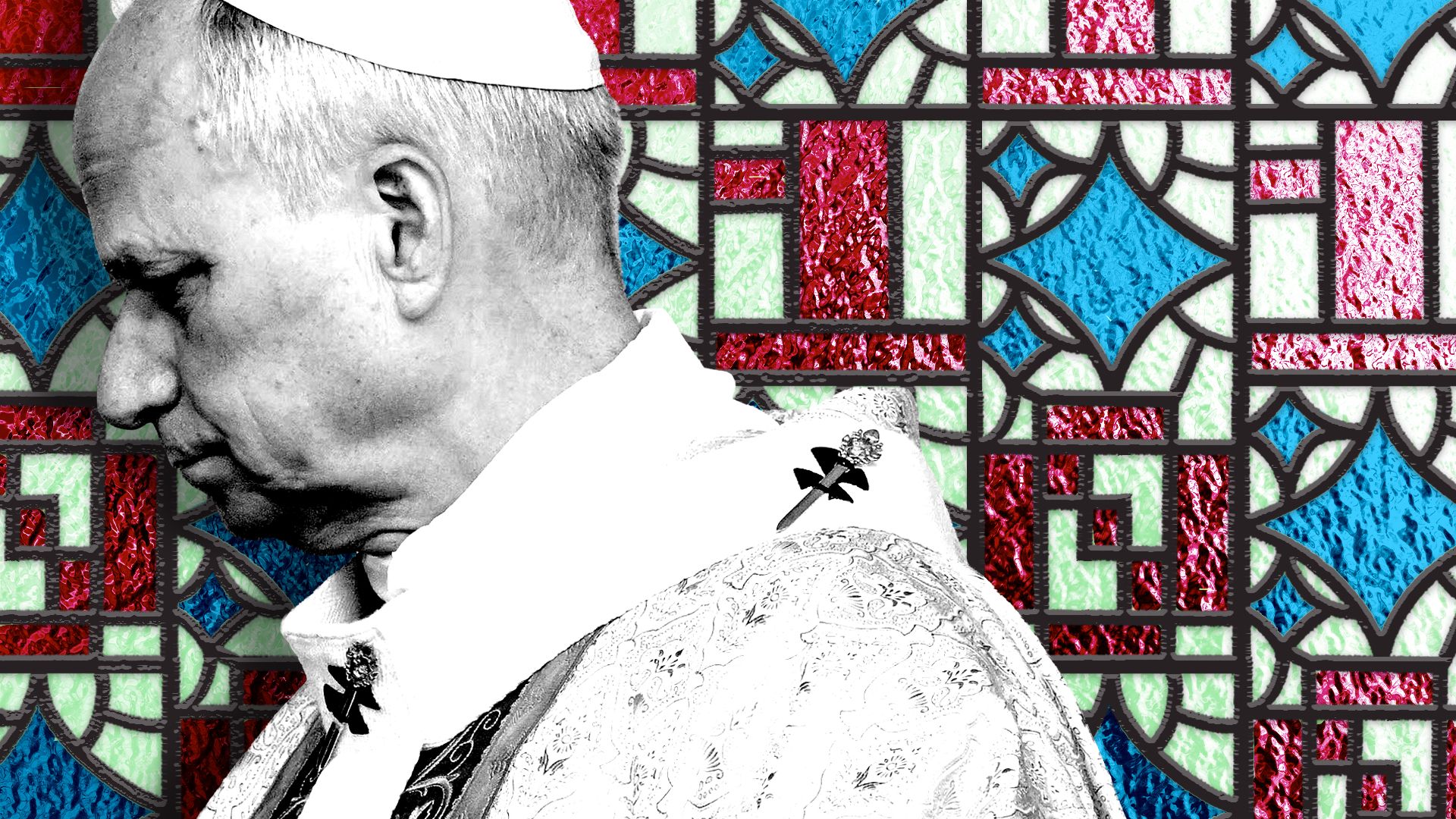
Photo illustration: Brendan Lynch/Axios. Photo: Alberto Pizzoli/AFP via Getty Images
Pope Leo XIV is expected to sign his first encyclical later this month, positioning artificial intelligence as the defining moral and labor challenge of a new industrial revolution.
Why it matters: The document, reportedly titled "Magnifica Humanitas" ("magnificent humanity"), would become the Catholic Church's clearest attempt yet to place human dignity, labor rights and ethics at the center of the AI race.
- Catholic and European outlets reported that Leo is poised to sign the AI encyclical on the anniversary of "Rerum Novarum" (1891), Pope Leo XIII's foundational industrial-era labor encyclical.
- But the Holy See's Press Office told reporters on Friday that the announcement about the document will take place on May 22, per InfoVaticana, a Spanish-language digital news outlet that covers the Vatican.
- The encyclical will focus specifically on AI's impact on "people and working conditions," framing it as Leo XIV's effort to modernize Catholic social teaching for the AI era, per the French newspaper Le Monde.
- Other reports suggest "Magnifica Humanitas" will argue technology must remain subordinate to the human person — not the reverse — and that AI systems should protect workers, creativity and moral agency.
The Vatican has not commented, but it has implemented formal AI guidelines and monitoring structures inside Vatican City.
Zoom in: The late Pope Francis warned repeatedly that AI risked reducing humans to data points and accelerating inequality, surveillance and autonomous warfare.
- The Holy See also backed the "Rome Call for AI Ethics," an initiative urging transparency and human-centered AI development.
Context: Encyclicals are among the most important documents a pope issues — used to set priorities and define how the Catholic Church responds to major global challenges.
- They often act as blueprints for a papacy, signaling what issues will take center stage for the world's 1.4 billion Catholics.
Zoom out: The Vatican has stepped up cybersecurity partnerships and AI oversight efforts, blending defense with diplomacy and ethics.
- In February, Leo told priests not to use AI to write homilies or to seek "likes" on social media platforms like TikTok.
What they're saying: "This is exactly the fear ... that machines were replacing human labor. And that's exactly what we're seeing right now with AI," said Andrew Chesnut, chair of Catholic studies at Virginia Commonwealth University.
- Chesnut said Leo is treating AI less like a tech trend and more like a replay of the industrial revolution, with entry-level workers already "evaporating" as automation accelerates.
- "This is going to be one of the fundamental pillars of his papacy."
Between the lines: Leo XIV's choice of name increasingly looks like a mission statement.
- By invoking Leo XIII, the pope is explicitly drawing parallels between 19th-century industrialization and the AI revolution now unfolding, Catholic experts say.
- The message: The Church believes it has a historic role to play again during a period of technological upheaval.
The intrigue: Some American Catholic institutions have also been preparing for this moment and discussing the use of AI.
- The Catholic Health Association of the United States, for example, has been examining the ethical implications as AI increasingly shapes health care delivery.
The bottom line: The Vatican is signaling it does not intend to sit out the AI era.
Editor's note: This story updates a previous version with the Holy See's Press Office giving a date for the announcement.
