Demonstrations to sweep the South over voting rights and redistricting


Add Axios as your preferred source to
see more of our stories on Google.
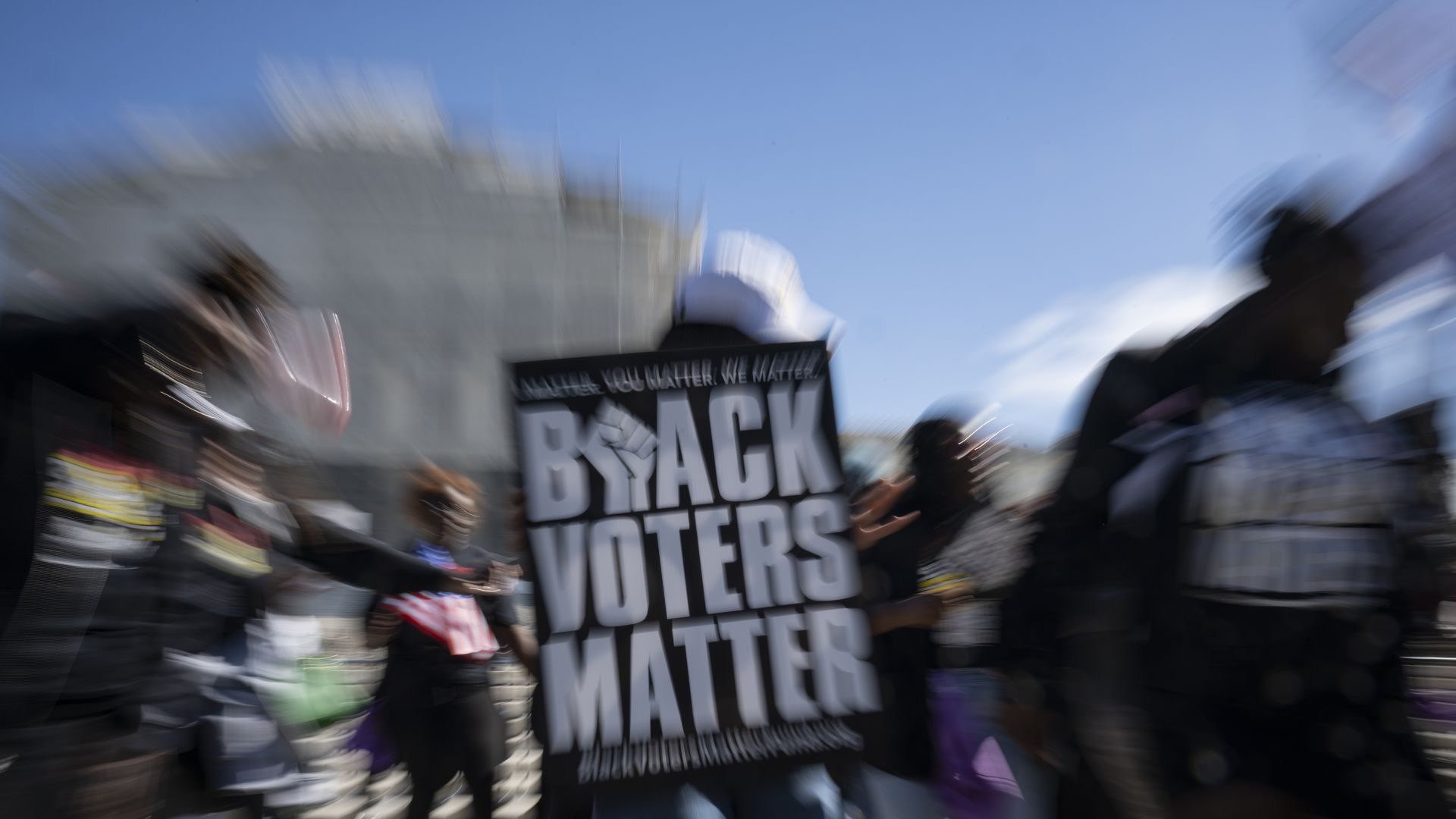
Motion-blurred outdoor protest scene with a central large black sign bearing bold white letters of Black Voters Matter; crowd on both sides and a blue sky above, conveying a dynamic, fast-moving moment. Photo: Celal Gunes/Anadolu via Getty Images
A wave of voting rights battles and GOP redistricting fights is triggering a coordinated response across the South, with organizers preparing a "Summer of Action" campaign with marches that start this weekend.
Why it matters: Organizers say the fight over congressional maps, voting access and political representation is accelerating in real time as states redraw political power ahead of November's midterms and the 2028 general election.
- The Supreme Court narrowed the Voting Rights Act in late April, making it harder to challenge maps on the basis of racial discrimination.
- Republican-led efforts in states like Tennessee and Alabama have targeted Democratic-leaning districts, particularly those anchored by Black voters in urban areas, for last-minute 2026 redistricting.
- Gov. Brian Kemp has called a special session to redraw Georgia's maps for 2028, and Gov. Tate Reeves said Mississippi Republicans will redistrict ahead of 2028 to draw out longtime Rep. Bennie Thompson's (D) seat. (edited)
Zoom in: Organizers in Selma, Alabama, are planning marches tied to the legacy of Bloody Sunday and the Edmund Pettus Bridge, framing this summer's demonstrations as a continuation of the civil rights movement.
- "This is an altar call," Black Voters Matter co-founder LaTosha Brown said during a national organizing call ahead of Saturday's event.
- Plans for marches are taking shape in Texas, where activists say rising living costs and concerns over representation are energizing younger Black voters.
- National organizing networks and "Day of Action" coalitions are coordinating marches, teach-ins and grassroots mobilization efforts across multiple states.
Zoom out: Arndrea Waters King tells Axios that returning to Selma also serves as a way for people to "come together and rededicate" themselves amid rapidly changing voting battles.
- "The reality is, it simply is our turn in that long march toward freedom."
Her husband, Martin Luther King III, questioned whether Americans are confronting deeper structural challenges around democracy itself: "How do you fight a system that is being manipulated not to work?"
The other side: The marches come even as President Trump is making gains with Black voters despite posting racist videos, using racist rhetoric and advancing policies critics say erase slavery history and weaken voting rights.
- An Axios review of recent data shows breaks in the strong Black support for Democrats going back to John F. Kennedy's 1960 presidential run and Barack Obama's historic 2008 win.
The intrigue: The South has become both the nation's population-growth center and one of its most contested political battlegrounds — making fights over representation and voting power increasingly consequential.
What they're saying: Marc Morial, president of the National Urban League, tells Axios the recent court ruling and redistricting fights mark "the beginning of a summer of action."
- "This is going to require sustained pressure and agitation," Morial said. "There will be multiple activations taking place in multiple places this summer."
- He warned that the full impact of the Supreme Court ruling has yet to be felt: "The impact will be felt when 10 to 15 Black members of Congress lose their seats."
Lisa Graves, co-founder of Court Accountability, said the ruling acted as "a gigantic green light" for legislatures to move quickly on congressional maps and voting-rights battles.
- Héctor Sánchez Barba of the Latino advocacy group Mi Familia Vota tells Axios that Hispanics will be joining marches this summer in solidarity.
- He said Latino voters are also concerned about the voting rights rollbacks and the Trump administration's immigration policies.
What we're watching: Whether organizers can turn a rapid response to court rulings and redistricting battles into a broader movement extending beyond seasonal protests or an election cycle.
- "This organizing ... is already, in some ways, underway," Graves said, arguing the moment should be viewed as a broader "moral fight" rather than a single political setback. "We cannot accept that as a defeat ... you use that setback as the fuel to grow bigger and stronger."
