Iran faces Trump's World Cup gauntlet

Add Axios as your preferred source to
see more of our stories on Google.
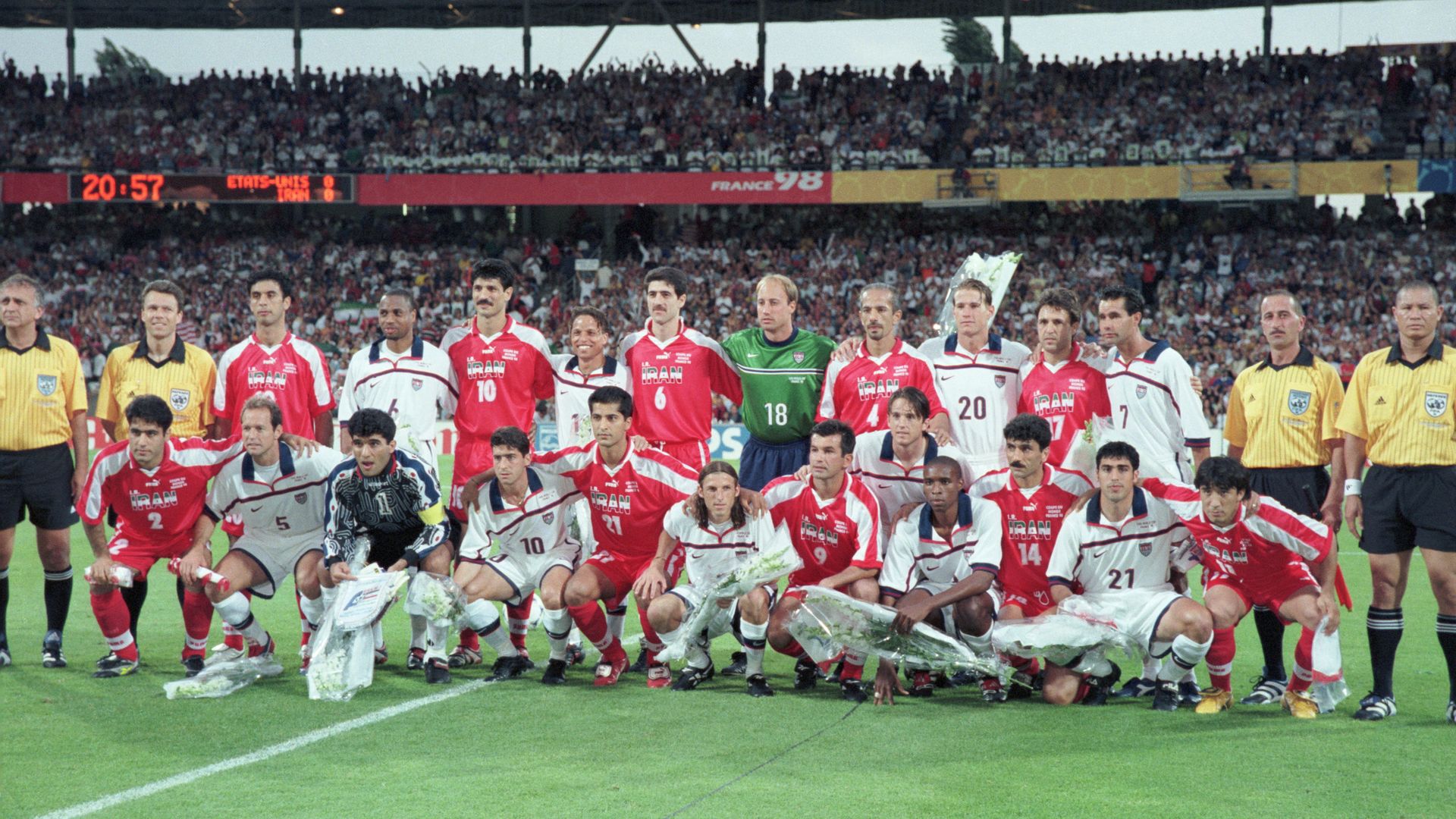
Iran and USA players pose for photo during the FIFA World Cup 1998 match between Iran and United States at Stade de Gerland on June 21, 1998 in Lyon, France. Nader Davoodi ATPImages/Getty Images
The U.S.-Iran war is forcing FIFA to navigate a diplomatic and logistical mess before the World Cup even kicks off Thursday.
Why it matters: Iranians are largely banned from traveling to the U.S. right now, while Iran's national team will face an exhausting itinerary each time it plays on U.S. soil.
Zoom in: Iran has three guaranteed matches on U.S. soil in the group stage after FIFA declined the nation's request to move its games to stadiums in Canada or Mexico after the war started.
- Without overnight stays, the Iranian team will have to fly in from Mexico, clear customs, play a match and then fly back to Mexico the same day for each U.S.-based match.
- "Everything has to go by schedule. There's a lot of preparations. The last thing you want to deal with is a TSA issue, and that's going to reflect very badly on the U.S. if anything like that happens," said Trita Parsi, co-founder of the Quincy Institute, a foreign policy think tank.
State of play: Iran's training camp was moved from Arizona to Mexico just weeks before the starting whistle.
- Mexican President Claudia Sheinbaum said that the request to move camps came through FIFA but originated with the U.S. government, which didn't want the Iranians staying overnight in the country.
- "While on the surface they may be complaining and pointing out that this is not the way the U.S. should be acting as a host, it doesn't mean that they're not happy that they don't have to be in the U.S.," said Trita Parsi, co-founder of the Quincy Institute, a foreign policy think tank.
Zoom out: Iran is on the travel ban list. While Iranian players, coaches, staff and immediate family are supposed to be exempt, members of the support staff and the head of the country's football federation were denied visas, according the New York Times.
- Secretary of State Marco Rubio also said in April that anyone affiliated with the Iranian Revolutionary Guard Corps, a designated terrorist organization, will be denied a visa.
- There is required national military service in Iran, which could include the IRGC. The head of the federation, Mehdi Taj, was a former commander in the IRGC.
Iran's fans won't be allowed to travel to the U.S. at all. Iranian nationals living in Iran or any other country won't be allowed to travel to the U.S. matches.
- The State Department declined to answer questions about the visa and consular processing.
- An administration official said in a statement, "We will not allow the Iranian team to abuse this system to sneak terrorists into the United States under false pretenses."
Between the lines: Likely demonstrations are another security risk to the tournament during Iran's matches. As in France's 1998 and Qatar's 2022 tournament, Iran's football team has been the target of anti-government protests during games.
- Los Angeles has a significant Iranian-American population, with a share who support the overthrown Shah, raising the risk of rule-breaking activity in the stands.
- The Department of Homeland Security didn't respond to requests about potential anti-Iran protests, but said in a statement that DHS is "steadfast in our commitment to the safety and security of the American people and attendees of the 2026 FIFA World Cup."
What they're saying: "President Trump has made it clear: the Iranian team is welcome to participate in the tournament," a State Department spokesperson said in an email statement.
- "Soccer is very popular throughout the world, and the United States is looking forward to welcoming international visitors to America for the sport's most important event, showcasing American excellence for the whole world to see," the spokesperson said.
Flashback: The U.S.'s 1998 World Cup match against Iran was one of the most politically charged games in the tournament's history. Without formal diplomatic relations between the countries for decades, both nations players took to the pitch and exchanged flowers in a show of sportsmanship.
- "We did more in 90 minutes than the politicians did in 20 years," U.S. defender Jeff Agoos said after the game.
- Close observers don't expect an encore in 2026: "You're not going to see, most likely, the type of images that we even saw in 1998 in which Iranian and American fans were posing together," said Parsi.
What to watch: If Iran and the U.S. both finish second in their groups, they will play each other in Texas on July 3 in the third meeting between the nations since 1998.
