Why American reindustrialization feels like "jazz and rock and roll"

Add Axios as your preferred source to
see more of our stories on Google.
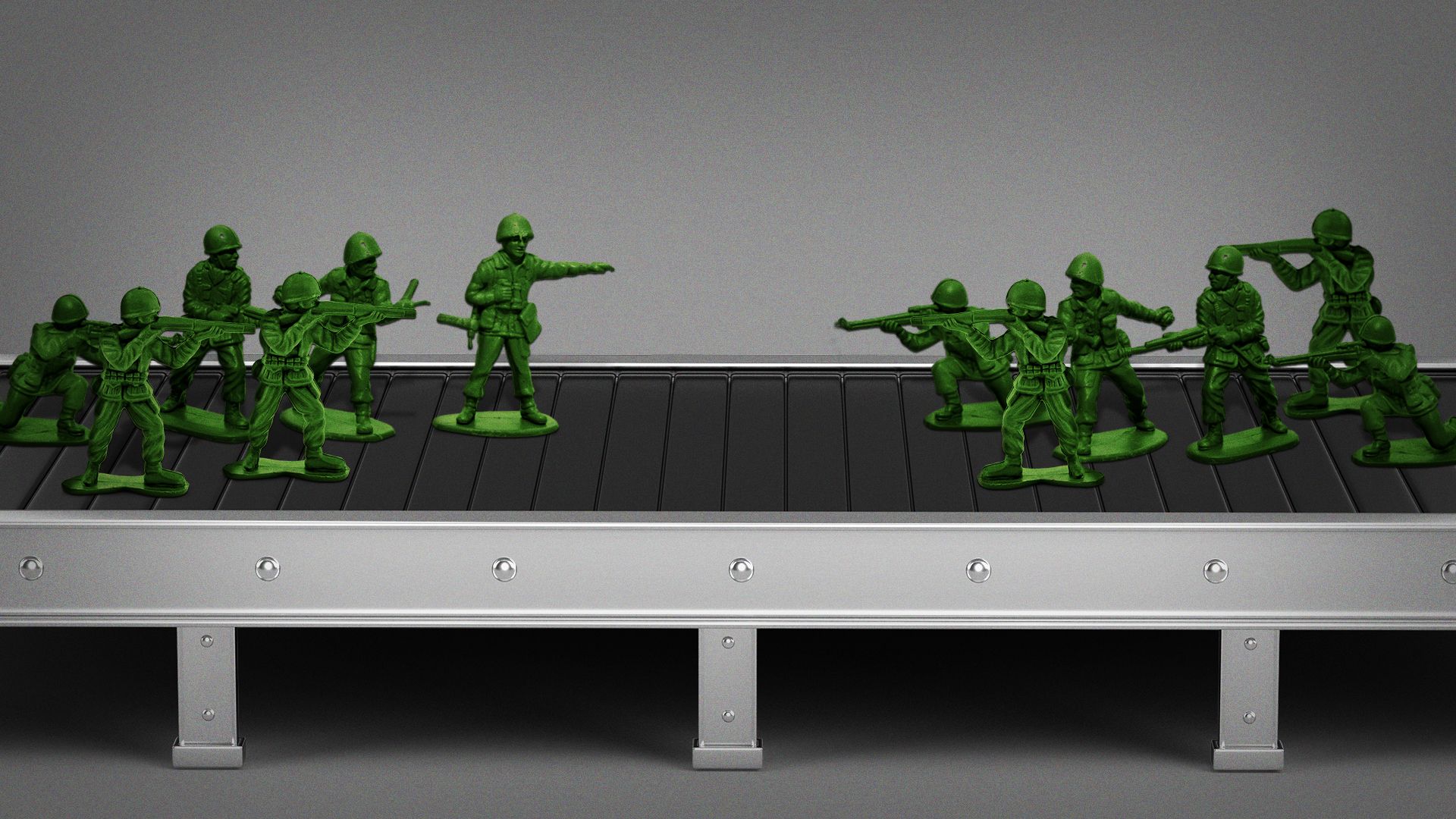
Illustration: Allie Carl/Axios
Private capital is pouring into the reindustrialization of America's arms industry. The folks involved in that push are gathered in Detroit this week to debate what success looks like, how long it will take to get there and whether it will truly make the U.S. safer.
Why it matters: This isn't just about pumping out more missiles, drones and jets on U.S. soil. It's about sourcing minerals and training workers. It's weathering political change, Pentagon bureaucracy and the boom and bust of investment cycles.
Driving the news: The ReIndustrialize conference is in its third year, and it's bustling as ever. The sustained buzz is a sign of traction, earned by acolytes as they rally around three causes:
- Improving American production scale and speed
- Fostering the stateside "build, baby, build" culture
- And reestablishing supply chain sovereignty
The big picture: Axios asked 10 defense-tech and manufacturing executives about this moment, as funding fills weapon-maker and autonomy wallets and every other person posts about their new factory.
- None mentioned making a quick buck.
- Some mentioned unrealistic promises and the novices who buy into them.
- Most mentioned a need to educate, grow and evolve a workforce gutted by offshoring and the dismissal of blue-collar work.
- Almost all mentioned supply-chain reform and a distancing from China, which maintains a stranglehold on critical minerals.
What they're saying: "This first phase of reindustrialization in the U.S. has looked a lot like: 'Oh, let's make end-products, because that's the way we've normally done this.' It's an extension of what we had done before, and that very quickly evolved into: 'Wait a minute, I can't get the things I need to make that product here,'" Miles Arnone, the chief executive at Re:Build Manufacturing, told Axios.
- "We're going to have to go deeper," he said.
- "Reindustrialization is, right now, very focused on defense and other things, because of current events. But I think that it's much more fundamentally about building — rebuilding — the culture of industry and industrial practice."
Threat level: Production and delivery, whether of shells, interceptors or their prerequisite parts, are chock with chokepoints — as evidenced by President Trump invoking the Defense Production Act for munitions.
- Multimillion-dollar air defenses expended in the Middle East, while combating Iran, will take years to replenish. Some of the Navy's most important vessels are over budget and years behind schedule.
- "Right now, the supply chain for some of our most critical defense systems is a black box, and we find out it's broken when it's already a crisis, not when we could have done something about it," Alisyn Malek, the chief executive at Averra, told Axios.
- "The countries that control their manufacturing infrastructure get to shape what comes next."
Reality check: Grand improvements take time. Small improvements rarely survive first contact. For reindustrialization to manifest, it must withstand elections, wars, middlemen and economic shock.
- "There's going to be this period where there's going to be a lot of capacity being brought up, as part of this hype, which I think long-term can pay off," Machina Labs CEO Edward Mehr told Axios.
- "If you say, 'Hey, everything manufactured in the United States?' I don't know, maybe 30 years. Maybe never."
The bottom line: Reindustrialization is bred by a motley crew. Financiers. Hawks and doves. Officials from all sorts of White Houses. Palmer-maxxers.
- "Some of the companies that got started during year one — at a bar, literally, founder meets a venture capitalist — are raising hundreds of millions of dollars," Austin Bishop, co-founder of the New Industrial Corporation, told Axios, referring to the conference.
- "It's the most American thing ever," he said. "It's like jazz and rock and roll. You put a bunch of people together and they start jamming, and out pops something magical."
Go deeper: A "desire to build"
