Bernie Sanders unveils AI "tax" plan


Add Axios as your preferred source to
see more of our stories on Google.
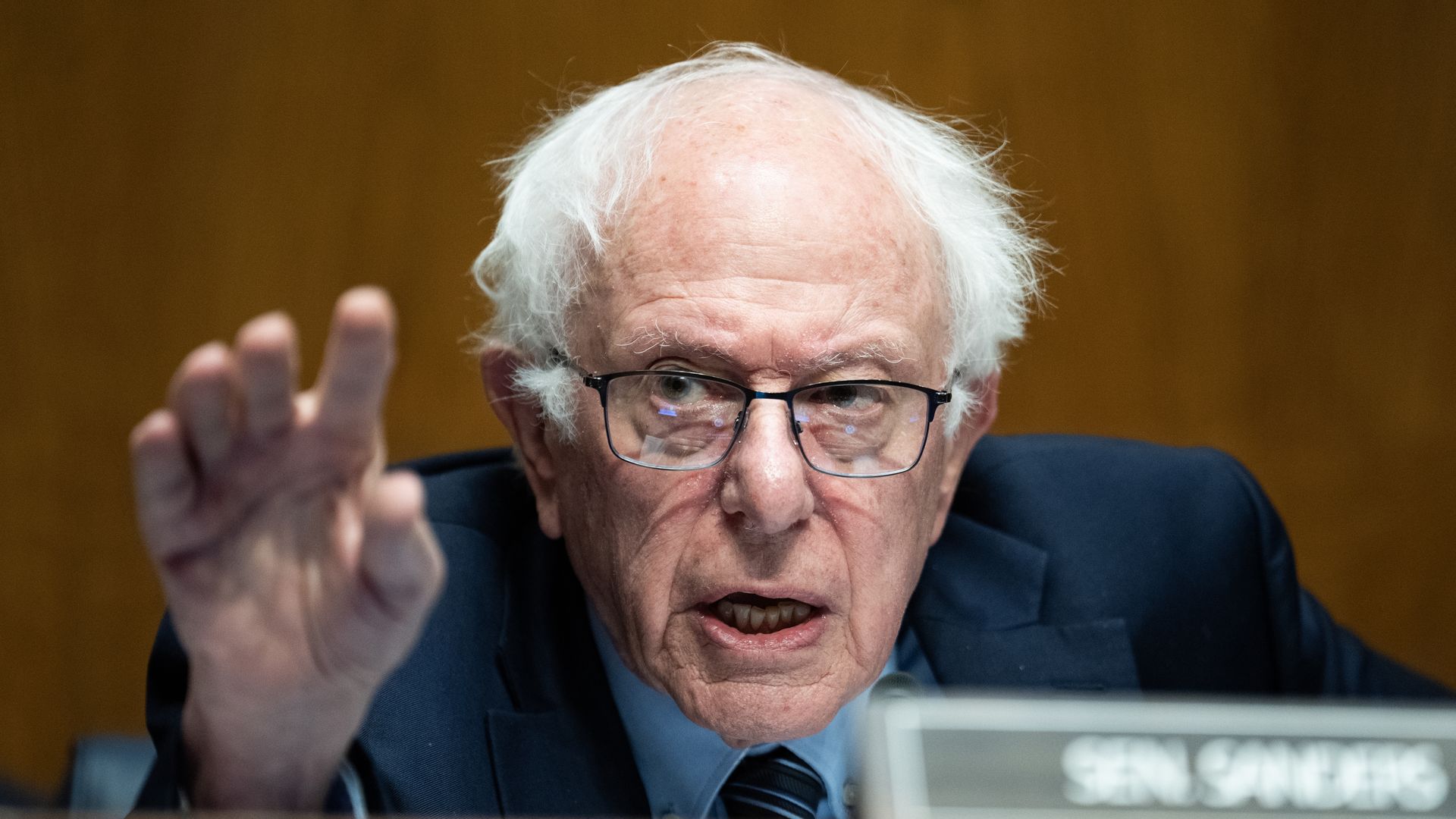
Photo: Tom Williams/CQ-Roll Call, Inc via Getty Images
Sen. Bernie Sanders (I-Vt.) on Thursday unveiled his plan for the U.S. government to take 50% equity stakes in large AI companies.
Why it matters: This is a supercharged version of what members of President Trump's administration already are discussing — all of which would be unprecedented — and a tacit acknowledgment that AI may eventually cause major labor disruptions.
Zoom in: The one-time "tax" would apply to any company with annual AI revenue of at least $200 million.
- The stakes would go into a new U.S. sovereign wealth fund, overseen by seven commissioners nominated by the president and confirmed by the senate. It then would pay out a 5% annual dividend directly to Americans.
- If a company were to increase its share count, including as part of employee compensation, it would be required to cede 50% of that additional equity to the government.
- The bill also would require such companies to separate their "AI and non-AI businesses," with the government only taking equity in the former.
Yes, but: Even if this could pass legislative and constitutional muster, there are many practical problems:
1. The universe of "AI companies" is massive.
- Sanders' bill doesn't only apply to AI token sales, which would scoop up companies like Anthropic and OpenAI. It also applies to data centers, AI compute infrastructure, AI services, and advanced robotics.
- That would mean the U.S. government gets 50% of everything from Amazon to Nvidia to Microsoft to SpaceX. It would be voting stock -- which means the government would have a major say in how such companies operate.
- Do these companies dilute existing investors, such as 401(k) managers and public pension funds? And, if so, isn't that taking from the same average Americans this bill is designed to help?
3. Practical constraints
- How does a large, integrated tech company distinguish between its "AI business" and "non-AI business?" It reads a bit like online vs. offline in 1998, which soon became inextricably blurred.
4. SWF strangeness
- The bill does not detail how the SWF would provide the annual 5% distribution, given that it's prohibited from selling any of its underlying equities.
- It's also worth noting that SWF's usually are developed by countries seeking to invest their surplusses — not indebted nations like the U.S.
The bottom line: You could easily dismiss this as Sanders' latest and greatest effort at mobilizing the grassroots so that someday there could be meaningful wealth redistribution.
- But don't. Because the White House is thinking along similar lines, just on a smaller scale. Strange bedfellows can make profound policy.
