U.S. and Iran launch direct negotiations in Switzerland

Add Axios as your preferred source to
see more of our stories on Google.
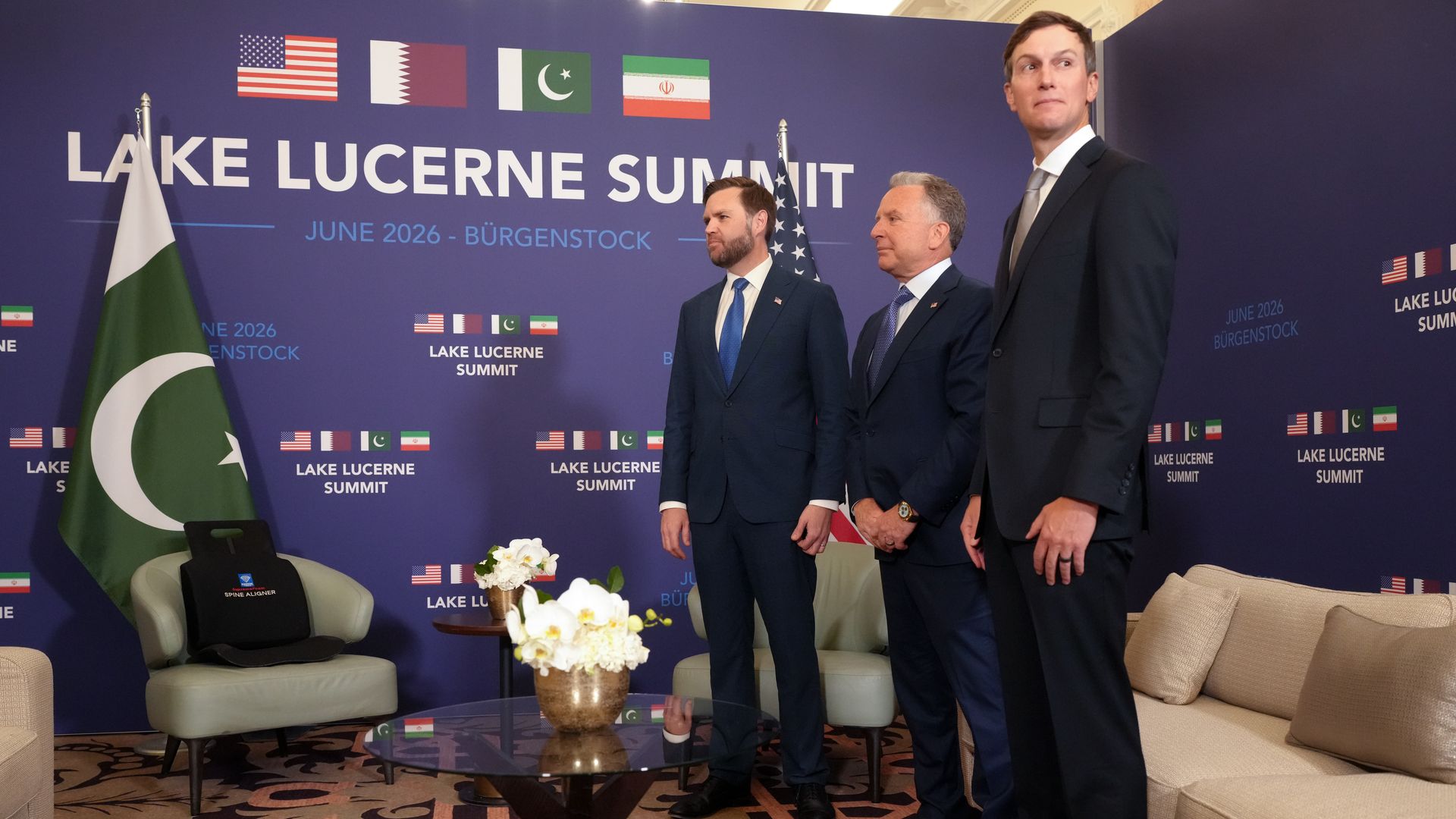
U.S. Vice President JD Vance waits, alongside Steve Witkoff, Special Envoy for Peace Missions and U.S. President Donald Trump's son-in-law Jared Kushner, to meet with Pakistan's Prime Minister Shehbaz Sharif for high-level talks aimed at advancing a deal to end the Iran war. Photo: Nathan Howard-Pool/Getty Images
Vice President J.D. Vance and other U.S. negotiators met with their Iranian counterparts at the Bürgenstock ski resort in Switzerland on Sunday for the first round of talks over a deal to end the war, according to a diplomat with knowledge of the talks.
Why it matters: The Lake Lucerne Summit is the first round of direct talks between the U.S. and Iran since the Islamabad summit last April. It's supposed to launch 60 days of nuclear negotiations with the aim of limiting Iran's nuclear program.
- The talks took place despite Iran claiming on Saturday that it was shutting down the Strait of Hormuz in response to Israeli ceasefire violations in Lebanon. Given that backdrop, things could break down at any time.
Driving the news: Vance and White House envoys Steve Witkoff and Jared Kushner met on Sunday morning with the prime ministers of Pakistan and Qatar and Pakistan's top general, the mediators for the talks.
- Shortly after, the Iranian delegation — headed by Speaker of Parliament Mohammad Bagher Ghalibaf and Foreign Minister Abbas Araghchi — held a similar meeting with the mediators, followed by a trilateral meeting with all three parties, a diplomat with knowledge of the talks confirmed to Axios.
What they're saying: Speaking to reporters before the trilateral meeting, Vance said the U.S. isn't just working toward opening the Strait of Hormuz or ending Iran's nuclear program, but changing its relationship with the nation.
- "The question is — can we turn over a new leaf? Can we change relations in the Middle East permanently, or do we go back to doing things the old way, which is not our preference but is certainly something that can happen," he said.
- Vance called the meeting "historic" due to the high level of direct engagement between Iranian and American leadership. Iran's Araghchi was in the room as U.S. negotiators and the Pakistani and Qatari prime ministers spoke to the press Sunday, but he didn't stand with Vance for a photo op or join in statements to reporters.
Iran and U.S. officials dispute the reasons for the photo-op not taking place, with Iranian state media reporting that the U.S. rejected Iran's request. A U.S. official told Axios that Iran had agreed to press availability before the media briefing.
- "They even brought state media with them to cover it, who were pre-staged at the event. Despite this, they left the meeting upon seeing the volume of press in attendance and then distributed an inaccurate account of the situation through state media," the U.S. official told Axios.
Between the lines: The U.S. would like the first round of talks to end with an Iranian invitation for UN inspectors to visit its nuclear sites, which were bombed by the U.S. and Israel, two regional sources with direct knowledge said. The last such visit took place in June 2025.
- In return, the U.S. is willing to give Iran access to some of its frozen funds — starting with a $6 billion account in Qatar.
- The Iranians would be able to use those funds to buy humanitarian goods, the sources said.
What to watch: As talks were underway in Switzerland, President Trump threatened to attack Iran if the nation doesn't restrain Hezbollah.
- "Iran must immediately stop their highly paid PROXIES in Lebanon from causing trouble. If they don't, we'll hit Iran very hard again, just like we did last week, only harder!!!" Trump wrote on Truth Social.
- Ghalibaf, Iran's chief negotiator, responded to Trump's threat on X, writing: "We do not take American threats seriously. They would do well to be careful about their statements. Our armed forces are prepared to respond to them in a different manner. The more they talk, the more we will act."
- Trump's comments follow Israel and Hezbollah saying they were recommitted to a ceasefire agreement after a similar effort broke down within hours on Friday.
Editor's note: This story has been updated with additional information.
