Robotaxi growth meets a regulatory maze

Add Axios as your preferred source to
see more of our stories on Google.
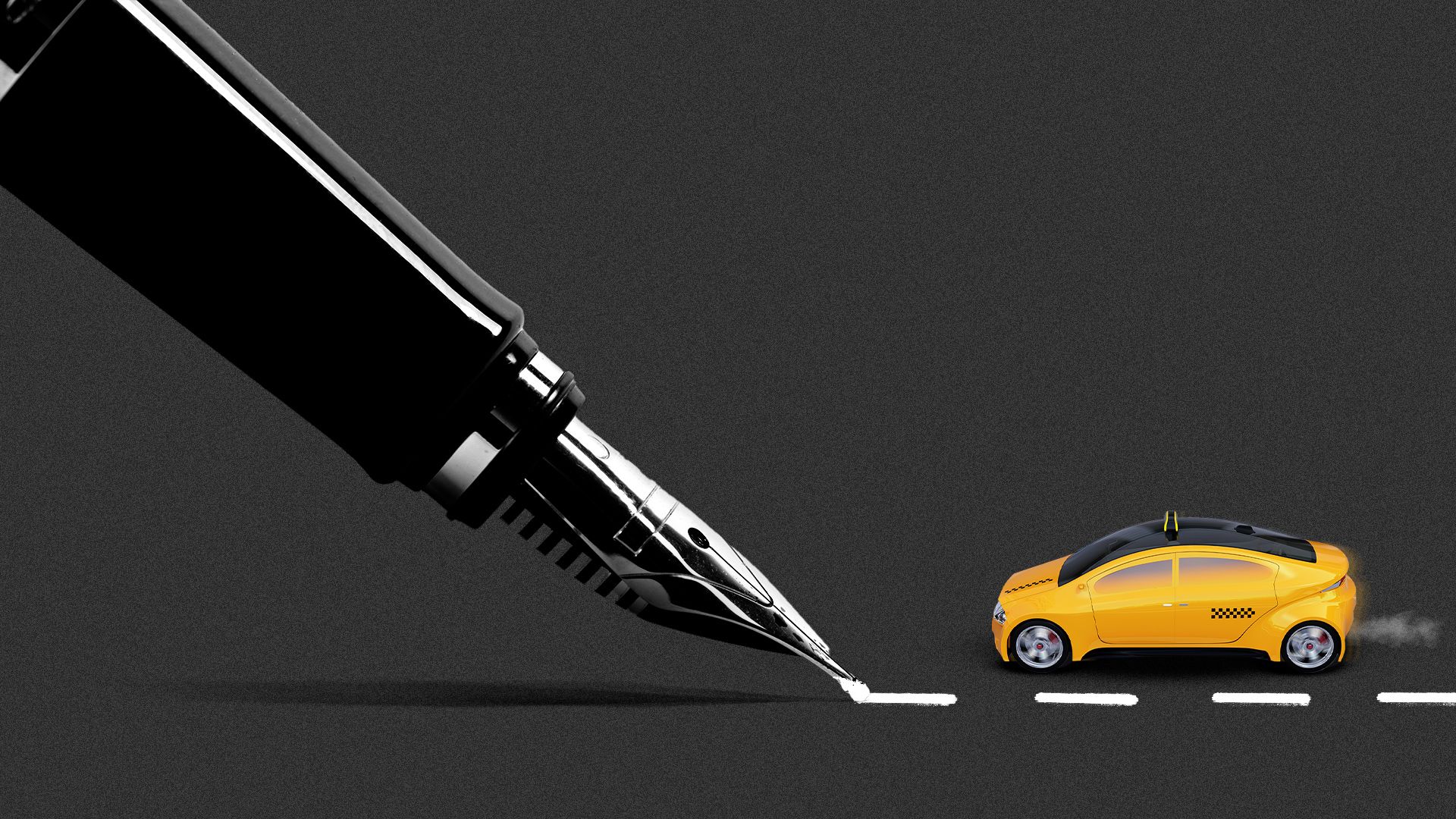
Illustration: Aïda Amer/Axios. Stock: Getty Images
The rules of the road for autonomous vehicles are being written in real time, one debate at a time, in Washington and in statehouses and city halls across America.
Why it matters: The growing patchwork of federal, state and local rules could become the next major hurdle to scaling robotaxis in the U.S.
The big picture: Every new robotaxi deployment is becoming a test case for policymakers about where AVs can operate, how they're regulated and who gets to write the rules.
- Traditionally, the federal government oversees vehicle safety standards, while states issue driver's licenses and local governments regulate road use.
- But those regulatory roles have blurred in the self-driving era, and Congress has yet to pass AV legislation that offers any clarity — leaving a free-for-all across every level of government that tangles together both halves of the robotaxi question: the technology and the business repercussions.
State of play: With robotaxis already deployed in many cities, governments are rushing to fill the policy vacuum by adding their own guardrails.
- A bill under consideration by the Washington, D.C., City Council would limit the number of robotaxis allowed and would tax operators 15 cents per mile traveled to deter empty cars from circling in search of riders.
- A highly prescriptive bill in New Jersey, meanwhile, would require AVs to use cameras plus at least two additional sensors — effectively banning Tesla's camera-only Robotaxi service.
Friction point: Lobbying has intensified across the spectrum, with Waymo touting its own safety research and doctors arguing AVs should be a public health imperative.
- Uber — with AV ambitions of its own — wants to prevent Waymo from getting too far ahead and instead is pushing for laws that require a hybrid network featuring both robotaxis and human drivers.
- Union leaders, meanwhile, are concerned about driver job losses and are successfully beating back legislative efforts in many states.
- "It is yet another example of Big Tech companies trying to steamroll cities into changing laws to accommodate them, and it comes at the expense of middle-class professional drivers and anyone else who wants safer streets in our city," Bill Davis, president of Teamsters Local 639, said earlier this week in opposition to D.C's proposed bill.
Where it stands: California and Texas, two of the earliest AV markets, recently adopted formal AV policies as the technology moves from the pilot phase to commercial deployment.
- But in many other states, AV bills have failed, including Maryland, Minnesota, Missouri, Oregon, Virginia, Washington and Illinois.
- Some cities, including Minneapolis, Portland and New Orleans, instead are trying to craft local ordinances that would govern robotaxis already roaming their streets in test mode.
Zoom out: At the federal level, the Trump administration is moving to rewrite decades-old safety standards for cars with no steering wheel or pedals while removing other red tape.
- Longer term, it's also working to establish dedicated performance standards for AVs.
Yes, but: At the same time, NHTSA is trying to rein in robotaxis that keep interfering with first responders.
The bottom line: The AV winners may be the companies that can navigate — and help shape — a rapidly evolving regulatory landscape as effectively as they built self-driving technology.
