Kimi K3's performance bolsters Sacks' case against AI regulation

Add Axios as your preferred source to
see more of our stories on Google.
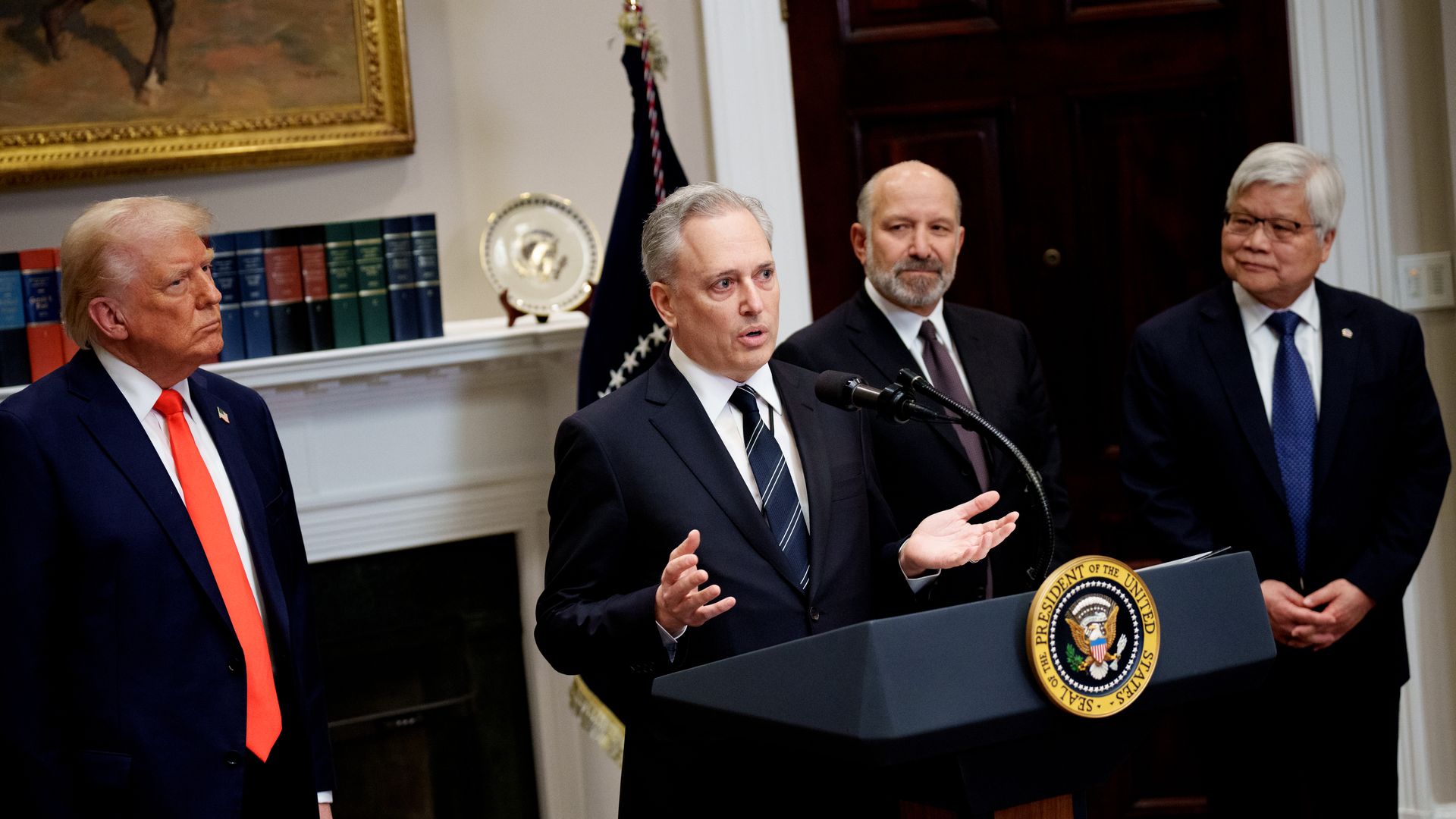
Donald Trump, David Sacks, Howard Lutnick and C.C. Wei. Photo: Andrew Harnik/Getty Images
David Sacks, AI investor and White House tech advisor, warned Friday that the U.S. is in danger of losing the AI race to China following the release of Kimi K3, a Chinese model that beats frontier American systems on several benchmarks.
Why it matters: Sacks is pitching a hands off regulatory approach to AI that he frames as do-or-die for America to hold onto its dominance.
What they're saying: "This is concerning," Sacks wrote on X, noting that for the first time a Chinese model has taken the top spot on the Frontend Code Arena, an AI evaluation platform, and is "scoring at or near the frontier" on other benchmarks.
- Meanwhile, he argued, America is "tying itself in knots" with its policy reactions to AI, including bans on new data centers and the recent push for federal agencies to pre-approve model releases.
- "This is how you lose the AI race," he wrote. "The rest of the world won't play by our rules if we bog ourselves down."
- Sacks dropped the official title of Trump's AI Czar, but retains the influence. He's currently the co-chair of the President's Council of Advisors on Science and Technology.
Sacks said in a statement to Axios: "I believe the U.S will win the AI race if we stick with President Trump's pro-innovation, pro-infrastructure, pro-energy and pro-export vision."
- "The danger is in abandoning that approach in favor of bureaucratic controls fueled by hysteria, fear, and companies seeking regulatory capture."
Catch up quick: Kimi K3, released Thursday by Beijing-based Moonshot AI, beat Anthropic's Fable 5 and OpenAI's GPT-5.6 Sol in blind front-end coding tests and outranked Opus 4.8 in Arena's broader text ranking, at roughly 40% lower cost.
- Moonshot plans to release the model's weights July 27, letting companies and governments customize and run it on their own systems.
Open-weight models are having a moment.
- Cost concerns, regulatory uncertainty and enterprise demand for more control over models are all driving greater business interest to open-weight models.
Zoom out: Kimi's release lands squarely in the middle of a live Washington fight, as calls grow for regulation of frontier models and CEOs argue they can't slow down for fear that China will catch up.
- Sacks's prescription is the same one he's championed for years.
- "Permissionless innovation is how America won the internet," he wrote, arguing the U.S. can win AI the same way "while addressing risks in a targeted way."
Friction point: Sacks' call for "targeted" safeguards contrasts with Anthropic's push for a statutory process that would allow the government to block unsafe frontier-model deployments.
- Just five weeks ago, Anthropic proposed giving the government standing authority to block frontier model releases that fail independent safety tests, with penalties tied to global revenue.
- Sacks's post can be read as a direct response to that: Kimi K3, he's arguing, is what happens while America builds approval gates that Beijing will never walk through.
Yes, but: U.S. regulators cannot directly control a Chinese lab's release of an open-weight model.
- Once the weights are publicly available, companies and governments may be able to download, customize and run the model themselves.
The bottom line: Sacks is using Kimi K3 to argue that U.S. AI regulation could give Chinese developers a competitive opening.
Editor's note: This story has been updated with a statement from David Sacks.
