British robo-wingmen are "very much today's business"

Add Axios as your preferred source to
see more of our stories on Google.
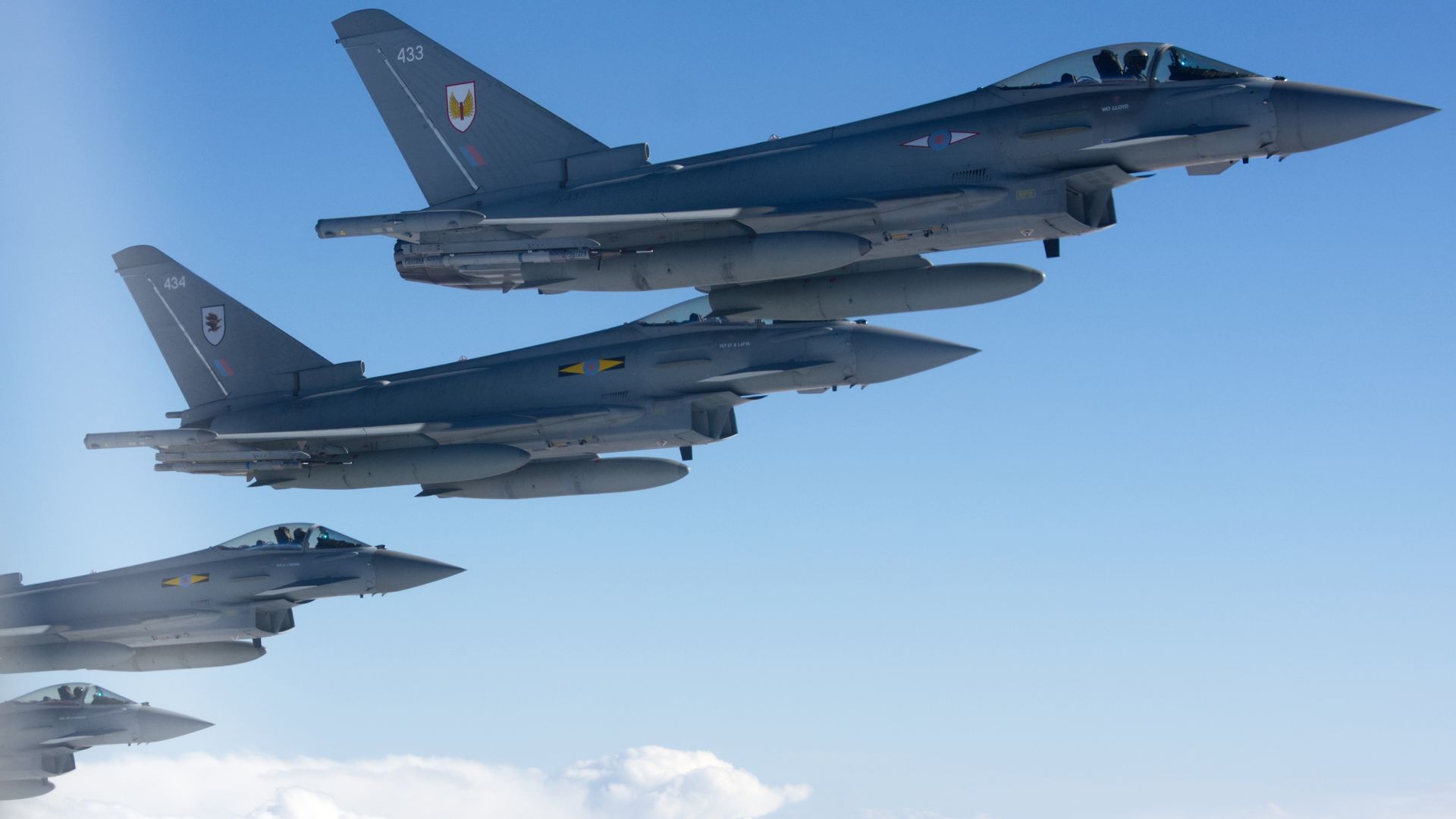
A group of British Typhoons flies over Nevada during Red Flag 26-1. Photo: Colin Demarest
LONDON — The U.K. is betting big on drones and robo-wingmen, assigning a growing number of existing and in-development machines to spying, jamming and bombing roles.
Why it matters: The maturation of artificial intelligence and autonomy has sparked a global sprint to build and deploy hybrid fleets no matter the domain.
Driving the news: Defense readiness and industry minister Luke Pollard this month revealed that the U.K.'s new collaborative combat aircraft effort will be known as Storm Fighter.
- In a speech at the Global Air and Space Chiefs' Conference in London, Pollard said Storm Fighter would act as a "guardian angel" and "attack dog" alongside aircraft like the Eurofighter Typhoon and the Lockheed Martin F-35.
- He also said the project would propel the British air force into the "sixth generation," a first for Europe.
Follow the money: The Defense Investment Plan, also rolled out this month, earmarked £300 million, or $404 million, to kick-start indigenous CCAs. A demonstrator should fly, it noted, by "at least 2030."
- Several defense contractors have expressed interest, according to Janes and Breaking Defense.
Zoom out: The U.K. is also pursuing Storm Chrome and Storm Fire, electronic warfare and long-range strike drones, respectively, as well as robotic compatriots for Boeing-made Apache attack helicopters.
- The latter, known as Project NYX, was allocated £220 million in the investment plan.
What they're saying: "Air supremacy is the baseline from which all other options flow," Air Chief Marshal Harv Smyth, the head of the Air Staff, said at the conference.
- "That all said, though, we know that crewed platforms alone are no longer enough to handle a complex and saturated battle space," he added.
- "CCAs are no longer something of the future. They are very much today's business."
Threat level: Drones are blamed for a majority of casualties in the Russia-Ukraine war. A lack of traditional air dominance, coupled with pounding artillery, has turned the conflict into a meat grinder on the ground.
The other side: The U.S. is also in hot pursuit of robo-wingmen.
- Anduril Industries, General Atomics, Lockheed Martin, Northrop Grumman and Shield AI have all thrown their hats into the stateside ring.
Go deeper: Shield AI unsheathes X-BAT, a missile-toting autonomous aircraft
