Doctors argue their role in the age of AI

Add Axios as your preferred source to
see more of our stories on Google.
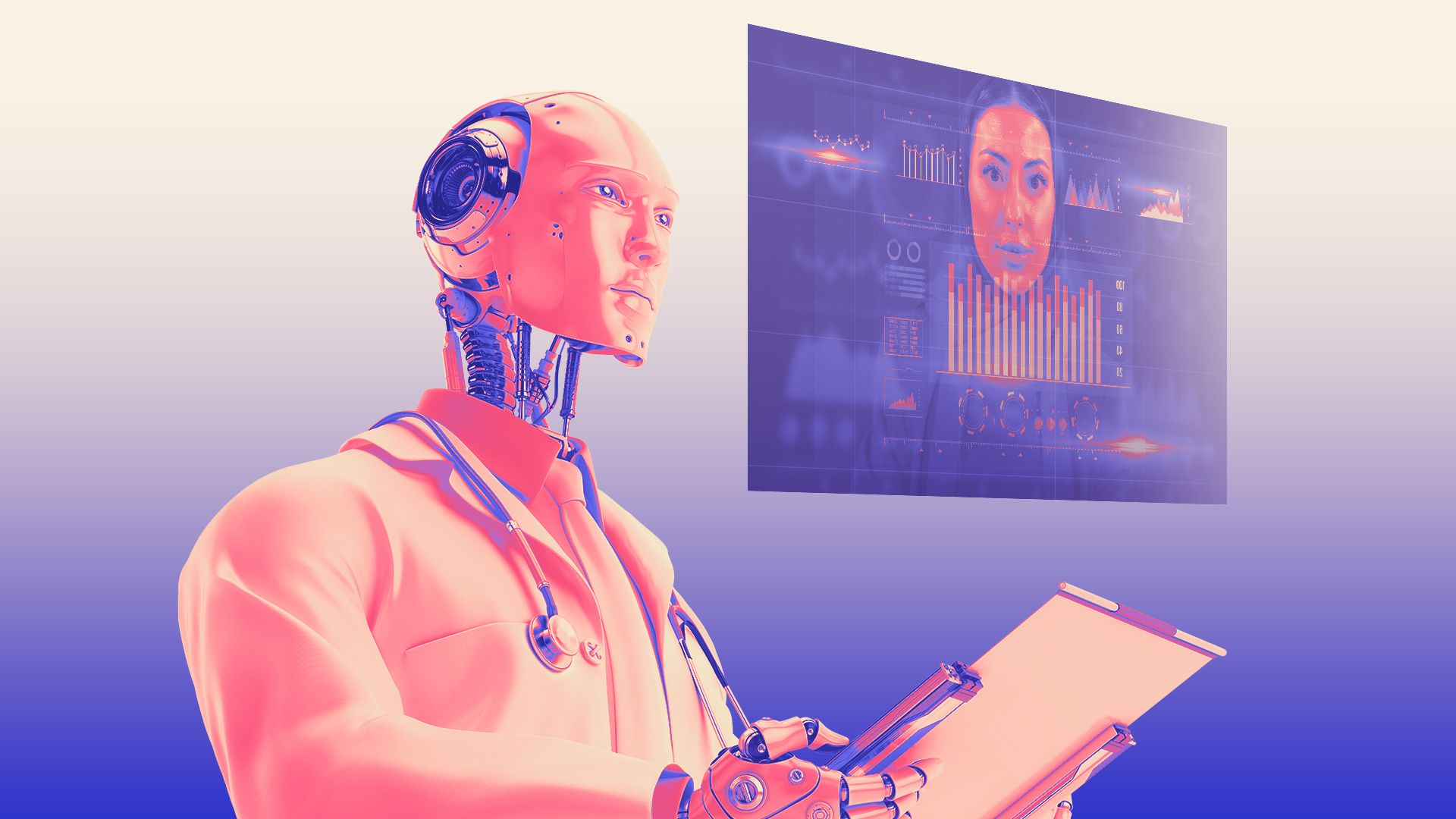
Illustration: Lindsey Bailey/Axios
The American Medical Association is out with a new framework for physicians' role in the age of AI, provided first to Axios, that insists doctors remain central to patient care.
Why it matters: The debate over whether AI will supplant doctors in clinical care is heating up, but the AMA has remained adamant that humans not only must remain in the loop but can't be replaced.
Driving the news: The framework, released in partnership with the Digital Medicine Society, argues that as technologies evolve, "the practice of medicine must evolve alongside them."
- "Individual tasks will evolve as technology advances, but the physician's enduring responsibilities remain remarkably stable," the intro adds.
- Those include human connection, clinical judgment and serving as stewards for the responsible use of technology.
"As it is today, physicians have to be in the loop. We're talking about the delivery of health care to people," AMA CEO and executive vice president John Whyte told Axios.
- "Do you really want to go to the ER and be treated by an LLM if you have chest pain? I don't think so."
State of play: A provocative opinion piece published Monday in JAMA made the opposite case: AI is or soon will be better than doctors at providing health care, and keeping humans in the loop may actually lead to worse outcomes.
- "Superior autonomous AI will likely be ready to be deployed for real-world cognitive medical tasks in some, maybe many, workflows by 2030," conclude the authors, including former White House health policy adviser Zeke Emanuel.
- "Consequently, physicians, policymakers, and others need to urgently devise approaches to workflow, liability, regulation, reimbursement and medical education."
Generative AI "rivals or outperforms" doctors at five cognitive medical tasks, the piece argues: gathering patient information, making diagnoses, selecting tests to establish a diagnosis, prescribing appropriate treatments and managing chronic diseases.
- And while LLMs will continue to get better, "physicians' skills are threatened by AI-induced deskilling."
The other side: While the piece brings up important discussion topics, "is simply performing a diagnostic test the practice of medicine? I don't think it is," Whyte countered.
- AI tools "augment what the practice of medicine is," he added. "It's an art."
The big picture: AI tools with patient-facing uses are rapidly evolving, but regulation of their use hasn't kept pace.
- The Food and Drug Administration this week issued a discussion paper that contemplated assessing generative AI-enabled medical devices similarly to how physicians are evaluated.
- But questions around who would be liable for AI errors or how to reimburse for AI-provided care remain largely unaddressed.
What we're watching: Whether autonomous AI care takes off without any real regulatory backbone in place, like it's poised to do in Utah.
