America's capital crunch: Soaring debt collides with AI spending spree

Add Axios as your preferred source to
see more of our stories on Google.
Illustration: Brendan Lynch/Axios
America is caught in a historic capital squeeze:
- On one side: Trillions Washington must borrow to pay for the past.
- On the other: Trillions the economy needs to build the future.
Why it matters: The next president will inherit a fiscal reckoning decades in the making. The price it exacts — on taxes, benefits, borrowing and investment — could shape America's prosperity and power for generations.
Zoom in: President Trump said in 2016 that he could eliminate what was then roughly $19 trillion in national debt within eight years. On Tuesday, the debt crossed $40 trillion, after growing by $3 trillion in the past year alone.
- About $32 trillion is owed to investors and other outside holders. The rest is debt the government owes to its own accounts, including Social Security and other federal trust funds.
- Treasury must refinance $9.7 trillion in debt coming due this fiscal year while covering a deficit the Congressional Budget Office now projects at roughly $2.1 trillion.
That creates a punishing cycle: Old debt comes due, Washington replaces it with more expensive debt, and the resulting interest bill feeds future deficits.
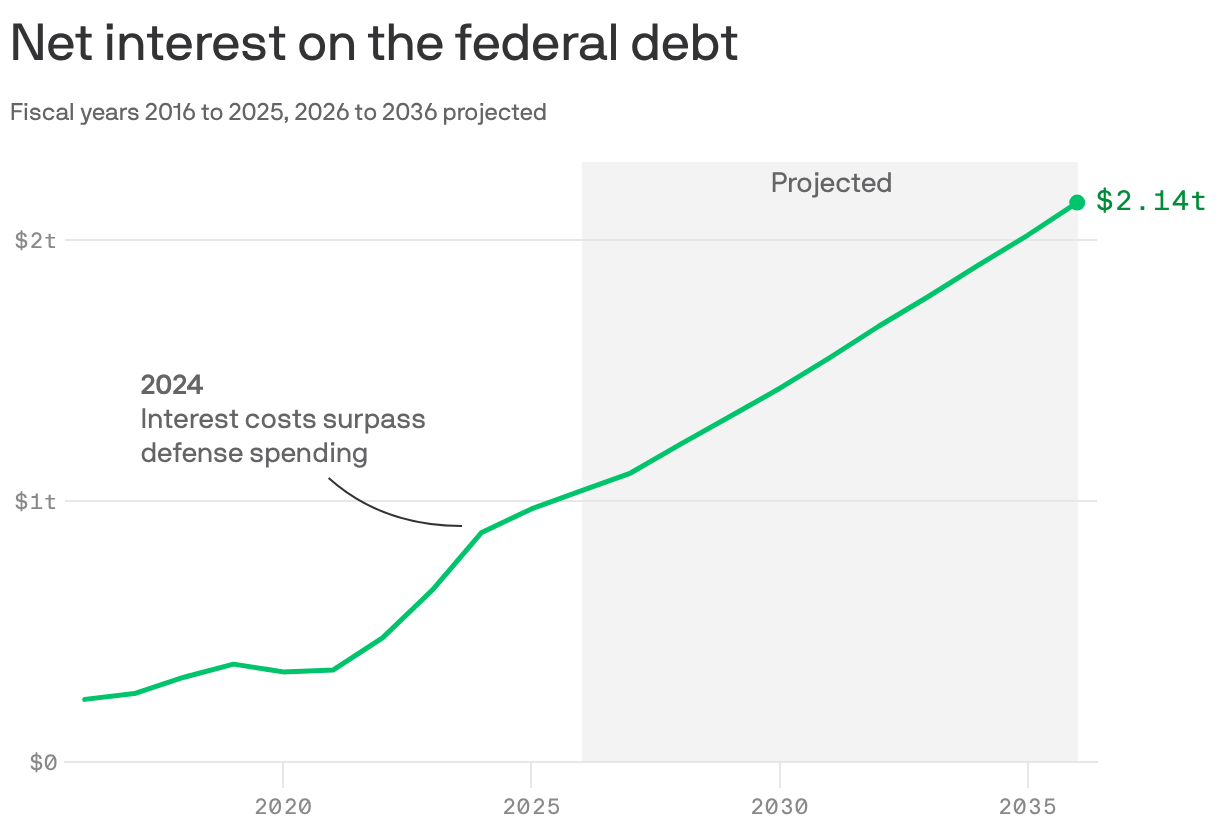
- CBO projects annual deficits will average $2.4 trillion through 2036, pushing debt held by the public to 120% of GDP — above the record set after World War II.
- The U.S. has already spent $963 billion on interest in the first 10 months of this fiscal year, $200 billion more than it spent on the military over the same period.
Zoom out: For years, Silicon Valley's AI buildout was financed almost entirely with cash. Now Big Tech is becoming one of the biggest new forces in global debt markets.
- Bond sales by the "hyperscalers" building AI infrastructure are on pace to roughly double in 2026. Goldman Sachs projects debt will fund more than a third of their AI spending by 2027.
- Nvidia is working with BlackRock, Goldman Sachs, KKR and other Wall Street giants on plans to marshal more than $500 billion for AI infrastructure.
Stunning stat: Nine major tech companies have already spent roughly $600 billion on capital projects over the past year.
- A Wall Street Journal analysis found they have another $3 trillion in future commitments, mostly tied to AI, that aren't yet reflected on their balance sheets.
The big picture: America's debt burden is approaching the point where it starts reshaping household finances, presidential politics and the country's economic choices.
- Long-term Treasury yields have climbed to their highest levels since 2007, raising borrowing costs across the economy — from mortgages to business loans — and making Washington's own debt more expensive to refinance.
- Social Security's retirement trust fund is projected to run dry in late 2032, during the final months of the next president's first term.
- Medicare's hospital trust fund follows in the second quarter of 2033.
Between the lines: Trump and Elon Musk promised to break Washington's addiction to debt without forcing Americans to swallow painful sacrifices.
- Musk launched DOGE with ambitions of cutting as much as $2 trillion from federal spending. Its final public tally claimed just $215 billion in savings — barely a tenth of that goal.
- A federal audit released this month found billions in unsupported or inaccurate savings claims, including $27.4 billion tied to contracts that were still active.
What to watch: America's fiscal options are narrowing as its political ambitions expand.
- On the left, democratic socialism and economic populism are surging, pairing promises of cheaper housing, health care and child care with calls for higher taxes on the wealthy.
- On the right, the Trump-era GOP has protected Social Security and Medicare politically while pursuing tax cuts and higher defense spending, including Trump's push for a $1.5 trillion Pentagon budget.
The bottom line: Few problems loom larger over America's future than its colossal debt burden. Yet few are treated with less urgency by the politicians who will have to confront it.
