Nvidia CEO Jensen Huang: AI fears designed to generate cybersecurity business

Add Axios as your preferred source to
see more of our stories on Google.
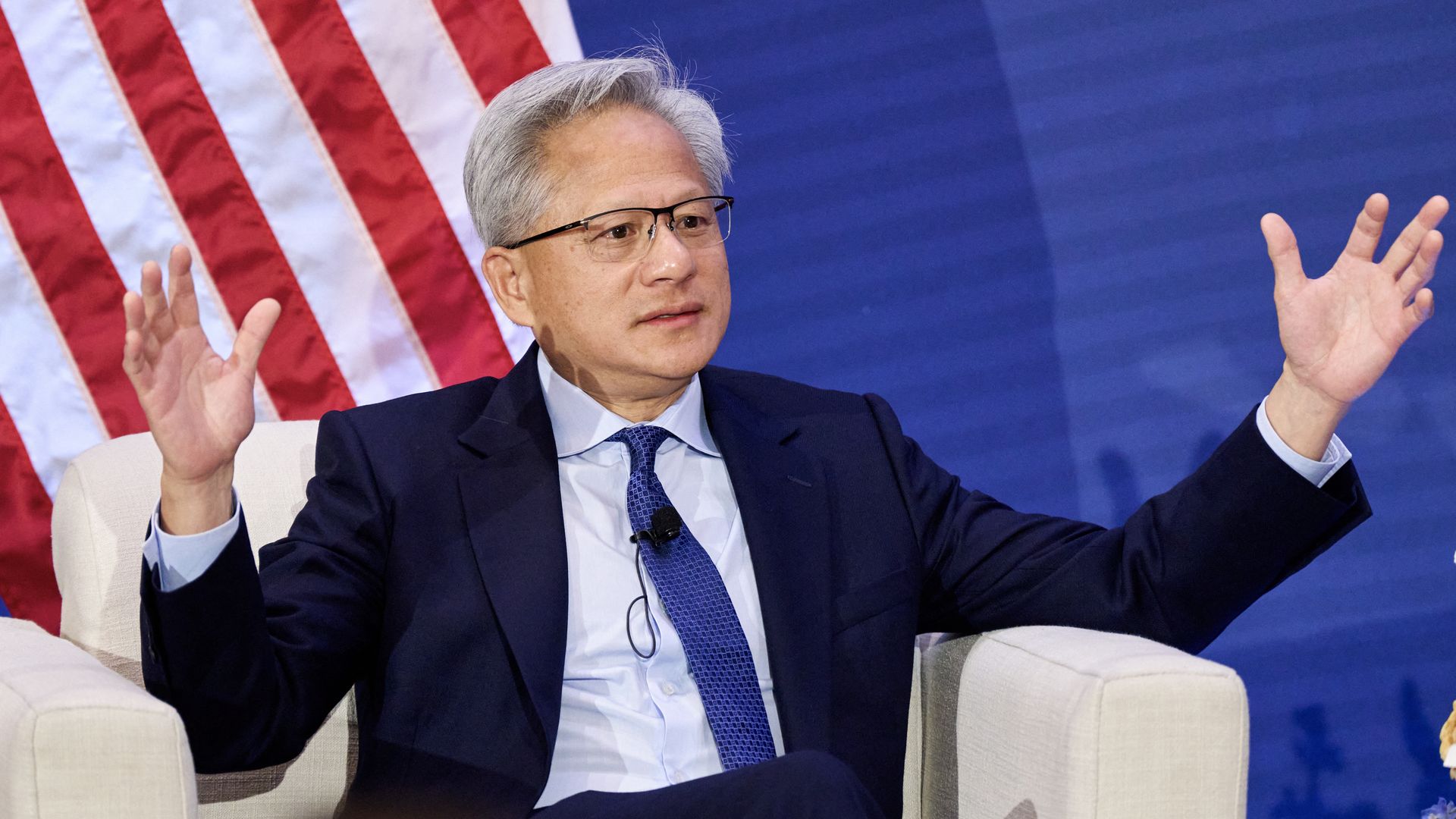
Nvidia CEO Jensen Huang speaks during the G20 Innovation Ministerial in Chapel Hill, North Carolina, on Sept. 2. Photo: Matt Ramey / AFP via Getty Images
Nvidia CEO Jensen Huang dismissed recent AI fears as a way for the cybersecurity sector to generate new business.
Why it matters: Huang — whose comments on AI are highly influential among investors — risks losing control of the narrative amid growing fears of widespread destruction.
Driving the news: Huang said Thursday at a Goldman Sachs conference that "the reason why there's so much conversation today about cybersecurity is because the industry is getting ready to launch some products."
- "And what better way to create demand than to create a problem?" he said at the event. "Who doesn't want their market to be hysterical about their product and line up around the corner for it?"
- His comments echoed similar remarks he made in an interview in July with Axios' Mike Allen: "The fact that this is going to be the end of humanity — it's complete nonsense. The fact that this is going to destroy half of the American jobs is complete nonsense."
The big picture: The conversation over the trajectory of AI exploded this week when an Anthropic researcher abruptly resigned his post and warned that AI could soon destroy humanity.
- "The people building AI earnestly believe that it could kill us all by the end of the decade," Anthropic AI researcher Jacob Coxon wrote on X. "This is not a marketing stunt."
Zoom in: Huang has been maintaining the outlook of a typical AI techno-optimist on three fronts:
- That it won't destroy the job market.
- That it won't destroy the world.
- That it's not a bubble ginned up by Nvidia's own circular investments.
Yes, but: Huang has a vested interest in painting the AI future as healthy and hopeful.
- The more it grows — and the fewer restrictions that are placed on it — the more chips he can sell.
What they're saying: "You can't ignore that he's talking his own book, but I don't think it's accurate to see his narrative as being merely self-serving — I think he is genuinely a techno-optimist," University of Michigan business professor Erik Gordon tells Axios.
- But "I think Jensen's narrative is losing ground to the narrative grounded in fear," Gordon says.
Before the latest hubbub over the Anthropic researcher's warning came a screed from Bill Gates warning that AI is poised to wipe out countless jobs.
- "I think Jensen's narrative would be more credible if he spent more time acknowledging the other fears and specifically addressing why we should be less fearful," Gordon says.
One area where Huang is getting more direct is the concern over Nvidia's growing number of investments in its own customers and its use of its own capital to transform chips into investable assets.
- "It's not circular because we put a little bit of money in, and a lot of money comes back," Huang said Thursday to laughter.
- He added: "We put in one, and a hundred comes back in. Is that circular? If that is, let's do more of that."
Huang also directly acknowledged that Nvidia's investment decisions often spark a rally for the stocks it's acquiring.
- "People are starting to recognize that wherever I invest, it's not a bad place to invest because I'm an informed investor. I'm not taking any risks. We're not smart like you guys," Huang told the Goldman conference crowd. "I need a sure thing."
The bottom line: Hopes and fears over AI's impact "are both valid, but we are driven more by fears than we are by optimism," Gordon says.
- It's not unlike nuclear technology, Gordon adds: "Nuclear could actually save the planet, but any given minute it could also annihilate us."
