Trump's mail-ballot rules blocked by another federal judge

Add Axios as your preferred source to
see more of our stories on Google.
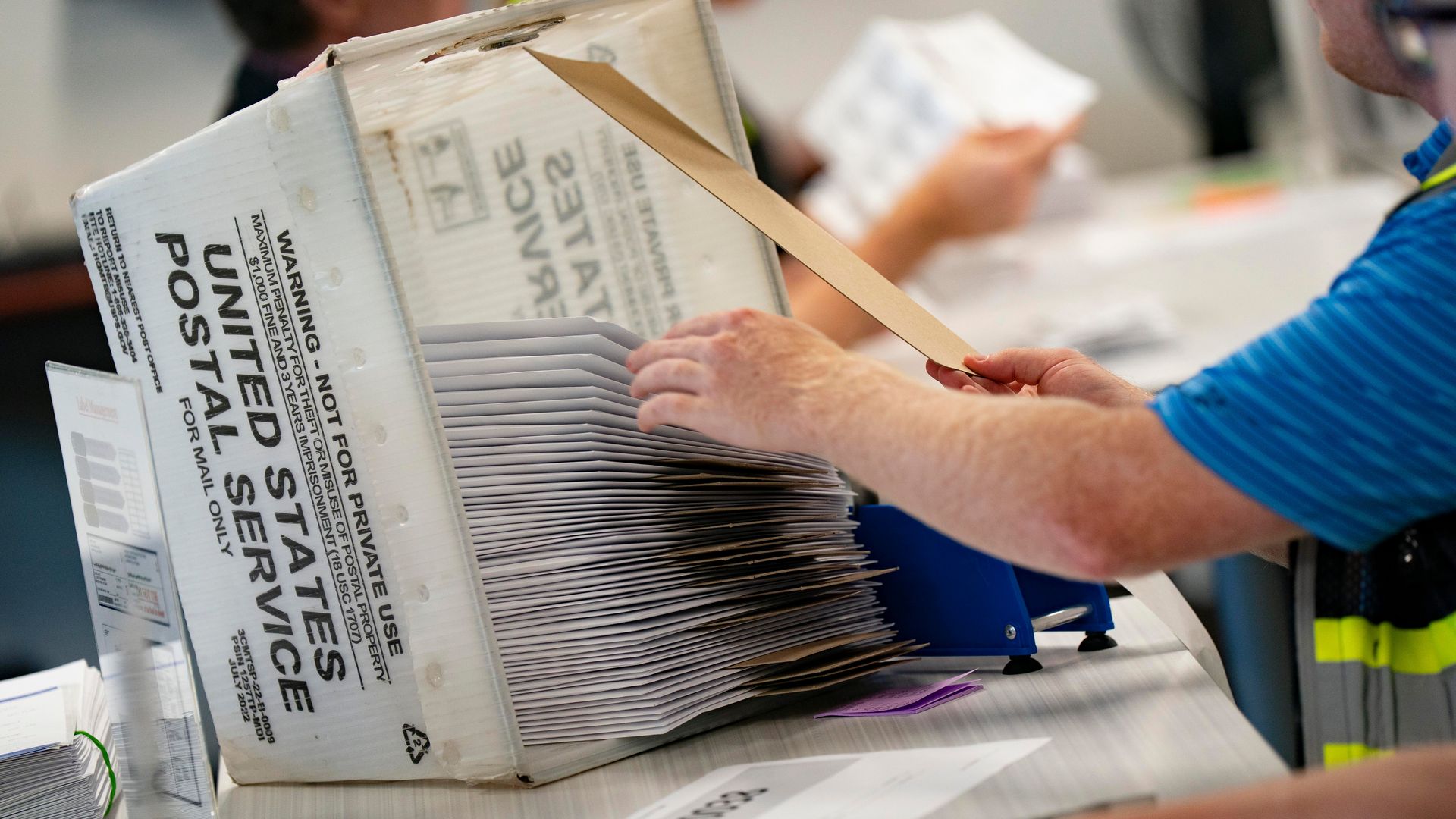
Mail-in ballots are prepared at the Wake County Board of Elections in Raleigh, N.C., on Friday. Photo: Allison Joyce/Bloomberg via Getty Images
A second federal judge blocked the U.S. Postal Service's new mail-ballot rules for the Nov. 3 midterms as the Supreme Court weighs whether to allow the restrictions in another case.
Why it matters: Sunday's order adds another hurdle to the Trump administration's bid to upend mail voting. The blocked rules would allow the USPS to refuse ballots that don't clear new standards, with mail voting already underway in some states.
The latest: U.S. District Judge Carl Nichols, a Trump appointee in Washington, D.C., concluded Congress empowered the Postal Service to move mail, not to force states to enroll mail voters in a federal portal or to refuse ballots that fail its checks.
- Nichols' ruling follows a similar order from U.S. District Judge Indira Talwani in Boston blocking parts of the same rule. The 1st U.S. Circuit Court of Appeals left Talwani's injunction in place on Sept. 10.
- Talwani's order found the postal rules violate the U.S. Constitution and federal statute, while Nichols' new ruling relied entirely on his finding that Congress' Postal Reorganization Act doesn't allow many of the new rules.
- The USPS did not immediately return requests for comment.
What they're saying: The White House wouldn't say if it planned to appeal this ruling but spokesperson Lauren Bis said election officials have had "ample time to prepare for the 2026 election."
- Bis added in the emailed statement, "These are commonsense measures to protect the security of mail-in ballots and ensure only Americans vote in American elections."
- Kristen Clarke, NAACP general counsel, said in an email that two district courts and a federal circuit court have now blocked the Trump administration's "unlawful attempt to weaponize the U.S. Postal Service to hijack our mail voting system in the middle of an ongoing midterm election."
- Clarke noted that the election is just 49 days away. "We urge the Supreme Court to reject this administration's request to green light this unlawful scheme and leave in place our mailing voting system which is safe, secure, and orderly," Clarke added.
Catch up quick: President Trump has long attacked mail voting, despite repeatedly using the method himself, including in August's Florida primaries.
- His March executive order directed the Postal Service to develop new envelope, tracking and voter-list requirements for mail voting.
- The Supreme Court already lifted an earlier injunction because the final rule hadn't been published yet. But after its publication, challengers returned to court and won new injunctions in Boston and D.C.
- The Trump administration is now asking the high court to stop Talwani's order and allow the new rules.
Between the lines: Nichols said USPS might have the authority to issue rules on ballot-envelope designs, but he blocked the whole rule, finding its design, portal and rejection provisions too intertwined.
Friction point: Even with enforcement blocked, voluntary preparations have exposed how exacting the new system could be.
- USPS initially rejected envelope designs from Florida's Leon County, a heavily Democratic area that includes Tallahassee, because the words "Return Service Requested" were 0.014 inches too close to other text, according to the Tallahassee Democrat.
- An anonymous USPS whistleblower also told Congress the Postal Service's portal was rushed, and a single scanning error could cause a batch of ballots to be rejected.
The bottom line: The Supreme Court could rule on Talwani's injunction at any time. But Nichols' order now gives the administration a second injunction to overcome before it can enforce its mail ballot rules.
Editor's note: This story has been updated with comment from the White House and NAACP general counsel Kristen Clarke.
