The space war conversation has dramatically changed

Add Axios as your preferred source to
see more of our stories on Google.
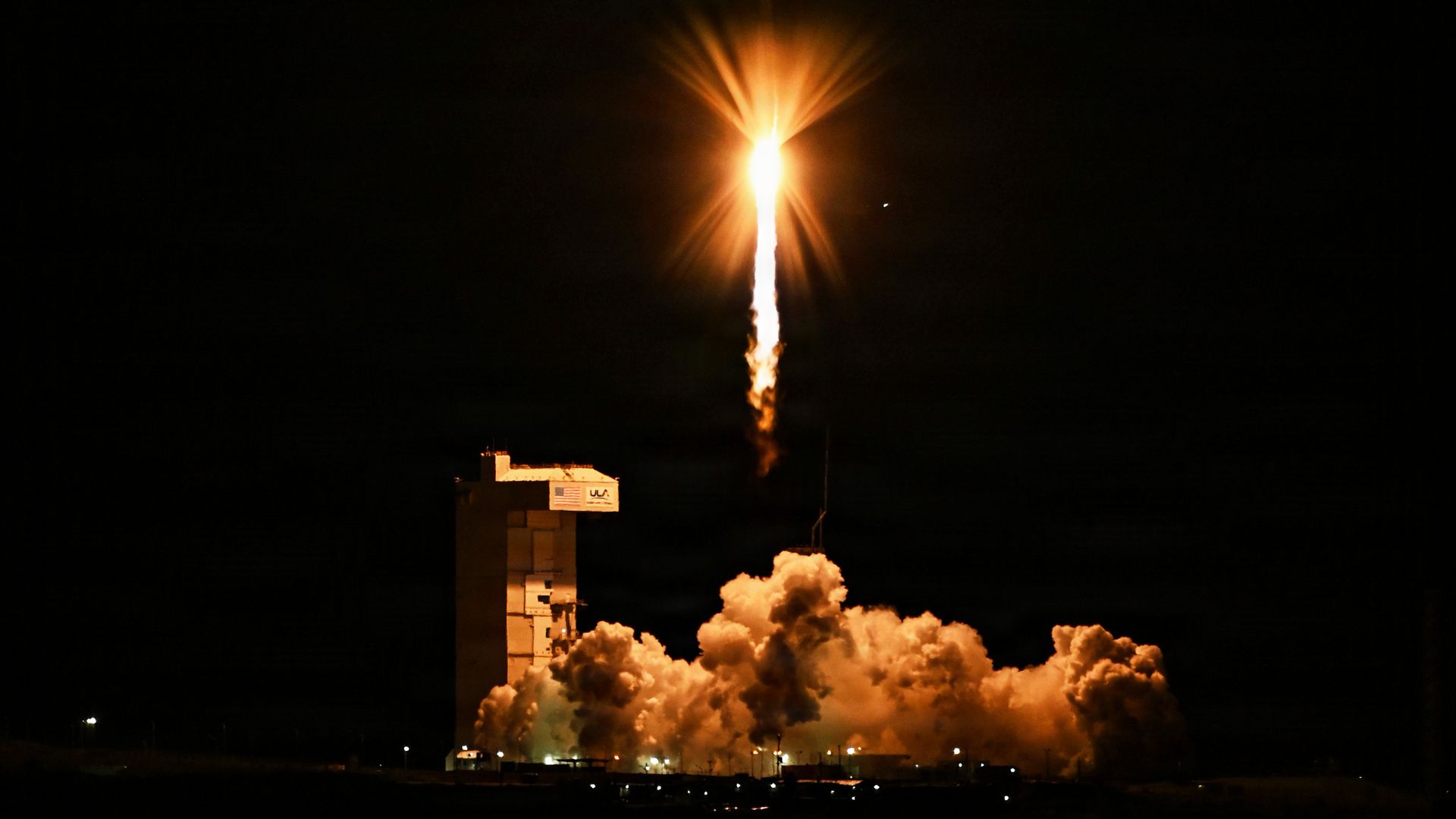
An Atlas V rocket launches from Vandenberg Space Force Base, California, in 2022. Photo: Ryan Quijas/DVIDS
Three U.S. military leaders in just as many days changed how the public talks about war in space, including the secretive weapons already among the stars.
Why it matters: Space fights will happen. They will look nothing like conflict on the ground or on the water. And the consequences will be enormous.
Driving the news: Last week and in quick succession:
- Air Force Secretary Troy Meink said America has "on-orbit space control weapons" — a historic acknowledgment.
- Chief of Space Operations Gen. Douglas Schiess told reporters that "it was time" to have such a discussion and be clear-eyed about Russian and Chinese capabilities, including "being able to grapple a satellite and move it to a different orbit."
- And Joint Chiefs Chairman Gen. Dan Caine said troops must be "prepared to fight, endure and win in global, contested environments, from the seabed to cislunar space."
Threat level: The U.S. has long held an advantage in space and has used the domain for surveillance, communication, missile tracking and more.
- But experts warn Russia and China are eating into that lead.
- The Pentagon's 2025 report on Beijing's firepower warned of "close approach and rendezvous operations between different sets of satellites" as well as "space-based jammers, including global navigation" spoofers.
Between the lines: Space is ruled not only by conventions and treaties but also social mores. Openly talking about weapons has been taboo, whether because of strategy, classification or stomach.
What they're saying: The pronouncements give "U.S. adversaries evidence for their claims that an arms race in space is already underway. But greater candor could also support negotiations if it leads to clearer doctrine and reciprocal transparency," Thomas González Roberts, the director of Georgia Tech's Engineering Space Policy Laboratory, told Axios.
- "Space has been militarized for decades, and counter-space weapons are not new," he added. "The shift is toward more open acknowledgment."
Context: The U.S., Russia and China have all tested anti-satellite weapons.
What we're watching: If and when the Trump administration's ambitious space plans — Golden Dome, Space Academy, lunar reactors — are achieved.
Go deeper: Why D.C. defense experts wrestled with a simulated space nuke
