Muse is proving to be one tough customer

Add Axios as your preferred source to
see more of our stories on Google.
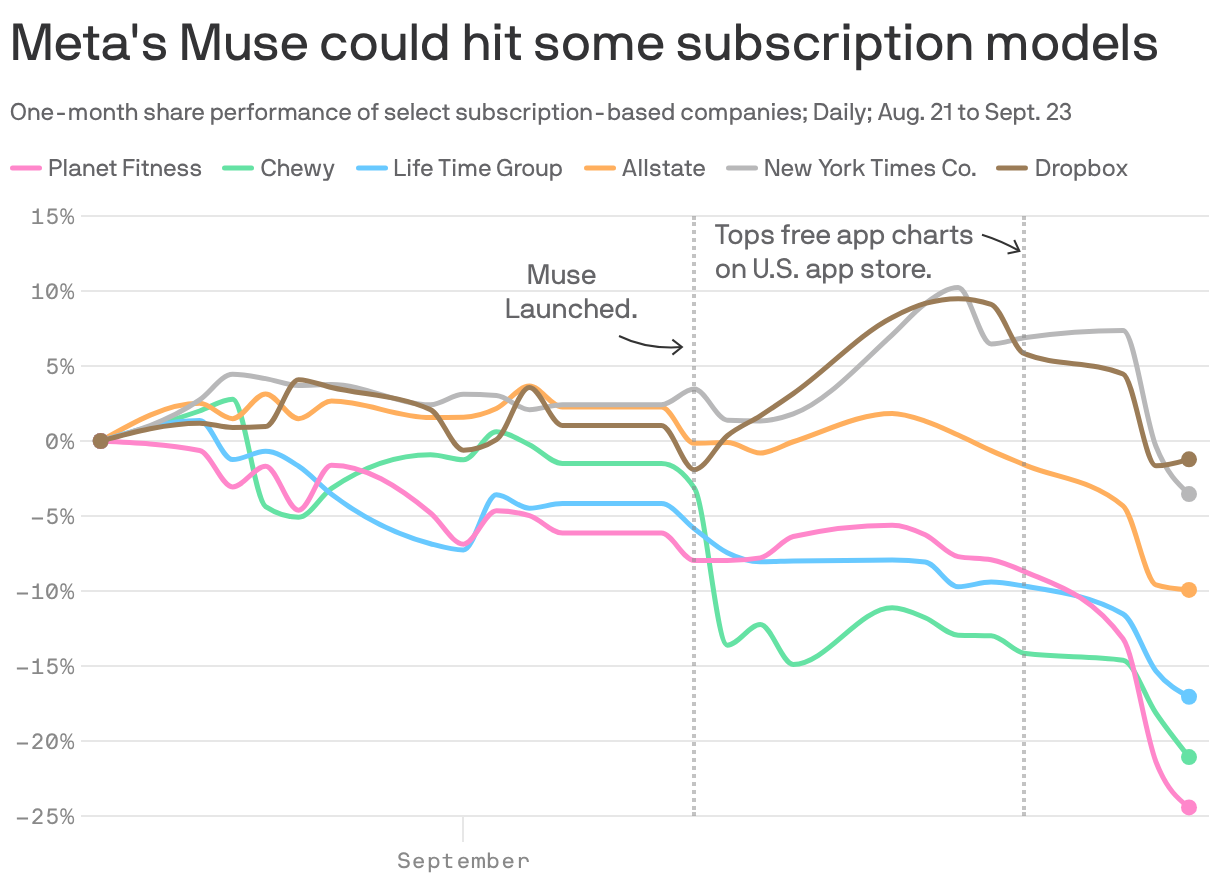
Companies that stand to profit revenues linked to the kind of auto-renewals that benefit from customer inattention and inertia have slumped since the well-received release of Muse, Meta's new AI agent.
Why it matters: One of the beauties of the subscription model — at least for the companies collecting the revenue — is that customers often keep paying for subscriptions long after they stop valuing or using the service.
The big picture: And that subscription economy has boomed: gym memberships, streaming services, meal kits, home security, video games and dating sites, as well as pricier stuff like GLP-1s and concierge health care.
Stunning stat: Spending on non-utility subscriptions rose 7.7% in July from a year ago, outpacing overall credit card spending, Bank of America said earlier this month, citing its payments data.
Zoom in: A paper in the American Economic Review last year looked at purchase-level data from a payment card network for 10 popular subscription services.
- Using that data, economists Liran Einav, Ben Klopack and Neale Mahoney then tried to estimate the impact of customer inertia on subscription revenues more broadly.
- "We estimate that these cancellation frictions roughly double seller revenues on average," they wrote, while cautioning that there could be substantial differences in the impact that customer inertia has on different kinds of products and services.
What they're saying: "People are paying for many months of subscriptions that they no longer value," Mahoney, a Stanford economist and one of the coauthors, told Axios last year. "That allows companies that don't perhaps have a viable business model to continue bringing in money."
The latest: Meta's Muse seems to be quite good at identifying and keeping track of redundant, seldom-used or soon-to-renew subscriptions and then canceling them.
- In a review, the New York Times' Eli Tan wrote: "I found Muse to be the most useful AI app I had ever used. One clarifying moment came after I connected my credit cards to Muse and asked it to track my spending in Google Sheets. I watched as it spun up tabs with hundreds of rows of data each in minutes, then flagged two duplicate subscriptions, which it canceled for me."
- The specter of such efficient axing of stale subscriptions by consumers has prompted investors to sniff out a number of companies where the prospect of Muse closely monitoring subscriptions could pose a risk to revenues.
- "As artificial intelligence assistants like Muse and Instinct improve at price comparison, trip booking and dealing with customer service interactions, industries that rely on recurring bills, negotiable pricing and add-ons could come under pressure," Goldman Sachs said in a note, according to Bloomberg.
What's next: The threat to subscription models could be part of an emerging AI-driven shakeup over who controls the strategically important relationship between sellers and buyers.
- Already, Amazon has moved to curtail Muse from making purchases on its site, citing security reasons.
- Yet sellers that lack the heft of an Amazon will be less likely to opt out of an economic ecosystem increasingly curated by Meta.
Emily Peck contributed reporting.
