A "clean sweep" for Boeing in next-gen Navy and Air Force fighters

Add Axios as your preferred source to
see more of our stories on Google.
A conceptual look at F/A-XX. Photo: Courtesy of Boeing
The future of American fighter aircraft is now Boeing's to decide.
The big picture: The world's sixth-largest defense contractor by revenue has secured a monopoly on these sixth-generation warplanes, with the rights to build not only the U.S. Air Force's F-47 but also the Navy's F/A-XX.
Driving the news: Analysts Axios spoke with described this moment as an upswing for Boeing, which has taken lumps on the VC-25B presidential transporter, KC-46 refueler and T-7 trainer.
- "This is, obviously, a huge, huge win," Eli Cook, a senior associate at the Capstone strategy firm, told Axios. "It's a clean sweep."
- "Modern, next-generation aircraft — especially combat aircraft, with all the systems and subsystems and weapons, etc. — are extremely hard to pull together in an effective way," he added.
Here are some things to chew on:
The "full-scale development" contract for F/A-XX is worth more than $20 billion. It includes multiple aircraft for ground and weapons integration testing, among other trials.
Boeing declined to say how many aircraft are actually due, whether there will be different versions or variants for testing purposes, by when they must be furnished, and what other companies it is in talks with. Boeing also did not share specs, such as range and payloads.
Both the program and deal were long awaited. That ostensibly provided plenty of time to mature designs, invest in infrastructure and identify potential pitfalls.
The contract rollout, itself, was muted. A few paragraphs and X posts shared. No Oval Office ceremony with big, illustrative boards.
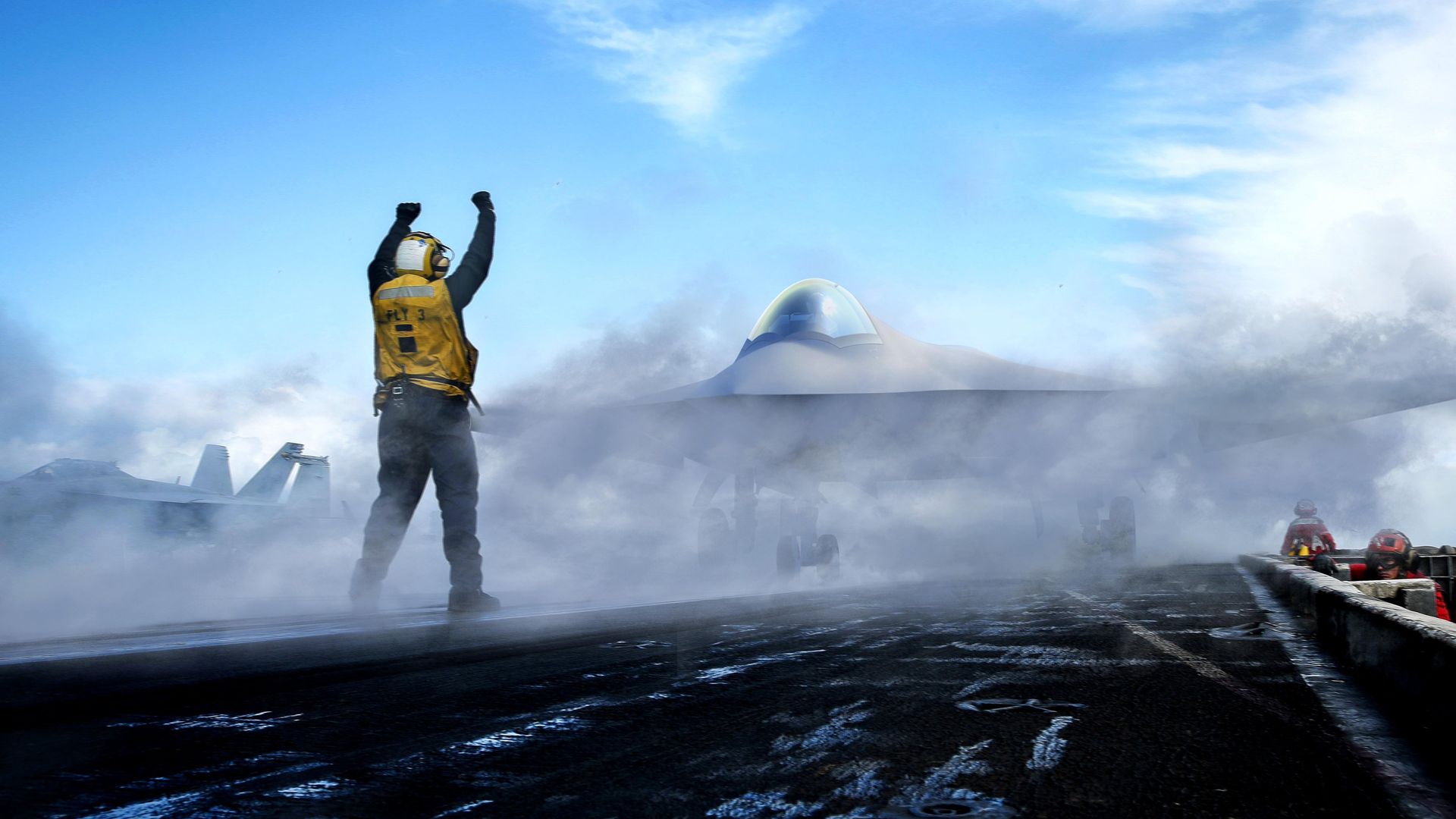
The render, which should be treated with skepticism, shows a very broad, flat, tailless aircraft with chunky landing gear. It also appears there is a single person in the cockpit.
The render is reminiscent of a photo taken aboard the USS Theodore Roosevelt in 2018.
F/A-XX will augment and replace F/A-18E/F Super Hornets and EA-18G Growlers beginning in the 2030s, according to the Pentagon.
The propulsion has not been disclosed, but has been described as a derivative of an existing engine. A GE Aerospace spokesperson told Axios the company is "excited to see this important program advance."
F/A-XX will operate alongside Lockheed Martin's F-35C, the carrier variant, as well as Collaborative Combat Aircraft. (Boeing was one of several aerospace companies selected by the Navy last year to cook up "conceptual designs" for the service's robo-wingmen.)
There will be common DNA between F/A-XX and F-47. Both will be stealthy, for example. Beyond that, little authoritative information is available.
What they're saying: "The long-overdue final downselect for the F/A-XX program is great news for the U.S. aircraft carrier fleet," Rep. Joe Courtney (D-Conn.) said in a statement.
- The warplane, he added, "will serve as a critical platform for the Navy to overcome the tyranny of distance in the Indo-Pacific region."
Zoom out: On the same day it won the F/A-XX contest, Boeing also secured a $2.4 billion contract for more F-15EX fighters.
- A total 120 F-15EX are under contract for the Air Force.
The bottom line: "The good news is, overall, there's been a real focus on building a lot of capacity," Jerry McGinn, an industrial base expert at the Center for Strategic and International Studies, told Axios.
- "Now they've got to be able to execute. That's always the trick."
Go deeper: Stratolaunch buys Boeing 777 to boost hypersonic testing
