This neocloud may have a silver lining

Add Axios as your preferred source to
see more of our stories on Google.
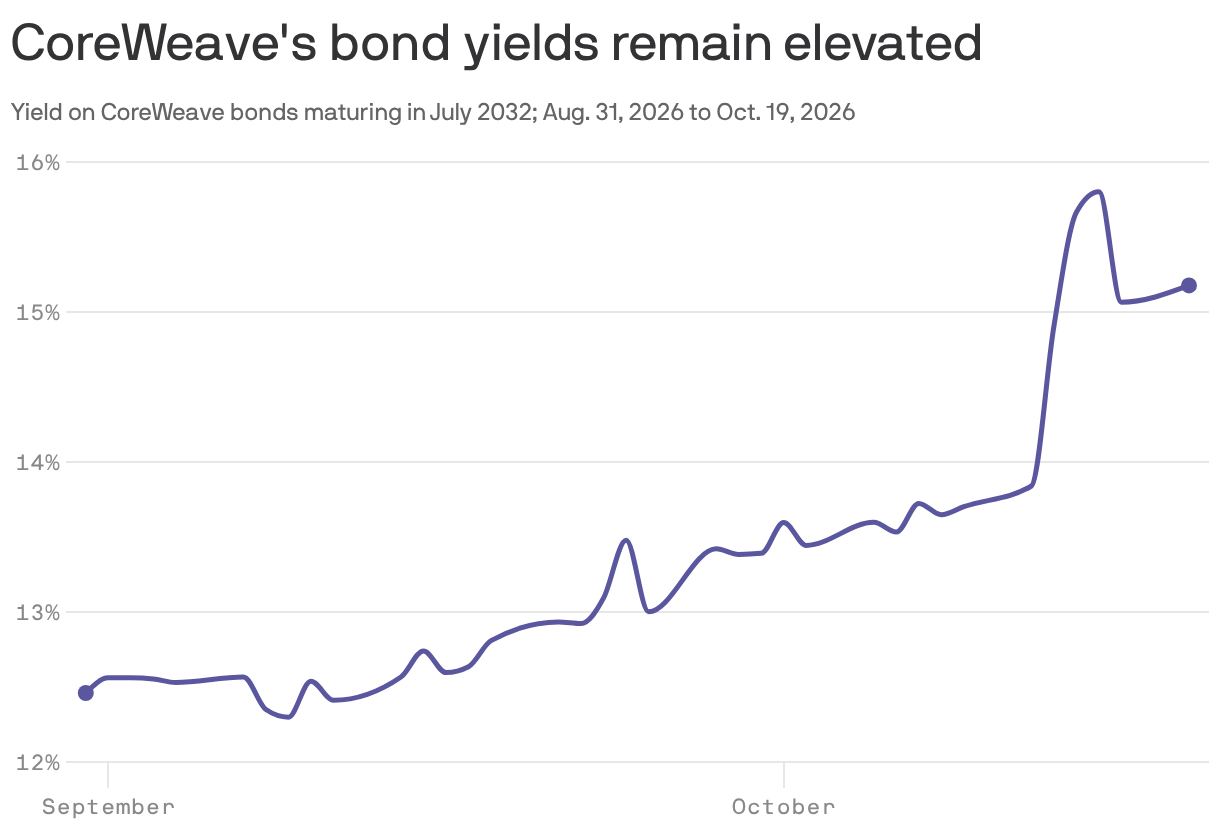
Goldman Sachs has raised its rating on the shares of CoreWeave to a "buy" recommendation after a brutal week for the data center operator.
Why it matters: That view may come as a surprise given that the tumble in CoreWeave bonds and stock last week had appeared to encapsulate all what markets fear about the debt-dependent AI boom: too much money, most of it borrowed, chasing returns that may prove elusive.
Zoom out: What's cloudy (sorry!) about the outlook for CoreWeave and the other data center operators known as neoclouds, as well as their much bigger rivals, the hyperscalers, is that nobody really knows how profitable all these data centers will eventually be.
- But if the cost of borrowing to build them goes up — which is what the spike in CoreWeave's bond yields suggests — that should make them less profitable.
The latest: Goldman analyst Gabriela Borges argued in a note Monday that the increase in borrowing costs that CoreWeave ultimately faces will be less substantial than the company's yippy bond yields might suggest.
What they're saying: "Our discussions suggest that CoreWeave's unsecured spreads (currently at 13.5-15.0%) are not representative of what CoreWeave's true cost of new debt is; in fact, the unsecured bond market has already been closed to new CoreWeave issuance for several months," she wrote, meaning that the company can't issue new unsecured bonds anyway, so those yields won't be representative of what it will pay when it needs to borrow more.
- What will it pay? Well, CoreWeave's primary way of tapping the capital markets for cash it needs to build data centers now, Borges says, is by borrowing in the fast-growing project finance market.
Zoom in: Project finance debt is a niche that developed as a way to fund giant infrastructure projects that required a lot of upfront investment, like power plants.
- Such projects require a lot of upfront investment during the risky construction phase, but pay off only over the long term.
How it works: A standalone corporate entity, known as a special purpose vehicle — legally separate from the "sponsor" companies that actually want the project built — is created that has legal control over the project.
- The SPV is provided with a little bit of equity from the sponsors.
- This legal entity is then, typically, able to leverage that equity at a higher rate than it would be if it was technically part of its sponsor companies, which likely already have debts of their own limiting the capacity to take on more.
- For heavily indebted sponsor companies, such as CoreWeave, project finance debt can also carry a lower interest rate.
The big picture: AI-related issues have transformed the project finance market in recent years, a separate Goldman Sachs report on credit markets noted on Oct. 15.
- AI issues dominate the $106 billion in project finance debt issued so far this year.
- That's nearly triple the $37 billion issued last year. Just three years ago, hardly any AI-related project finance debt existed.
Yes, but: The boom in the project finance market also suggests that a hefty chunk of risk related to the AI boom continues migrating to complex corners of the market where it might be tougher to keep track of.
The bottom line: The emergence of the AI project finance market could mean CoreWeave has a bit more financial flexibility than its bonds — currently at yields of about 15%, still in distressed territory — would indicate.
