The AI trade gets a reappraisal

Add Axios as your preferred source to
see more of our stories on Google.

Illustration: Aïda Amer/Axios. Stock: Getty Images
The AI boom is moving into its rational exuberance phase, to adapt a term from the last tech bubble: Investors are pulling back funding and demanding more evidence that their investments will actually pay off.
Why it matters: It's a delicate dance. The economy is running on the AI trade right now. Can investors take air out of the bubble without popping the whole damn thing?
The big picture: Investors still believe that long-term AI will pay off in big productivity gains — and that's clear from the gains in the stock market — but lately they've toned down the mania.
- Signs of the retreat are coming from all corners of the AI buildout:
Neoclouds are the hardest hit. These are the new players borrowing heavily and using backing from Big Tech companies to build data centers and sell computing power back to those hyperscalers, as part of what many see as the AI circular economy.
- Bond investors are demanding more compensation to lend to neoclouds — CoreWeave is Exhibit A — as rising interest rates make them look more risky.
- South Korean neocloud Elice's stock plunged more than 30% in its trading debut Tuesday. In Australia, an Nvidia-backed neocloud called Firmus shelved a planned IPO earlier this month after investors balked at its valuation.
- "We think that Firmus indeed has a compelling story. It just doesn't have a compelling valuation," said John Pearce, the chief investment officer of one of Australia's largest pension funds, in explaining why his fund wouldn't participate in the stock offering.
The latest: Nvidia might be poised to swoop in and invest hundreds of millions in Firmus, the Information reports. The deep-pocketed chipmaking behemoth is already an investor and a big backer of neoclouds.
Chipmakers are also getting a reappraisal. Since the tech-heavy Nasdaq peaked at an all-time high on Oct. 6., chip stocks have slid.
Even Big Tech is getting a second look. The hyperscalers like Amazon, Meta and Google parent Alphabet began the AI boom using their enormous cash stockpiles to build data centers.
- Now, these giants have moved on to borrowing — a lot. And investors are adjusting.
- "They started by financing with free cash flow. That kind of ran out," David Lebovitz, head of alternative research and strategy at JPMorgan Asset Management, said at an event Monday.
- "Now, they're moving into the credit markets. Well, credit markets are having a little bit of an indigestion period."
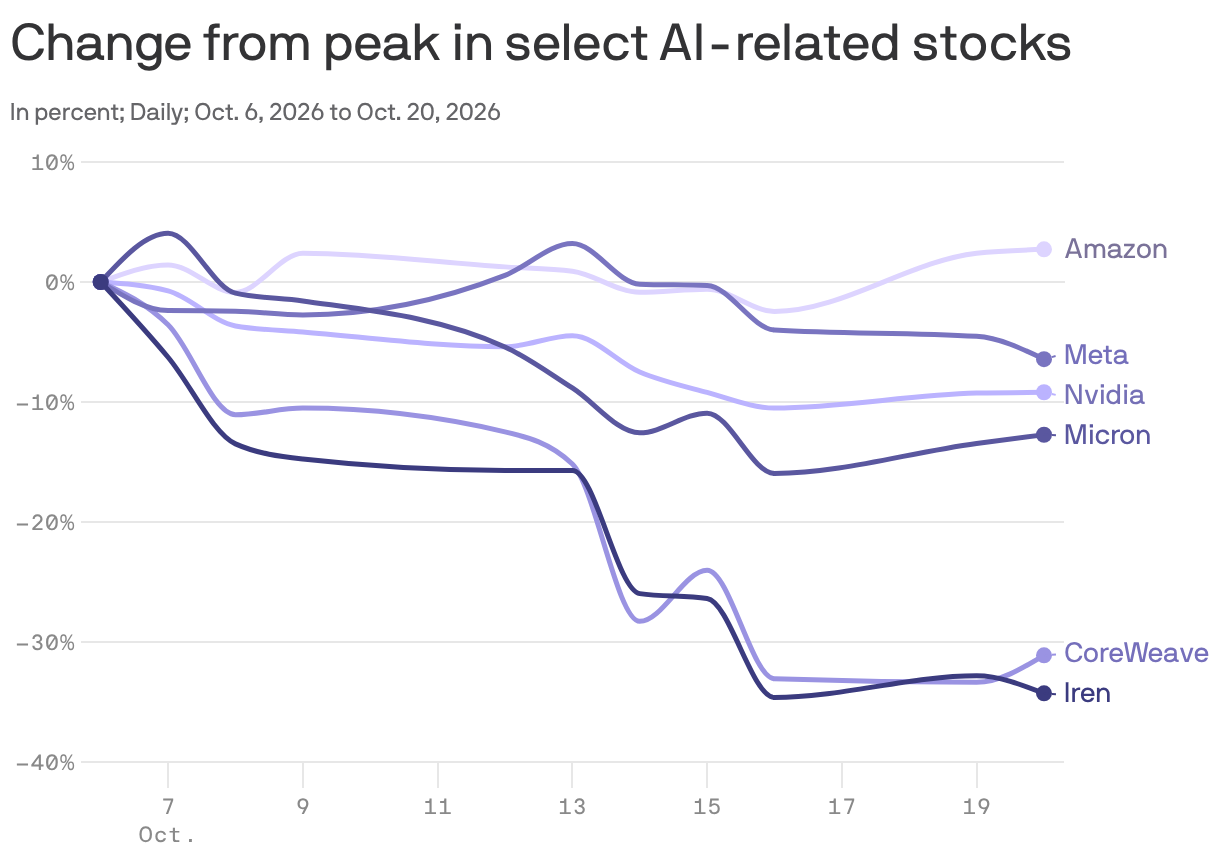
Yes, but: For now, Wall Street is holding on to the belief that AI will transform markets and the economy.
- Take JPMorgan. On Monday, the bank raised its forecast for annual returns on U.S. large-cap stocks to 7.5% over the next 10 to 15 years, up from 6.7% last year — courtesy of AI-driven productivity gains and resilient corporate profit margins.
- And even the boom's most prominent skeptics concede that a massive transformation is happening. The bursting of the dot-com bubble didn't mean the internet went away.
Zoom out: "My point was that we have had this blind enthusiasm for all things AI — endless financing, companies converting business models and a relentless focus on building as much computing power as possible," JPMorgan's Lebovitz later told Axios.
- "What you are seeing now is that markets are beginning to differentiate between players, business models and financing approaches."
The bottom line: It's becoming clear that AI is no Lake Wobegon, where all the companies are above average and good-looking.
