F1 intends to see Apple deal through 2030 and "hopefully beyond," Liberty Media CEO says

Add Axios as your preferred source to
see more of our stories on Google.
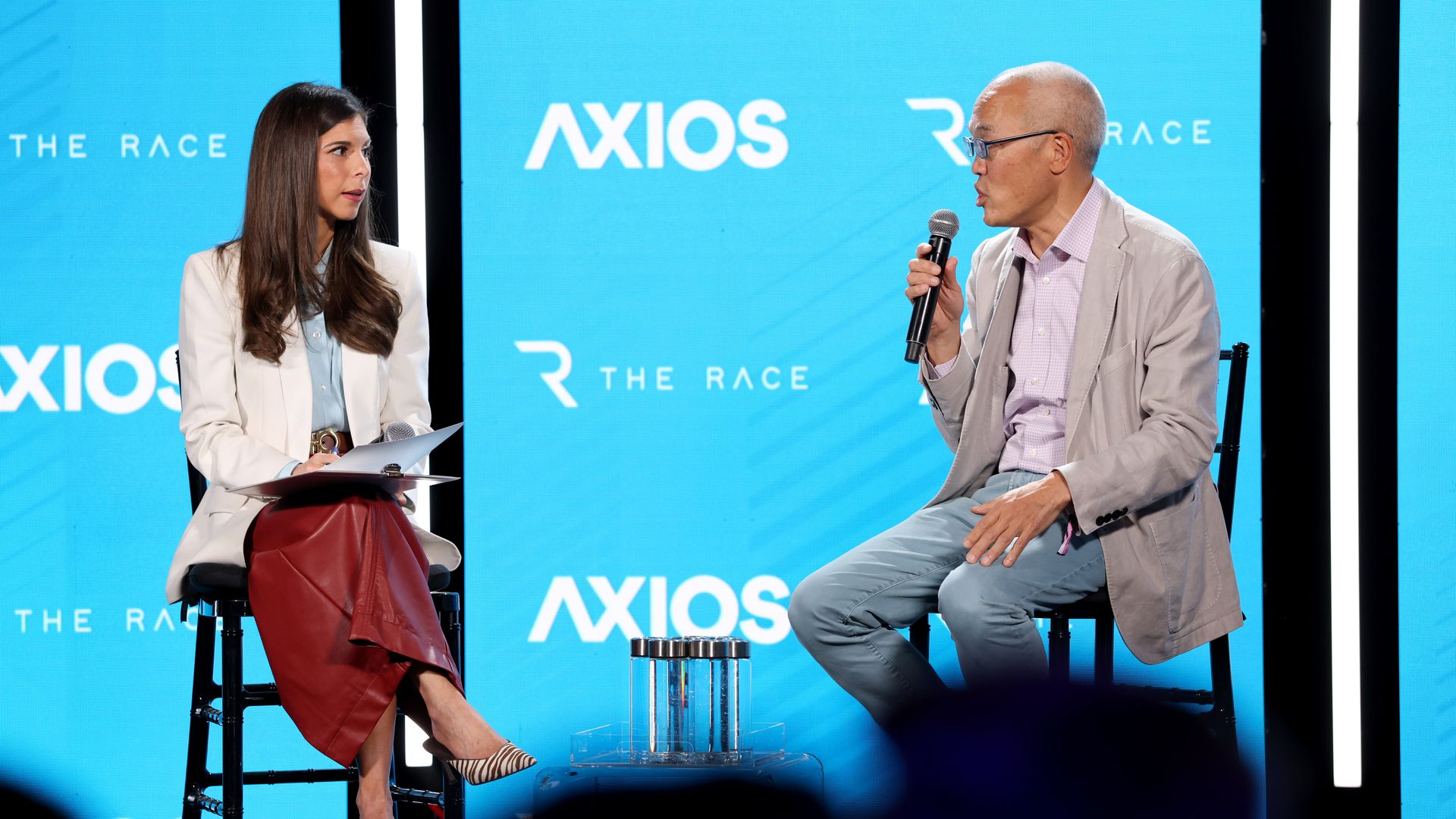
Axios' Sara Fischer interviews Liberty Media CEO Derek Chang on Oct. 22 in Austin. Photo: Rick Kern/Getty Images for Axios
Formula 1 intends to see its Apple distribution deal through its 2030 expiration date and "hopefully beyond," Derek Chang, president and CEO of F1 owner Liberty Media, told Axios x The Race at an event in Austin last week.
Why it matters: The deal is a major test for sports franchises looking to understand the value in potentially trading broader reach on traditional broadcast for a more strategic distribution opportunity on streaming.
Zoom in: Chang wouldn't comment on whether F1 has an opt-out agreement in place that would allow renegotiations before the deal expires, but he said the idea of an opt-out is a "moot point" because "we've got a great partner."
- Apple has performed "exactly the way we thought and frankly even better," he said.
State of play: Chang didn't address the validity of third-party metrics that suggest F1's household reach has declined since its U.S. rights moved from ESPN to Apple this season, but he said F1 views engagement as its key metric for success, not just traditional broadcast viewership.
- He said Apple's ecosystem allows it to engage fans beyond broadcast reach, "whether it's promoting the races on Apple News, Apple TV, in the Apple Store, on your iPhone."
- He pointed to "other innovative stuff they can do with the product," such as "being able to follow whatever driver you want" and "having multiple feeds." Those things "will only improve over the next few years."
- "All of that, to me, has been playing out exactly as planned," he said.
Zoom out: The five-year deal, which was announced last year ahead of the Austin Grand Prix, represents a milestone in F1's U.S. growth.
- Apple is reportedly paying around $140 million for the U.S. distribution rights annually, compared with the $90 million ESPN paid for the five years prior.
- Apple senior vice president Eddy Cue, who oversees sports rights and services, said last month viewership is "up by significant double-digit percentage growth on the race day, and more importantly on Saturdays," while noting that viewership is younger and skews more female.
- Chang credited Apple's audience as having "a very similar demographic" to the F1 audience. "Great overlap there," he noted.
The big picture: Central to F1's success has been its ability to reach casual fans through shoulder programming, such as Netflix's "Drive to Survive" series and social media.
- F1 only began allowing teams and drivers to post social video from inside the paddock in 2017, when Liberty bought the franchise.
- Chang said 60% of F1's "hundreds of millions of fans" engage with F1 content on a daily basis.
- "You no longer think about F1 as sort of something that you've got to go to every race or watch every race on television to be a fan, right?"
Between the lines: The deal is important for Apple as it looks to expand its footprint in live sports.
- Chang said Apple's dual role as broadcaster and distribution platform gives it an advantage over traditional broadcasters who are constrained by contracts.
- He pointed to deals Apple made to allow Netflix to distribute the Canadian Grand Prix, and to put F1 races in IMAX theaters, as examples of how Apple can expand access beyond its own streaming service.
Yes, but: While executives on both sides seem pleased, there's no question the season got off to an unusual start.
- Geopolitical conflict in the Middle East caused F1 to cancel two April races in Bahrain and Saudi Arabia, which created a five-week break between the Japanese Grand Prix and the Miami Grand Prix.
- Asked whether F1 would have to rebate Apple for the missed events, Chang wouldn't comment on contract specifics. He said distribution deals typically have certain volume "thresholds," and "as good partners, you always talk through those sorts of things."
Context: F1 originally planned for the 2026 season to have 24 races. The canceled Bahrain Grand Prix was relocated to Malaysia in October, but the Saudi Arabian Grand Prix was never rescheduled.
- Chang said at this point, F1 is anticipating a 23-race season, and "we feel good about where we are."
What to watch: Chang confirmed that F1 has contingency plans in place should upcoming races in Qatar or Abu Dhabi be disrupted by geopolitical events but wouldn't confirm a backup location.
