Reaction to elections will be key for markets

Add Axios as your preferred source to
see more of our stories on Google.
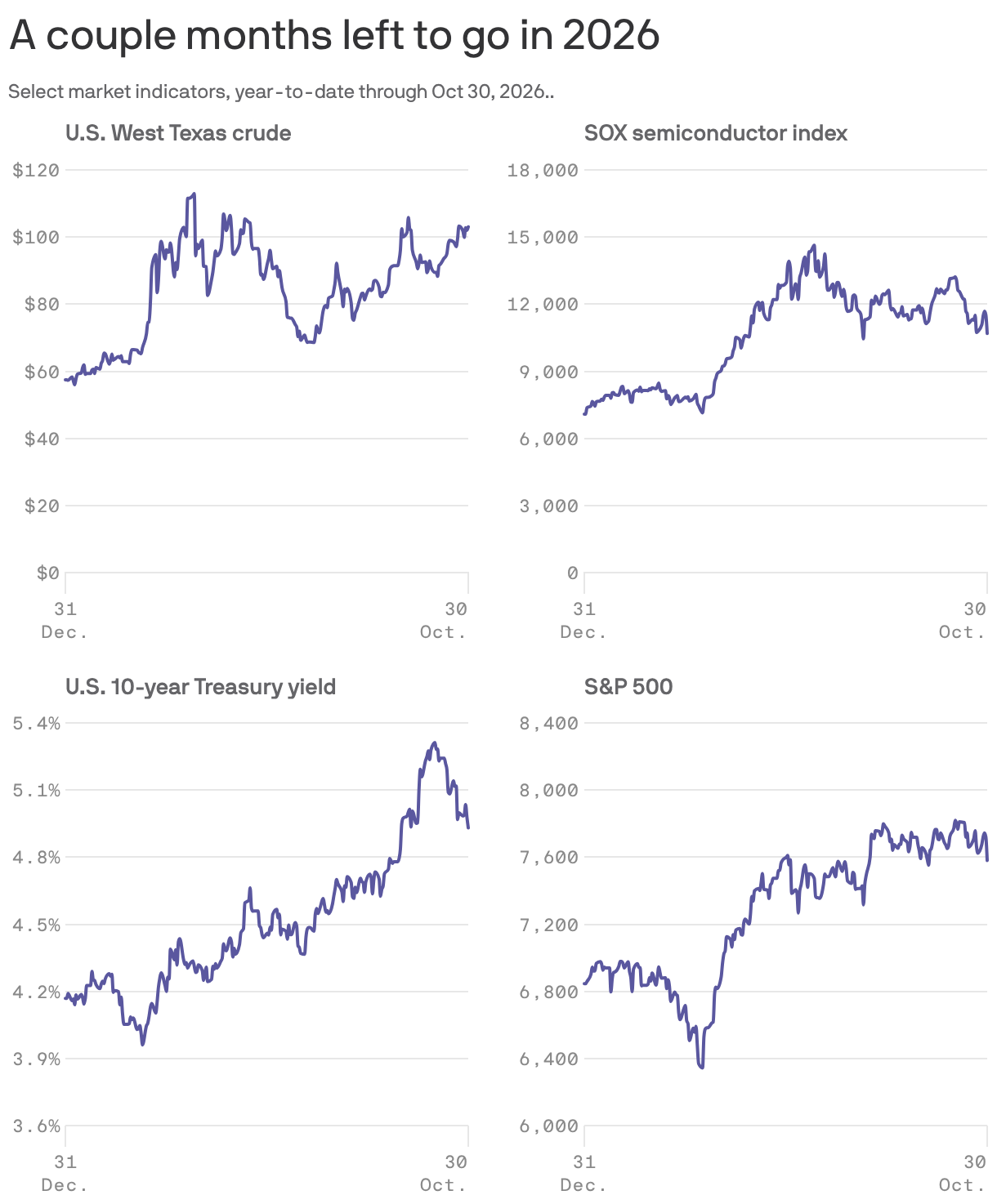
After another rough week for the AI trade, stocks seem to be bracing for more uncertainty in the days ahead.
Why it matters: While the AI trade has sputtered, the S&P 500 has managed to largely tread water thanks to strength from shares tied to the basics of the economy, like consumer staples, health care and utilities. (Soaring oil shares didn't hurt either.)
- But Tuesday's U.S. midterm elections and the potential reescalation of major fighting in the Iran war after the vote pose another potential hurdle to the market.
The latest: The S&P 500 finished October with a price decline of just less than 1%, a far better showing than the Nasdaq 100, which dropped by more than 6.7%.
- The SOX semiconductor index dropped more than 15% in October.
The other side: Investors' moves toward safety limited the impact on the S&P 500.
- The S&P consumer staples sector surged 11.4%.
- S&P 500 health care shares rose 9.8%, in part, pricing in a strong Democratic showing that could boost federal funding for the sector.
Context: But the looming vote could also pose headwinds for sectors.
- Tech companies are positioning for a shift in the regulatory winds coming out of Congress, for example, boosting lobbying strategies toward influencing Democrats.
- Additional scrutiny of the giant tech companies leading the charge — even if a Republican White House continues to make legislation unlikely — could be an overhang on the sector.
- Meanwhile, reports the U.S. could restart heavier attacks on Iran after the elections raise the risk of rising fuel prices and weaker spending from price-sensitive Americans.
What to watch: "Trump's and Democrats' and Iran's 'reaction function' to the midterm results holds the key," Julian Emanuel, equity strategist with Evercore ISI, wrote in a report on Friday.
- "Will it be the 'sudden impact' of a deal with Iran or a 'kinetic escalation' that spikes oil to a price high enough (over $120 for a month or a 'superspike' to $147), to stress the economy, stress credit and derail the equity bull?"
