Palantir loses its wow factor

Add Axios as your preferred source to
see more of our stories on Google.
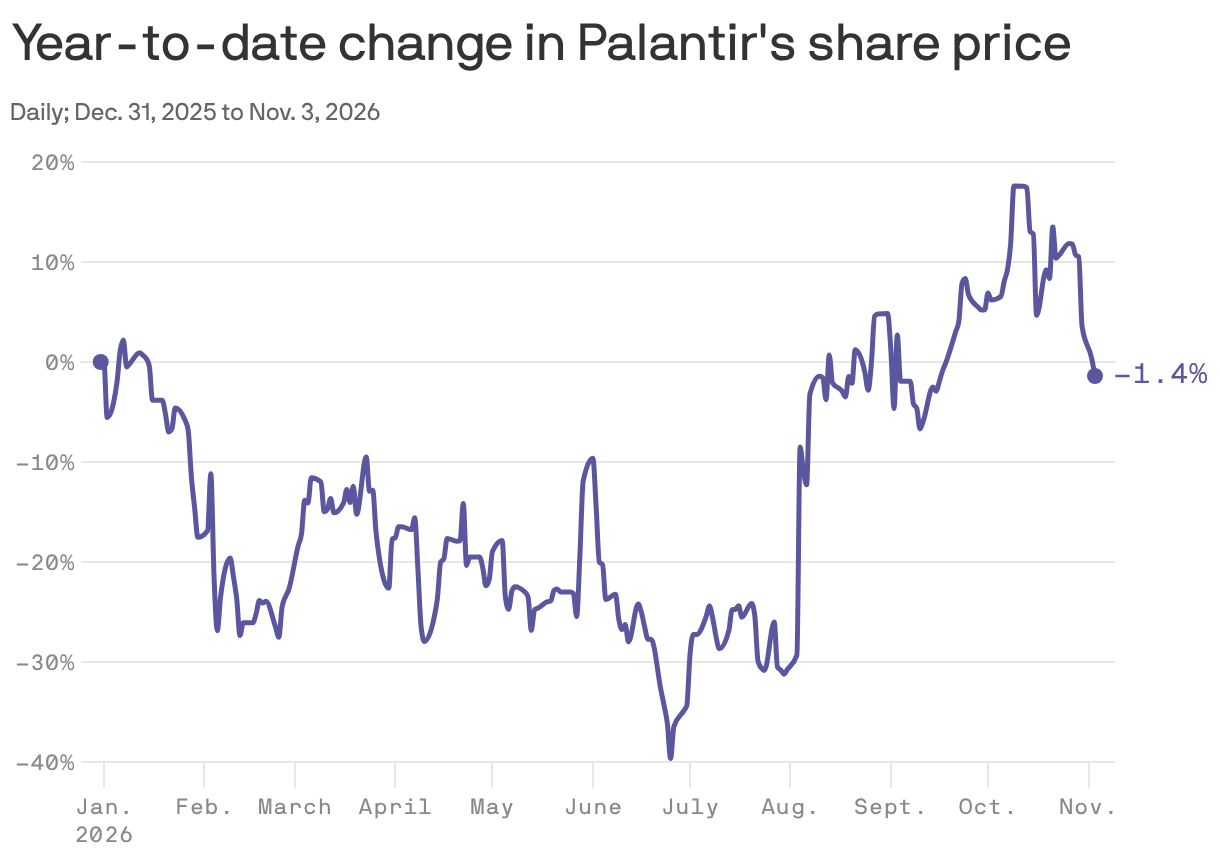
Palantir Technologies, the AI-driven analytics platform known for its work for the military, reported better-than-expected quarterly sales and earnings and raised its full-year sales guidance, yet still its stock slumped.
Why it matters: Such a lackluster response to an erstwhile favorite of retail traders underscores how investor psychology has shifted from the FOMO-fueled run-up between 2023 and 2025 to today's gnawing concerns about the durability of the AI boom.
The big picture: In recent years, the AI software company had been one of the top gainers in the S&P 500, which Palantir joined in September 2024.
- Its shares rose roughly 340% in 2024 and 135% last year, riding a combination of retail enthusiasm, AI-related optimism, interest in military technology and its perceived advantages of connections to the Trump administration. (The company's co-founder, chairman and top individual shareholder is billionaire Republican megadonor Peter Thiel.)
Yes, but: Palantir's roughly 2,000% increase in its stock price over the last four years vastly outpaced the company's actual fundamentals, resulting in valuation metrics that ranged from the extreme to the arguably lunatic.
- Palantir's forward price-to-earnings ratio peaked at 255 times in November 2025 and was over 100 times well into this year.
- A fairly valued company is traditionally considered around 15 times. The S&P 500 is currently about 18.5 times.
Palantir's forward price-to-sales multiple, meanwhile, topped out at more than 90 times in November 2025.
- For those not accustomed to these kinds of measures, that is mind-blowing.
- As a point of comparison, the S&P 500 currently has a forward-price-to-sales ratio of 3.1 times.
Between the lines: Then a funny thing happened. Palantir really started delivering the goods, financially speaking.
- Earnings per share jumped 64% in 2024, 83% in 2025, and they're expected to rise 122% when 2026 is done and dusted.
- Sales accelerated too, rising 29% in 2024 and 56% in 2025. They are expected to jump 89% this year.
- There's more. Margins expanded, as did backlogs. Costs stayed in check. Palantir's U.S. commercial division, focused on selling software to help companies use AI more productively, saw sales soar.
Zoom in: Analysts say one blemish on Palantir's third-quarter numbers — which it released Monday after the close — was that its order backlogs were largely flat quarter over quarter.
- That might seem a small nit to pick. But it touched a nerve for investors increasingly concerned about the sustainability of the AI trade.
What they're saying: "Over the past three months, tech investors have placed greater scrutiny on the results of companies across the AI ecosystem," wrote Louie DiPalma, who covers Palantir for the brokerage firm William Blair.
- "The valuations for many AI supply chain providers have been cut in half on concerns that recent growth is unsustainable."
- Likewise, Brent Thill, who covers Palantir for Jefferies, noted that "the debate is increasingly about sustaining acceleration against a larger base, rather than whether underlying demand remains strong."
The bottom line: None of this means that Palantir is troubled. In fact, just the opposite: The company has done so well that it has become harder and harder to wow the market, or as Thill puts it, "comps keep getting tougher."
- But it also suggests a subtle shift among the investing public toward caring about the realities of the present, rather than seeing only limitless AI upside ahead.
