Scoop: Trump asked Netanyahu to move on Gaza peace plan in post-election call

Add Axios as your preferred source to
see more of our stories on Google.
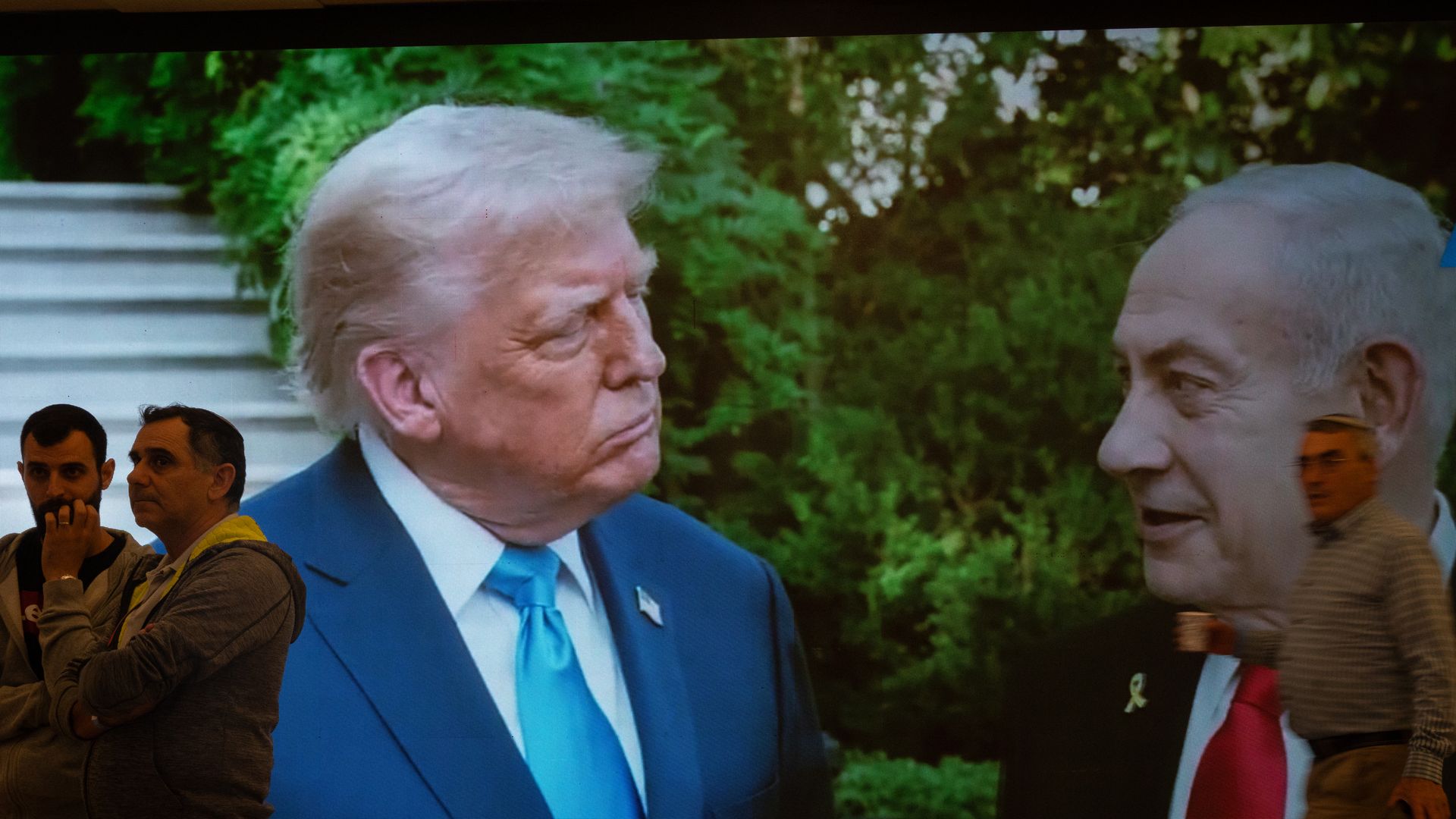
People stand in front of an electronic screen showing the face of Trump and Israeli Prime Minister Benjamin Netanyahu on Oct. 27 in Jerusalem. Photo: Chris McGrath/Getty Images
President Trump told Israeli Prime Minister Benjamin Netanyahu during a phone call Thursday that he wants him to take steps to implement his Gaza peace plan, according to two sources with knowledge of the matter.
Why it matters: The roadmap calls for disarming Hamas and demilitarizing Gaza, as well as transferring responsibility for governing the enclave to a new Palestinian technocratic government. But it has been on hold for months because of the Israeli elections held on Oct. 27.
- The Trump administration did not want implementation of the plan to become a politically explosive issue during the Israeli election campaign.
- Trump endorsed Netanyahu shortly before the election. Now that it's over, the president wants to forge ahead with his Gaza plan, regardless of whether Netanyahu or his opposition forms a new government.
Catch up quick: A year ago, Israel and Hamas agreed to the first phase of Trump's 20-point plan, which led to a ceasefire in the Gaza war and the release of the last 20 living hostages taken during the Oct. 7, 2023 attacks.
- Trump's Board of Peace, which was established as part of the Gaza agreement, has been working for months on an implementation plan that includes the establishment of a Palestinian technocratic government and an International Stabilization Force.
- Last July, the Board of Peace reached an agreement with Hamas on a 15-point plan to disarm the armed groups in Gaza and transfer civilian and security control to the new Palestinian technocratic government.
- Since then, Netanyahu's government has largely refused to move forward with implementing it, mostly for domestic political reasons.
- In an August visit to Israel, Trump adviser and son-in-law Jared Kushner told Netanyahu that Hamas for the first time had agreed to disarm. He urged the Israeli prime minister to take steps to test whether that commitment was real.
- Netanyahu was and still is extremely skeptical that Hamas will ever demilitarize. He says the group is reconstituting and rearming in Gaza.
Zoom in: Over the past three months, Trump's Board of Peace has been working with the Israeli government and military to refine details of the plan and address Israeli concerns about demilitarization in Gaza.
- A U.S. official said the process would be gradual. Reconstruction would only begin after progress in disarming Hamas had been verified.
- Trump's Board of Peace unveiled a six-month, $2.45 billion initial recovery plan for Gaza during the U.N. General Assembly in September.
- The 66-project proposal offers one of the most comprehensive roadmaps yet for what the early months of post-war recovery and governance in Gaza would look like.
- But for the plan to move forward, the Board of Peace needs Israel and Hamas to cooperate.
- A source with knowledge of the details said the Trump administration, Board of Peace and Israel agree that the plan remains the best way forward and that there is no credible alternative.
Behind the scenes: Secretary of State Marco Rubio as well as Kushner and Trump envoy Steve Witkoff also participated in the call between the president and Netanyahu.
- A source with knowledge of the details described the call, which Netanyahu initiated, as constructive. It also addressed the war in Iran.
- The White House and the Israeli prime minister's office did not immediately respond to requests for comment.
State of play: A day after the call, former British Prime Minister Tony Blair, who is a member of the Board of Peace, visited Israel.
- He met with Netanyahu and his opponent Gadi Eisenkot, who's been tasked with trying to form a new government to replace Netanyahu's.
- A source with knowledge of the visit said Blair urged Netanyahu and other Israeli political leaders to give the plan a chance.
What they're saying: "The implementation will be difficult but we believe it is a good plan for Israel. Nevertheless we can't do it with one hand tied behind our back," the U.S. official said.
- "We want to move forward collaboratively and we need full cooperation and partnership from the Israeli government," the person added.
