Where EVs are most common

Add Axios as your preferred source to
see more of our stories on Google.
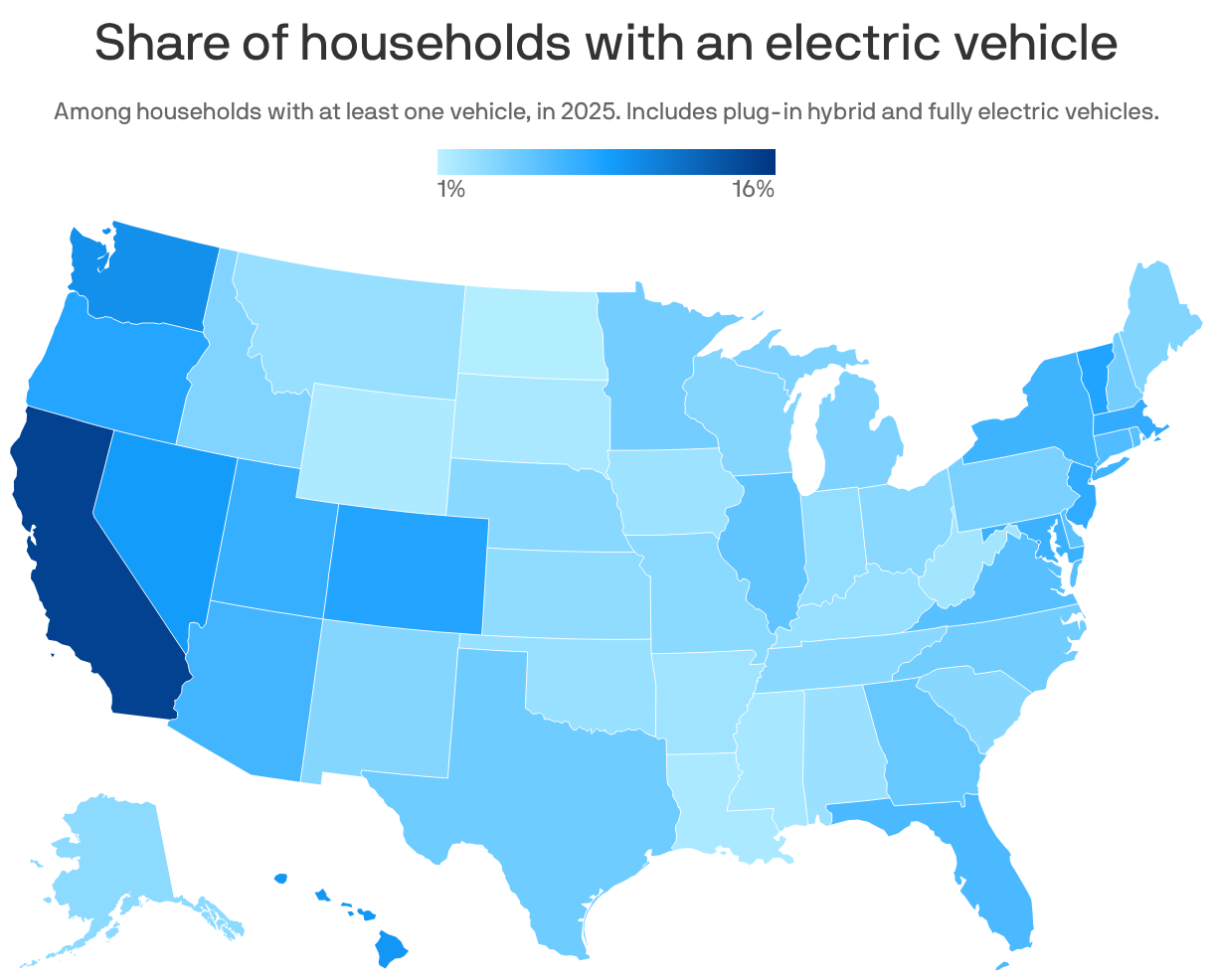
U.S. electric vehicle ownership is most concentrated in the West and in major metropolitan areas, according to an Axios analysis of newly released Census Bureau data.
Why it matters: Where EVs are taking hold will shape who benefits first from electric transportation, where charging networks expand, and how quickly the country's auto market shifts away from gas-powered cars.
By the numbers: About 6% of U.S. households with at least one vehicle had an all-electric or plug-in hybrid vehicle in 2025.
- California led the way at 15%, more than double the national rate.
- Washington (9.6%) and Hawaii (9.1%) rounded out the top three states, followed by Nevada (8.8%) and Vermont (8.1%).
- North Dakota (1.4%), Wyoming (1.7%) and Louisiana (1.8%) were among the states with the lowest shares.
Zoom in: California's commanding lead reflects decades of policies encouraging EV purchases and requiring automakers to offer electric models. The state began adopting zero-emission vehicle requirements in 1990.
- The state accounted for nearly 30% of U.S. zero-emission passenger vehicle sales in 2025, despite having 12% of the nation's population.
Zoom out: EV ownership is especially concentrated in major metropolitan areas.
- In the Austin metro area, for example, that share was 9.3%, more than double the Texas statewide rate of 4.5%.
- San Francisco stood at 20%, a high-end number in the EV-rich Golden State.
- Research has linked higher EV adoption around population centers to household income. And another study found that, particularly in higher-income areas, establishing charging infrastructure boosts adoption.
What we're watching: How adoption changes after 2025, the first year the Census asked about EV ownership.
