Jeffries changes tactics ahead of House Dem speaker vote

Add Axios as your preferred source to
see more of our stories on Google.
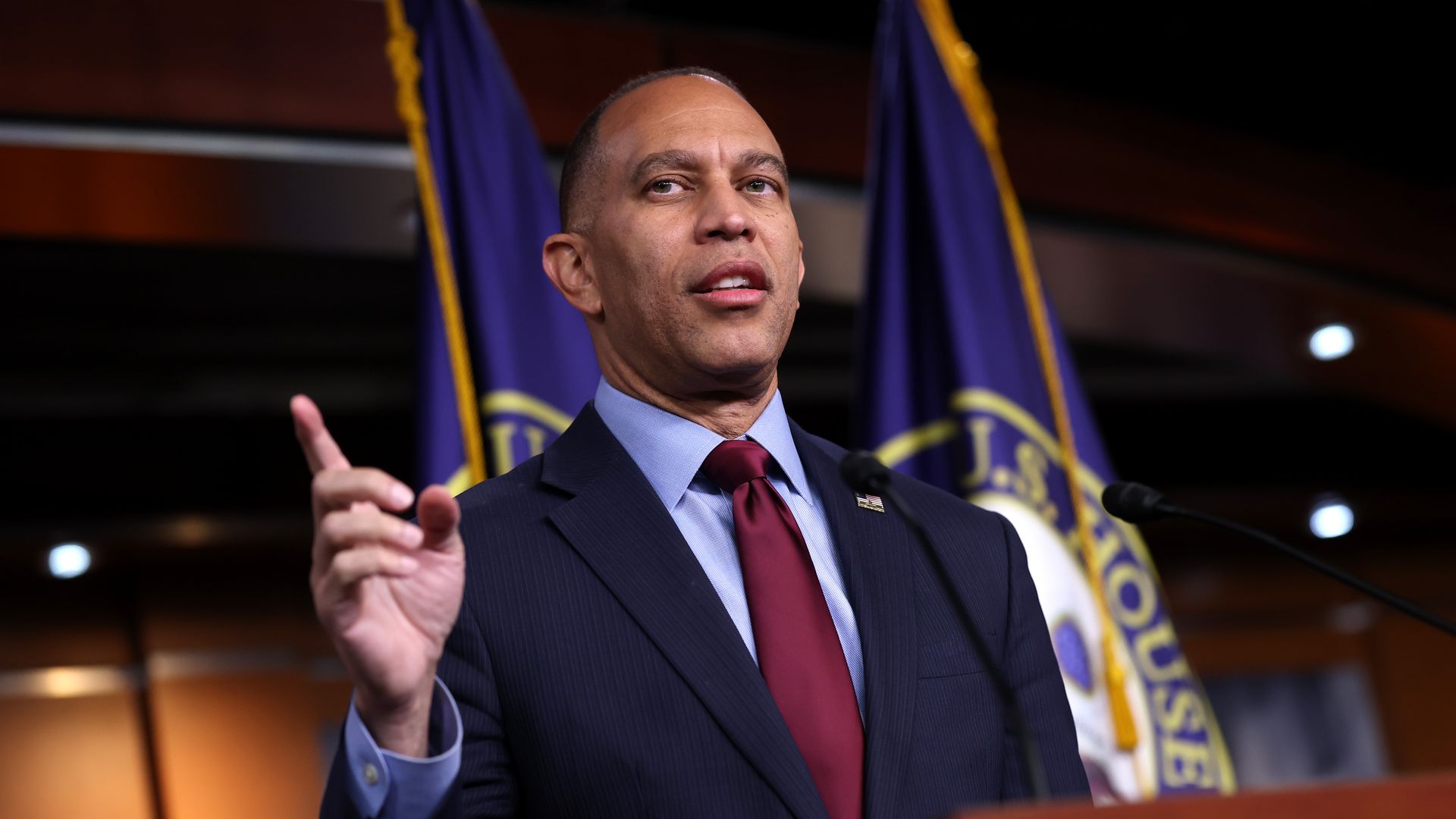
House Minority Leader Hakeem Jeffries speaks at a press conference at the U.S. Capitol on Nov. 9. Photo: Kevin Dietsch/Getty Images
House Minority Leader Hakeem Jeffries (D-N.Y.) plans to force his members to take a tallied vote this week on whether to nominate him as speaker of the House, according to two sources familiar with the matter.
Why it matters: The plan represents a shift in tactics — his allies had previously hoped to nominate him by acclamation — that would help reveal whether he has the votes to become speaker on Jan. 3.
- If he loses more than 40 votes, he may be in trouble. If not, he likely sails through even if some of his members ultimately oppose him on the House floor.
- Jeffries and his allies are confident he has more than enough support to get the 218 votes needed to become speaker even as some of his freshman members express skepticism or even outright opposition to him.
- "Jeffries will win," a senior House Democrat told Axios.
Jeffries' plans were first reported by Punchbowl News.
Between the lines: This new strategy would exploit the fact that, as of Tuesday, no other House Democrat has announced their candidacy for speaker.
- Rep. Jamie Raskin (D-Md.), who is often floated as a possible alternative in constituent phone calls to lawmakers urging them not to back Jeffries, told Axios he is not running for speaker.
- Rep. Ayanna Pressley (D-Mass.), who has become the focus of a recent draft movement, has also told allies she is not interested in the role, as Axios previously reported.
- Pressley, asked about running for speaker at a town hall event in her district on Monday, told attendees: "I do not need to be the speaker of the House to speak for the people."
State of play: House Democrats are set to meet behind closed doors starting Wednesday morning to elect their leadership team for the 120th Congress.
- In addition to nominating a candidate for speaker, they are set to vote on electing a House majority leader and whip, an assistant speaker, and a Democratic caucus chair and vice chair, among other leadership positions.
- Most of the candidates for those senior roles are running unopposed and are still expected to be elected by voice vote because "people don't want long votes," said the senior House Democrat.
- Any recorded votes would still be secret ballots, unlike the Jan. 3 speaker vote in which members must stand on the floor and announce their choice.
