Exclusive: HEO unveils new space intel platform

Add Axios as your preferred source to
see more of our stories on Google.
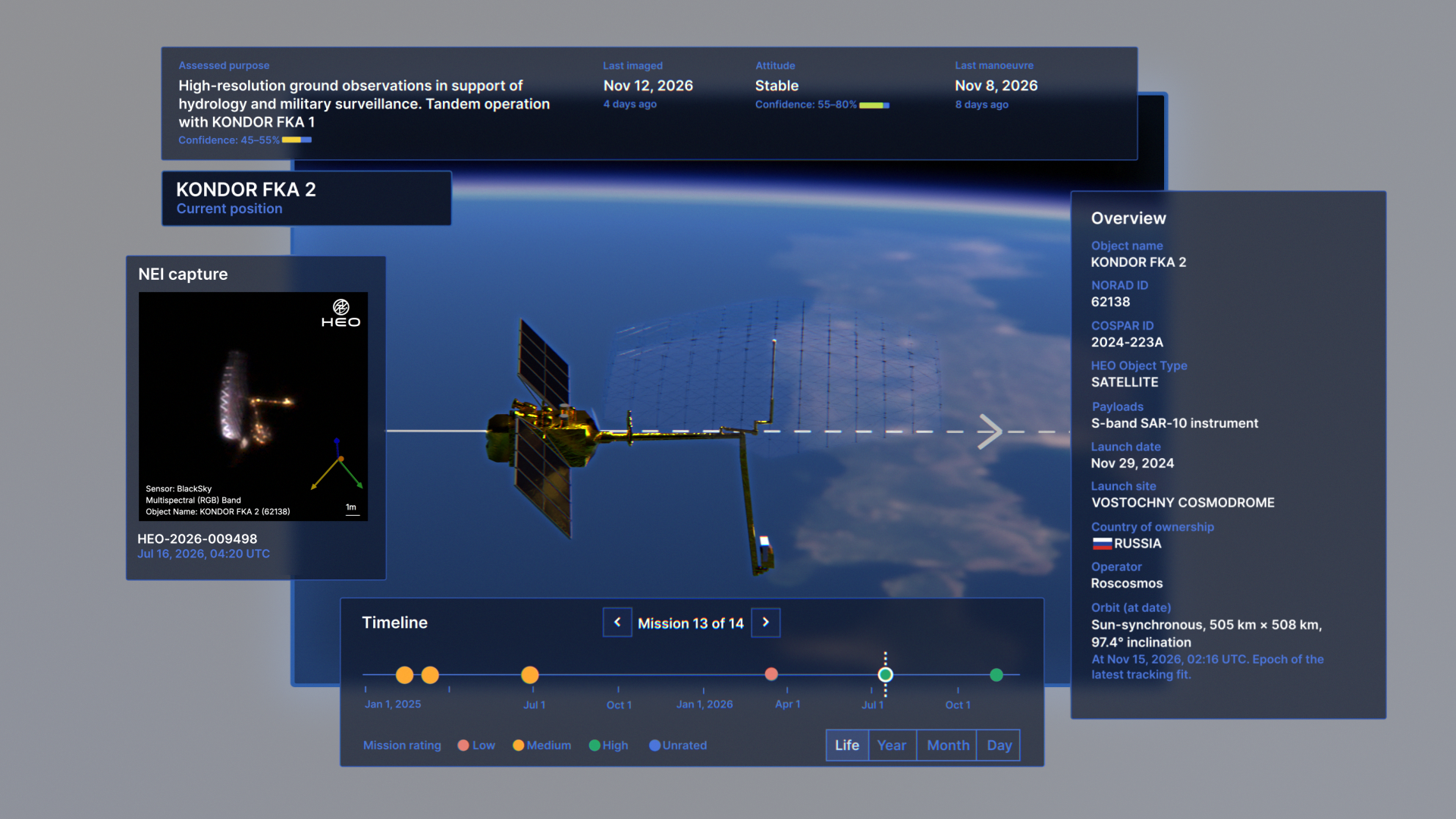
HEO's new Insights Next platform aims to be the "Google Maps" of outer space intelligence. Photo: Courtesy of HEO
HEO, an Australian company, has been taking thousands of images of objects in orbit and has woven them together in a new space intelligence platform, Axios has learned.
Why it matters: As space warfare looms, countries need to be able to track potentially hostile activities in orbit to protect their military and commercial satellites from interference or attack.
- In October, an orbital showdown between a Russian spacecraft and a U.S. ICEYE satellite illustrated why keeping a close eye on space is crucial for emerging conflicts.
What he's saying: HEO's CEO William Crowe told me the firm has sensors and software that can be used with maneuverable imaging satellites to capture detailed photos of spacecraft, akin to orbital paparazzi.
- "We've got sensors in all different orbits that can look at objects at different angles," Crowe said. "Now, there's really nowhere to hide."
- Crowe said HEO's customers wanted to gather even more intelligence and information from those images, which led to the creation of the firm's new Insights Next platform.
How it works: Think of it like "Google Maps" for space. Using information from 7,500 imaging missions across 1,200 unique objects, HEO has put all the data into its Insights Next platform.
- Users can see what was once a 2D image of a satellite as a 3D model.
- It also shows a satellite's "position relative to Earth, orientation, dimensions, payload configuration and pointing direction," according to HEO.
- HEO said the platform allows total inspection of a satellite to see how it operates, what its purpose might be and whether its orbit or behavior changes.
Follow the money: HEO is growing.
- In September, the Australian space firm raised $25 million in Series B funding to expand its imaging capabilities from low-Earth orbit to a much larger geostationary orbit.
- HEO's imaging has also supported a wide range of U.S. and allied militaries, including the U.S. National Reconnaissance Office, the Australian Department of Defence, Japan's Ministry of Defense and the U.K. Space Agency, the firm said.
The bottom line: Crowe told Axios that the ability to closely monitor space activity will reveal the rapid pace of military space developments.
- "The craziest is definitely still yet to come," Crowe said.
