AI's spending slowdown

Add Axios as your preferred source to
see more of our stories on Google.

Illustration: Brendan Lynch/Axios
The AI trade has entered uncharted territory as stocks limp to the end of an astonishing month.
The big picture: An important new reality for AI emerged in the just concluded third-quarter earnings season that has been overshadowed by the midterm elections, Jensen Huang and the Anthropic IPO.
Zoom in: Wall Street analysts covering the hyperscalers didn't ratchet up forecasts for further capital investment by Amazon, Alphabet, Microsoft, Meta and Oracle — the biggest spenders of the AI data center boom.
- That's a change from recent trends, seen in the chart below, where tech giants regularly announced shocking amounts of planned AI investment as part of quarterly results.
- Those announcements would lead Wall Street analysts to increase their estimates, and the capex line would spike up and to the right.
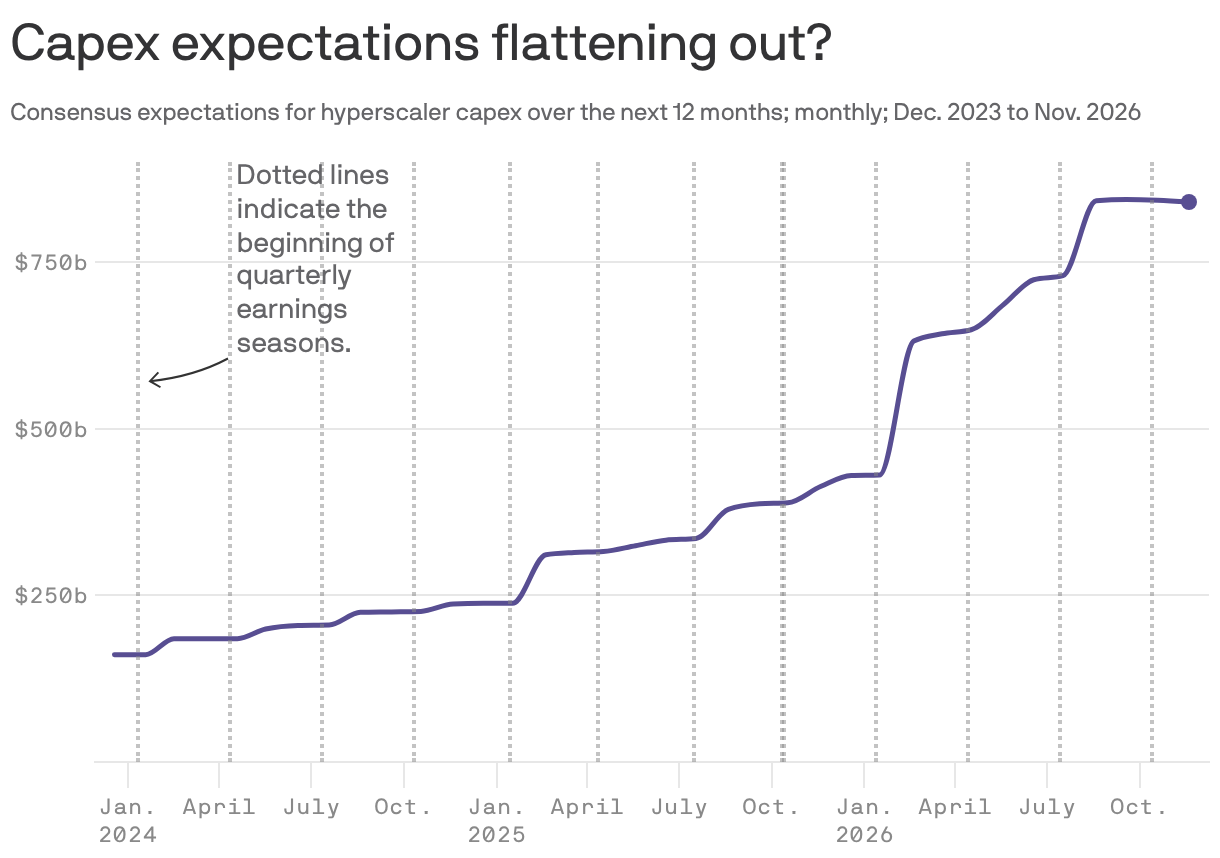
Reality check: This flatlining trend is huge.
- That wave of hyperscaler investment into data centers is also the source of giant profits that other companies — construction and engineering firms, merchant power providers, fiber-optic cable makers and, of course, makers of chips and memory devices — have been raking in from the boom.
- The AI investment gravy train has driven levels of S&P 500 earnings growth and overall corporate profitability to remarkably high levels.
Threat level: Slower capex will curb profits for the "picks-and-shovels" AI stocks that delivered some of the most astonishing gains of the AI boom.
- That's not necessarily a disaster: Analysts are expecting a more-than-respectable 16.4% increase in earnings for the S&P 500 next year.
- But it's clearly a sharp slowdown from earnings-per-share growth of nearly 35% that Wall Street thinks we'll end up with in 2026.
What they're saying: "We think the nature of the market environment is shifting a bit away from this sort of constantly higher capex numbers," David Lefkowitz, head of U.S. equities at UBS Global Wealth Management, told Axios last week, adding "We need to see the monetization at the AI layer, because that's ultimately who's paying for all this capex."
What we're watching: As Lefkowitz says, we're watching for clear, conclusive proof that there's serious money to be made from AI — aside from selling equipment used to build data centers. We haven't seen it yet.
The bottom line: Slowing future earnings expectations, expected Federal Reserve interest rate hikes and the chance of increased AI regulation have the market on edge.
