The "bank of AI" is back in business

Add Axios as your preferred source to
see more of our stories on Google.
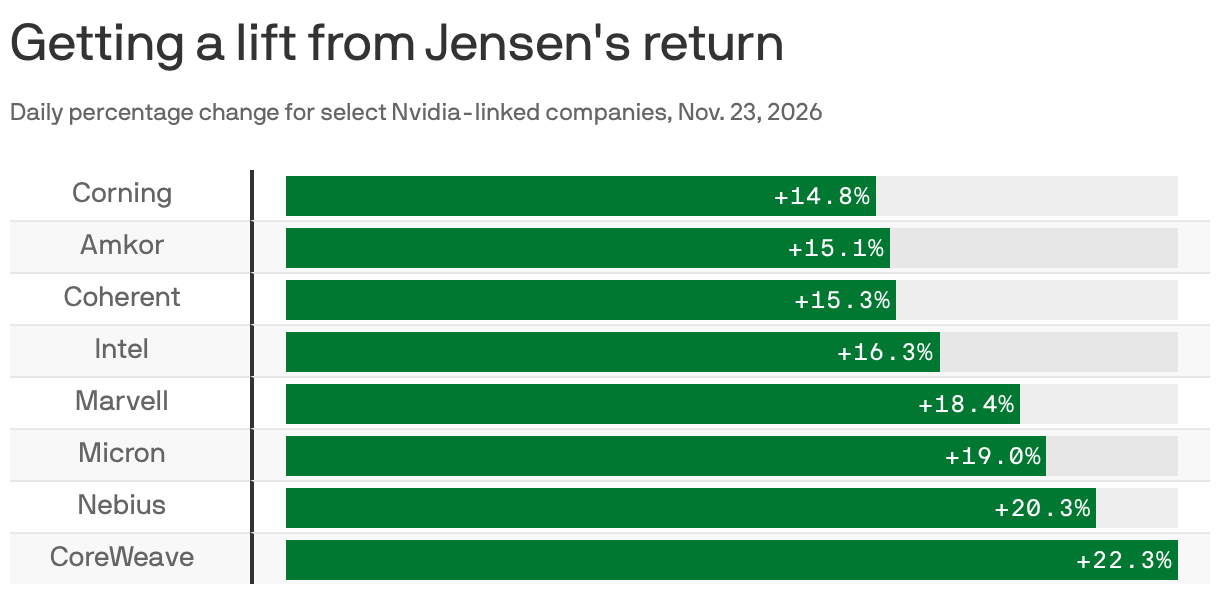
AI players that have been supported by Jensen Huang's willingness to finance, invest and otherwise backstop the AI ecosystem soared on his return.
Why it matters: Their surge highlights Nvidia's role as the linchpin of the AI trade that has powered the market in recent years.
State of play: Money-losing neoclouds CoreWeave and Nebius — large purchasers of Nvidia processors in which Nvidia also happens to own significant stakes — soared 22.3% and 20.3%, respectively.
- Corning and Coherent also had huge days. They make fiber-optic cable connectors and other equipment needed to link servers inside data centers. Both have billions of dollars of financial ties in the form of supply contracts and equity positions held by Nvidia. They jumped 14.8% and 15.3%, respectively.
- Struggling American semiconductor icon Intel, in which Nvidia bought a roughly 4% stake in late 2025, rose 16.3%.
- Amkor, a manufacturing partner of Nvidia's that packages its chips, gained 15.1%.
- Chip designer Marvell, which focuses, in part, on networking chips that help quickly move data around data centers and enable Nvidia's chips to do their calculations, leapt 18.4%. Nvidia owns a stake in Marvell.
Between the lines: During Nvidia's quarterly earnings report last week, Colette Kress, the chief financial officer then serving as interim CEO, emphasized how Nvidia's approach to such investments would be disciplined, rigorous and selective.
- "Some of the language and commentary along those lines did sound a touch more measured to our ears," Bernstein analyst Stacy Rasgon wrote in a note summarizing the company's results.
Context: Nvidia potentially stepping back, or being more rigorous, about its investments is a big deal, as the types of companies it has often supported — like the neoclouds — have found it increasingly difficult to borrow money in bond markets, potentially curtailing their ability to keep building data centers (and buying Nvidia chips).
The bottom line: But with Monday's news, traders seemed to signal they see few external limits to Huang's willingness to serve as the "bank of AI" that can backstop some parts of the AI ecosystem.
- In other words, weaker AI companies again have a deep-pocketed booster with almost unchecked power to decide how he will use Nvidia's financial reserves — which belong to shareholders — as he sees fit.
- What's more, because his remarkable return was an explicit project of President Trump, one could argue that Huang may be even more untouchable than he was before — at least for the next couple years.
- So is that a good thing? Well, it's an open question.
- In recent weeks, we've learned Huang's judgment really isn't perfect.
