What bonds are telling us about the AI trade

Add Axios as your preferred source to
see more of our stories on Google.
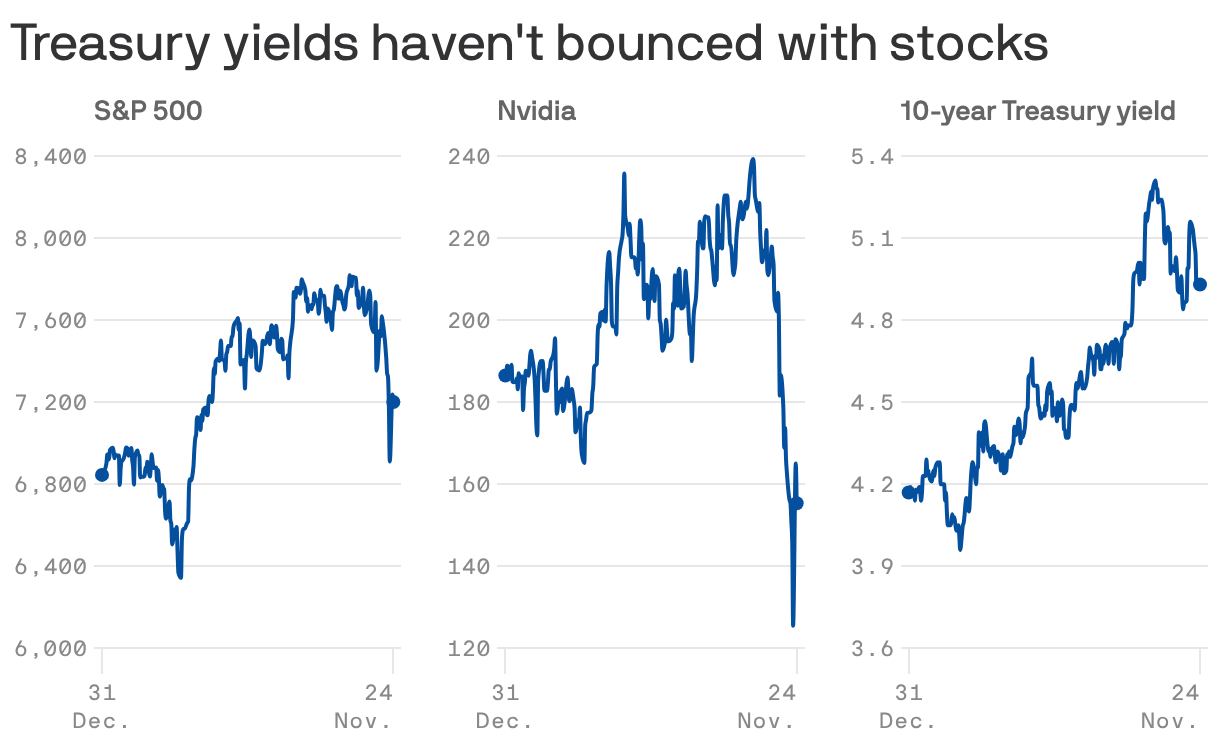
While stock market participants were wildly celebrating the return of Jensen Huang to the corner office of Nvidia, bond investors were playing it cool.
Why it matters: That jarring contrast at the start of the week was what poker players might call a "tell" — showing that concerns about the financial realities of the AI boom continue to gnaw at investor confidence.
Catch up quick: AI-related stocks — neoclouds, server makers, optical cable-smiths, memory chip mavericks and hyperscalers — tumbled again Tuesday after Monday's remarkable rip.
- Nvidia, which jumped 31.5% Monday, gave back a chunk Tuesday with a 5.9% drop.
The big picture: When it becomes difficult to discern a clear signal from such Wimbledon-worthy back-and-forth in stocks, it can be helpful to check how the bond markets see things.
Zoom in: Normally, on a day when the S&P 500 is up almost 5%, as it was Monday, you see money leave the safety of bonds to join the party, pushing bond prices down and bond yields — they move in the opposite direction — up.
- But in the government bond market, the yield on the U.S. 10-year Treasury note, for example, moved higher by less than a single basis point. (That's bondspeak for one one-hundredth of a percentage point.)
- In the corporate bond market, meanwhile, there were no signs that traders were feeling as exultant about Huang's return and what it meant to the AI trade.
Case in point: Just look at CoreWeave. The troubled neocloud's stock price soared 22.3% Monday, but the price of its bonds coming due in 2031 actually fell, pushing yields up 20 basis points to 16.57%, according to Tradeweb data. (That suggests traders were viewing those bonds as even riskier, despite all the happiness in the stock market.)
- CoreWeave's bond yields continued to push higher Tuesday, clearing 17%.
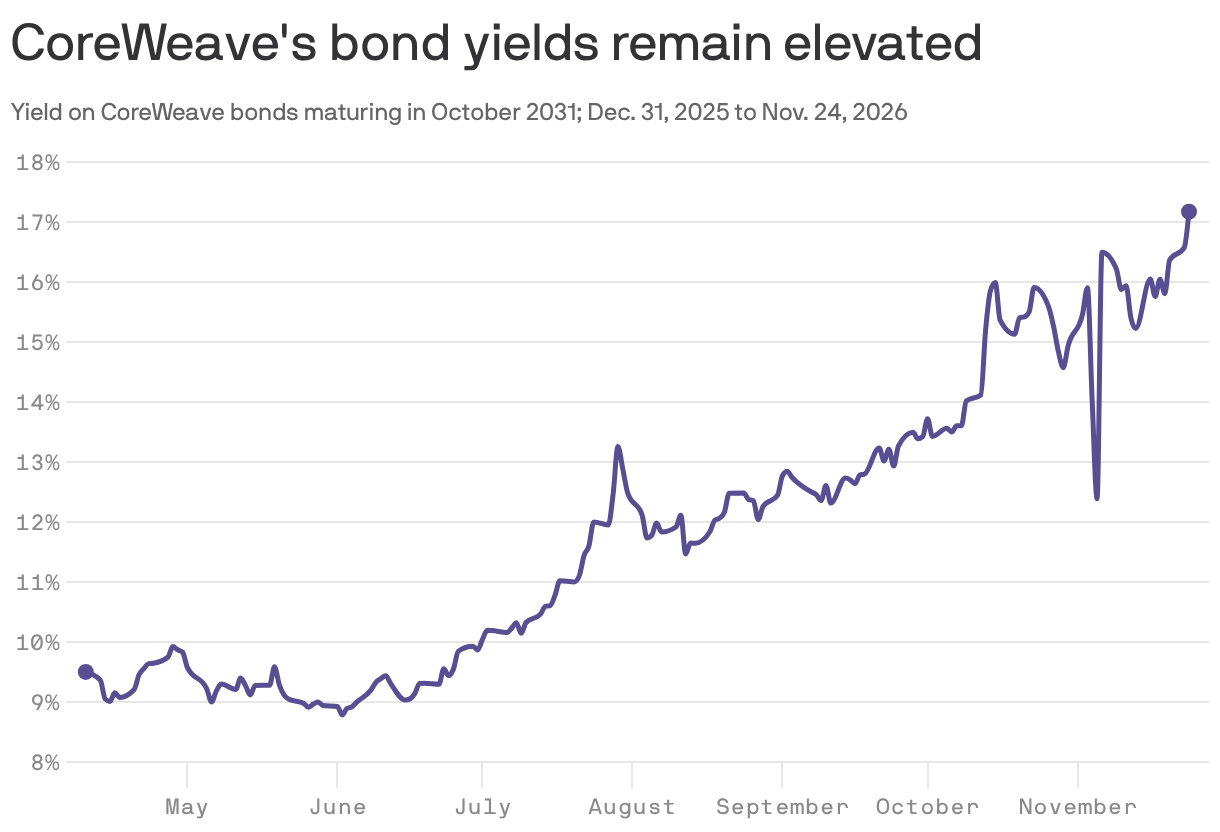
What they're saying: The bond market's concern is specifically about AI and how much more bond market borrowing will be needed to keep the buildout going.
- "Credit investors are paying for diversification away from AI-related debt," wrote Lotfi Karoui, a multi-asset strategist at the giant money management firm Pimco.
How it works: Stocks represent an ownership share in a company. But bond investors own debt, not companies. That is, they effectively lend companies money in the hope of getting paid back with interest.
- This fundamental fact has been said to shape the profoundly different character of the two markets.
- Stock markets are often said to be overly excitable and prone to become enamored with overly rosy visions of the future and of the profits a company could make.
- Bond investors, by contrast, are more concerned with downside risk, that is, what could drive a company into default and keep investors from getting paid back.
- They're not focused on the long-term upside of a company because after they get their interest payments and capital back, they won't benefit from the company's bright future.
The bottom line: The fact that down-to-earth bond investors stayed relatively leery of AI exposure, even as stocks soared to start the week, also helps explain why Monday's big rally fizzled the next day.
- Huang's return as Nvidia CEO does nothing to resolve the questions of financial sustainability and profitability that are increasingly nagging at investors four years into the boom.
