Glen Canyon Dam turns 70

Add Axios as your preferred source to
see more of our stories on Google.
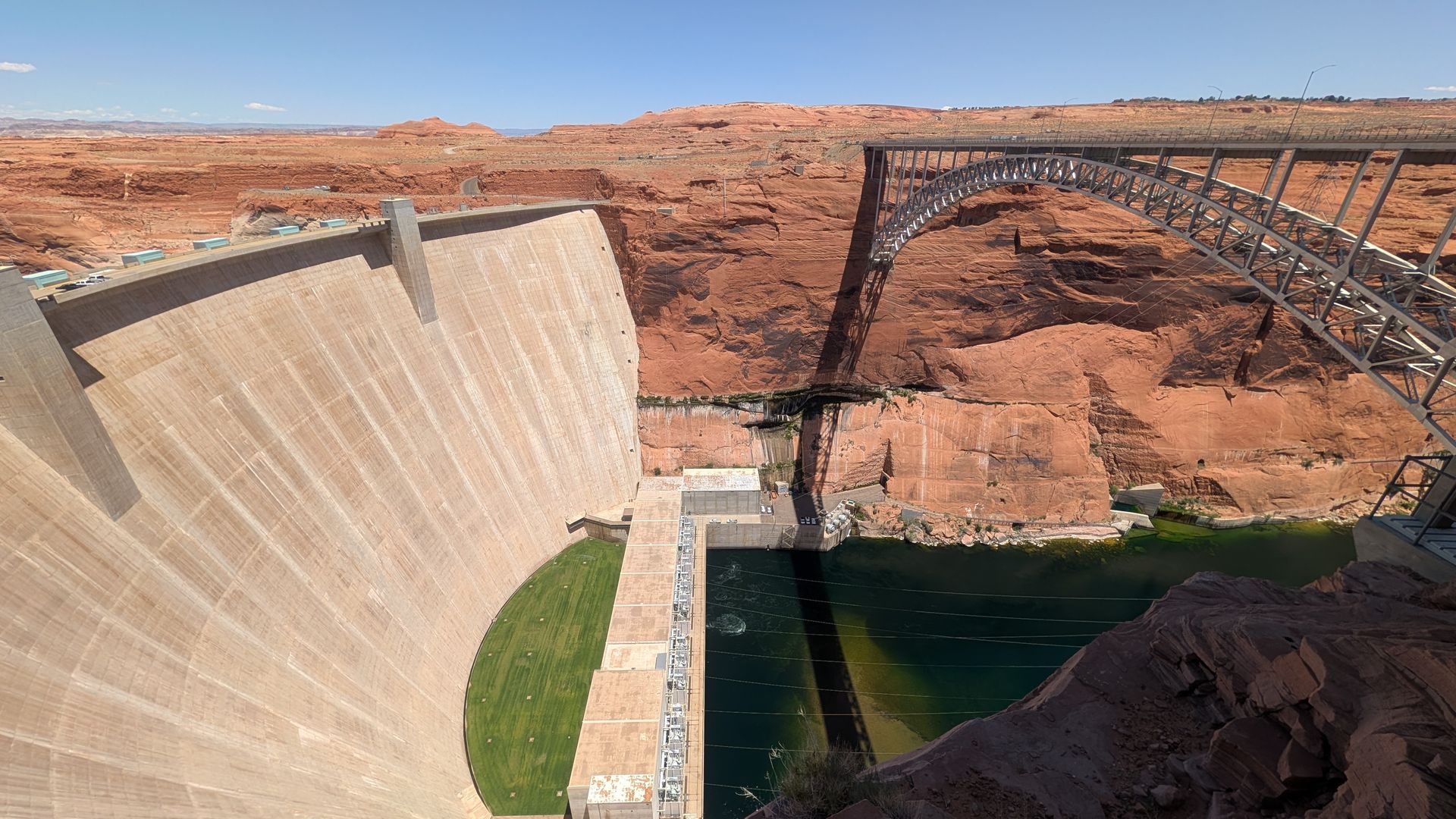
The Glen Canyon Dam. Photo: Erin Alberty/Axios
With a remote-activated dynamite blast triggered from the White House, former President Eisenhower officially broke ground on the Glen Canyon Dam 70 years ago this week.
- This is Old News, where we survey Utah's shorelines as the waters of time recede.
Why it mattered: The dam was one of the most controversial developments in the modern West.
- It advanced water storage and electricity production in a region whose population has since exploded — but submerged a stunning canyon of huge archeological and environmental significance.
It also created Lake Powell, which draws more tourism than any of Utah's Big Five national parks.
Friction point: Drought and heat have thrown the dam — and the river it holds up — into crisis.
The latest: Lake Powell sat at 3,517 feet above sea level as of Friday, the lowest level for that date since the dam was completed in 1963.
- The combined storage of Lake Powell and Lake Mead last week was the lowest since before the dam's completion in 1957.
By the numbers: If the surface falls below 3,490 feet, the dam's turbines can't operate, which would affect power rates for nearly 6 million households in the West.
- 3,370 feet is "dead pool" — where the river stops flowing beyond the dam. That's an existential threat to the ecologies and economies of Nevada, Arizona and California.
Caveat: Upstream, Flaming Gorge can release more water if needed to stave off catastrophe.
Yes, but: That creates problems in northeast Utah and Wyoming, where Flaming Gorge is an economic engine that will struggle to function if the lake shore is nowhere near the marinas.
The bottom line: Human ingenuity can go a long way, but liquid still takes the shape of its container, its volume is fixed and mass can't be created or destroyed.