U.S. Supreme Court clears Texas' GOP-favored congressional map

Add Axios as your preferred source to
see more of our stories on Google.
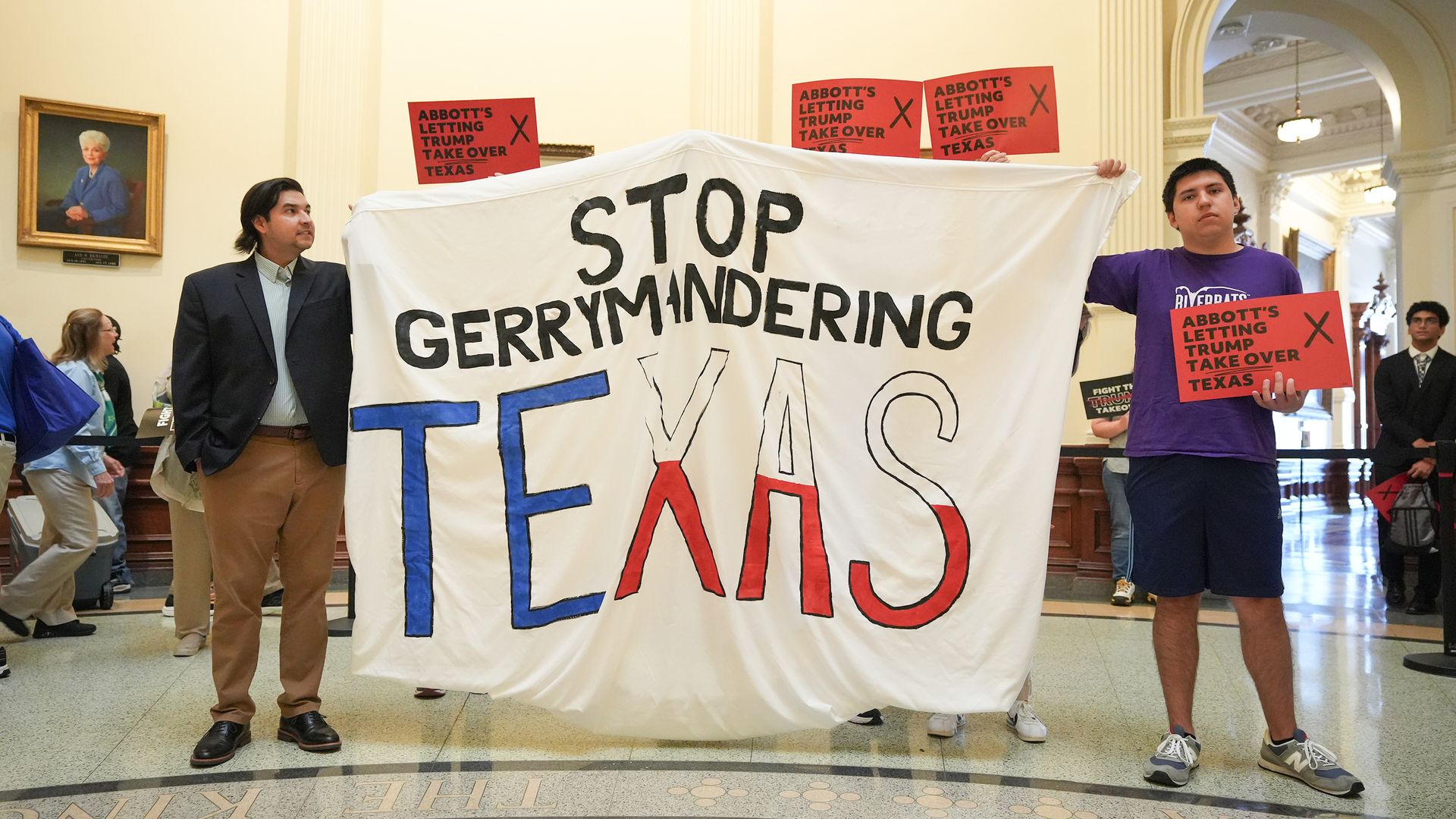
David Sanchez (left) and Christian Lopez (right) protest redistricting plans in Austin in August 2025. Photo: Jay Janner/Austin American-Statesman via Getty Images
The U.S. Supreme Court on Monday struck down a lower court ruling that blocked Texas from using its new congressional map favoring Republicans, with the high court cementing the new map that was already in use.
Why it matters: The ruling ends a lawsuit over the new map in Texas, the first state to begin what turned into a nationwide redistricting battle.
- Barring separate legal challenges, Texas' new map, which Gov. Greg Abbott signed in August 2025, can be used until lawmakers change it again after the next U.S. census.
Reality check: The ruling won't change anything for elections in Texas. The state held its midterm primaries in March, after the Supreme Court had given the go-ahead to use the new map.
State of play: Several lawsuits, including one filed by the League of United Latin American Citizens, had challenged the new Texas map on the basis that it was racially discriminatory.
- Redistricting based on politics is legal, but racial gerrymandering is not.
Catch up quick: In November, a panel of three federal judges temporarily blocked the new congressional map from going into effect in Texas, saying there was "substantial evidence" it was "racially gerrymandered."
- In December, the Supreme Court allowed Texas to use the new map for the primaries. Monday's ruling keeps that decision in place.
The latest: Liberal justices Sonia Sotomayor, Elena Kagan and Ketanji Brown Jackson dissented in Monday's ruling.
Context: States typically redraw congressional maps once a decade after the U.S. census to account for changes in population. Doing so mid-decade at the request of a sitting president was unprecedented.
What they're saying: "This was an intentional effort to limit the power of people of color," Damon Hewitt, president and executive director of the Lawyers' Committee for Civil Rights Under Law, said in a statement Monday.
- "It is one of the most blatant examples yet of modern-day racial gerrymandering, under the thin guise of partisanship."
State Rep. Gene Wu (D-Houston), who led Texas Democrats in leaving the state last year to delay a vote on the new map, said in a statement Monday that they were successful in bringing attention to Texas' redistricting.
- "Greg Abbott should not confuse this ruling for a victory ... California and Virginia have answered and leveled the playing field, and Democrats across the country are still fighting back."
The other side: Abbott did not immediately comment on Monday's Supreme Court ruling. In response to Wu's statement on X, Abbott wrote, "Cry harder."
- Abbott has said in the past that Texas lawmakers redrew the state's map to reflect conservative voting preferences — and nothing else.
The big picture: Texas kicked off a nationwide redistricting battle last year when it redrew its congressional districts in the middle of the decade at President Trump's request, as Republicans sought to maintain their hold on the U.S. House.
- But redistricting appears to have backfired for Republicans. With Virginia's vote last week to allow a new congressional map that leans Democratic, Republicans are now favored in fewer House seats than before they began redistricting.
Zoom in: In Texas, the GOP aims to pick up five seats. But Republicans have been leaning on gains among Hispanic voters that are showing signs of cracking, offering Democrats some hope.
What's next: All eyes are on Florida, where Gov. Ron DeSantis on Monday unveiled a new congressional map.
Editor's note: This story has been updated throughout with new information.