NASA Artemis II crew lands off San Diego coast

Add Axios as your preferred source to
see more of our stories on Google.
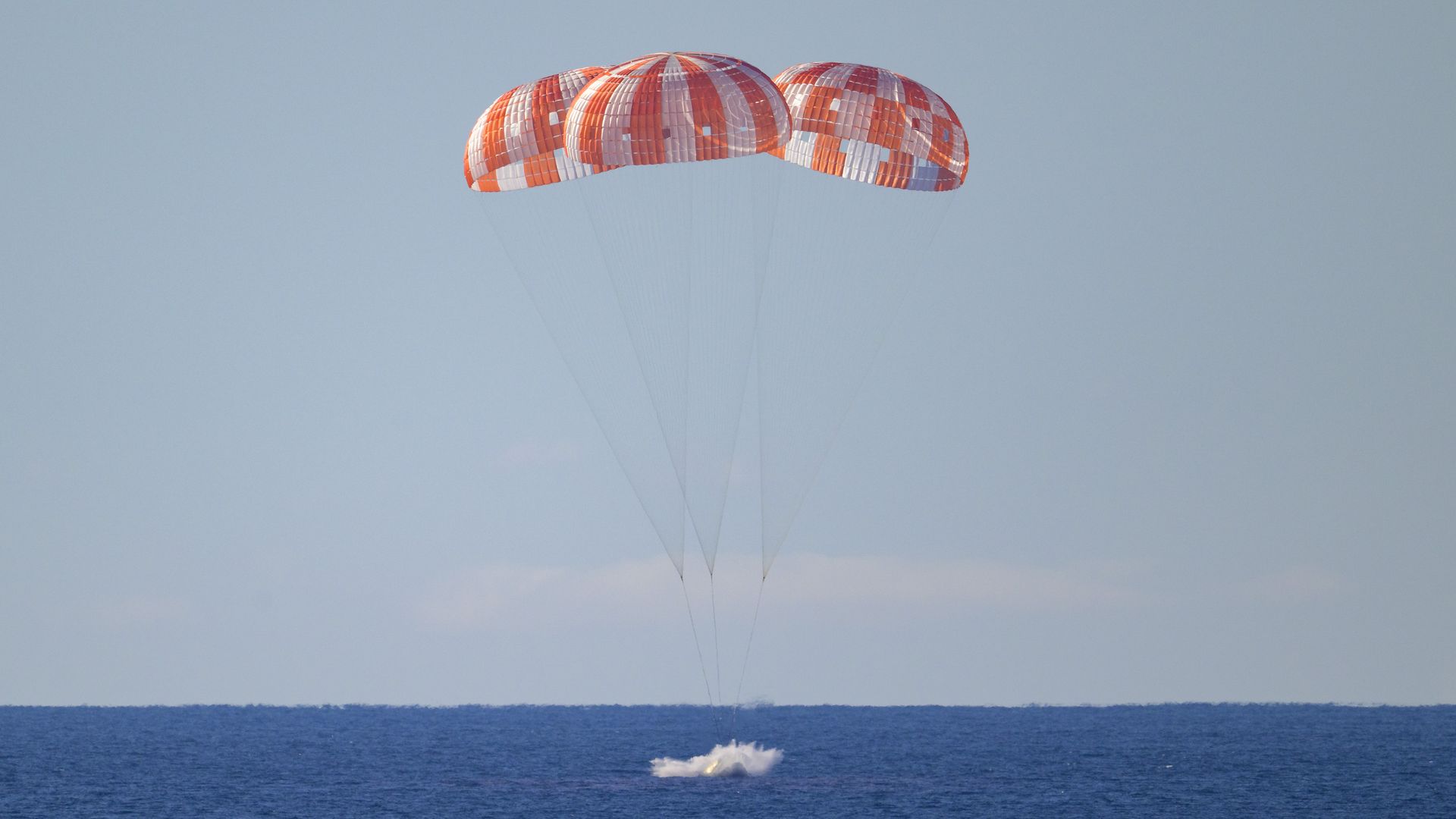
"A perfect bullseye splashdown," NASA officials said. Photo: Bill Ingalls/NASA via Getty Images
NASA's Artemis II crew is home from their historic spaceflight around the Moon.
Why it matters: The astronauts splashed down off the San Diego coast Friday night, completing a 9-day lunar fly-by that took them nearly 250,000 miles from Earth — the farthest humans have ever traveled.
- The mission was a test flight before NASA attempts to land on the Moon in 2028.
By the numbers: Within six minutes of breaking through the Earth's atmosphere, their Orion spacecraft (which the crew dubbed Integrity) reached its peak speed of 24,661mph – about 30mph short of the velocity record set by Apollo 10 in 1969, according to officials on NASA's live broadcast.
- The parachutes slowed the spacecraft down to 19mph when it splashed down.
- The blackout period immediately after re-entry with no communication between NASA in Houston and the astronauts lasted six minutes.
"A perfect descent," the NASA broadcaster said. "A perfect bullseye splashdown for Integrity and it's astronauts."
- "We are back in the business of sending astronauts to the moon," NASA administrator Jared Isaacman said after the splashdown. "This is just the beginning."
An elite U.S. Navy dive team will make first contact with the four astronauts and the spacecraft that reentered Earth's atmosphere and parachuted down to the Pacific Ocean.
- The San Diego-based sailors have been training for this rescue mission for over a year, and have rehearsed so many times "they can do it in their sleep," Marine Corps Lt. Col. Christopher Winn told Axios this week.
- Winn called the recovery "very low-risk" once the Orion capsule is in the water.
What's happening: Once the spacecraft lands and Navy divers have done an initial assessment inside the craft, the intrepid explorers will be hoisted out via helicopter and dropped off on the waiting USS John P. Murtha.
- The astronauts will be evaluated further by Navy and NASA medical teams on the ship before being flown via helicopter to Naval Air Station North Island in San Diego. Then they'll hop a flight back to NASA in Houston.
Meanwhile, the capsule will be brought aboard John P. Murtha, a ship chosen by NASA because it can essentially swallow the capsule by lowering itself into the water and reeling the spacecraft in to dock it on a cradle.
- The Navy will hold onto Orion until NASA picks it up next week for a post-mission analysis.
This recovery mission required detailed teamwork and planning, but it's very similar to the way capsules from NASA's Apollo missions were recovered by Navy SEALs decades ago, Winn said.
Still, he added, it's "quite remarkable that we can know exactly where the capsule is going to land, and we can have the astronauts out of it using a combination of both helicopters and ships in a matter of minutes."
- "This is going to hopefully be the most boring thing ever, and we'll just execute the plan that we've rehearsed for," Winn said Wednesday.
- "This is all down to a science," he added. "Rocket science."