Axios Markets

October 14, 2026


1 big thing: Crowding everything else out

Investment into AI is taking up a lot of the oxygen in the U.S. markets, and Wall Street's worries over its crowding-out effect appear to be spreading.
Why it matters: The surge of money flooding into this one sector is helping drive up borrowing costs for everyone — from the U.S. government to non-AI businesses to everyday Americans who face ever-higher rates for mortgages and auto loans.
Where it stands: The yield on the U.S. 10-year Treasury note — a critical benchmark borrowing rate — is at about 5.22%.
- That's up from 4.75% in August — a remarkable rise to levels last seen in 2007.
- "The step higher in global yields since the start of September fueled by the AI boom and energy prices will crowd out many types of non-AI related borrowing," Evercore's Krishna Guha wrote in a note yesterday.
The big picture: Even as borrowing costs rise, the AI buildout has been unrelenting. The hyperscalers — Amazon, Alphabet, Microsoft, Meta and Oracle — as well as data center and energy companies are borrowing ever-increasing amounts of capital.
- The U.S. stock market, meanwhile, has been surging — foreign investors have plowed cash into equities, fueling record highs.
By the numbers: As of July, foreign net private purchases of U.S. corporate bonds are outpacing purchases of U.S. Treasury notes and bonds.


Between the lines: The upshot is that the competition to attract investor money is intensifying.
- "People are like, 'Why should we stick our money in government debt when we can just pile into the equity market?'" Yesha Yadav, a professor of law at Vanderbilt who specializes in Treasury market structure, said in an interview.
- "The Treasury market is having to compete really hard against these other spaces."
The intrigue: In a normal time, the rise in rates would dampen investment. Companies would pull back on borrowing money as it became more costly to do so.
- But AI appears to be less sensitive to the rise in interest rates.
What they're saying: "AI's rate-insensitive boom is triggering 'Dutch disease' in the U.S. economy by draining capital, power and labor from vulnerable sectors like housing and autos," Apollo's Torsten Slok wrote last week.
- He's referring to a term coined in 1977 by The Economist to describe how the discovery of a huge natural-gas field in the Netherlands drove up the value of the country's currency and then caused an overall decline in the manufacturing sector in the country.
- It's a shorthand way of saying one sector is overshadowing everything else.
Yes, but: There are some signs that the AI borrowing binge is slowing. Global AI-debt issuance in September was $23 billion, nearly half of August's level and below June's record $113 billion, the Financial Times recently reported from Morgan Stanley data.
What to watch: "The spike in interest rates is a classic spike at the end of a private investment boom," Liaquat Ahamed, the author of "Lords of Finance" and "1873" — two histories of global economic depressions — said in a recent interview.
- "We've had four or five of these private investment booms in U.S. history, and they've all ended the same way. They all push up interest rates, which then causes a series of defaults."
2. Why the chip stocks wobbled
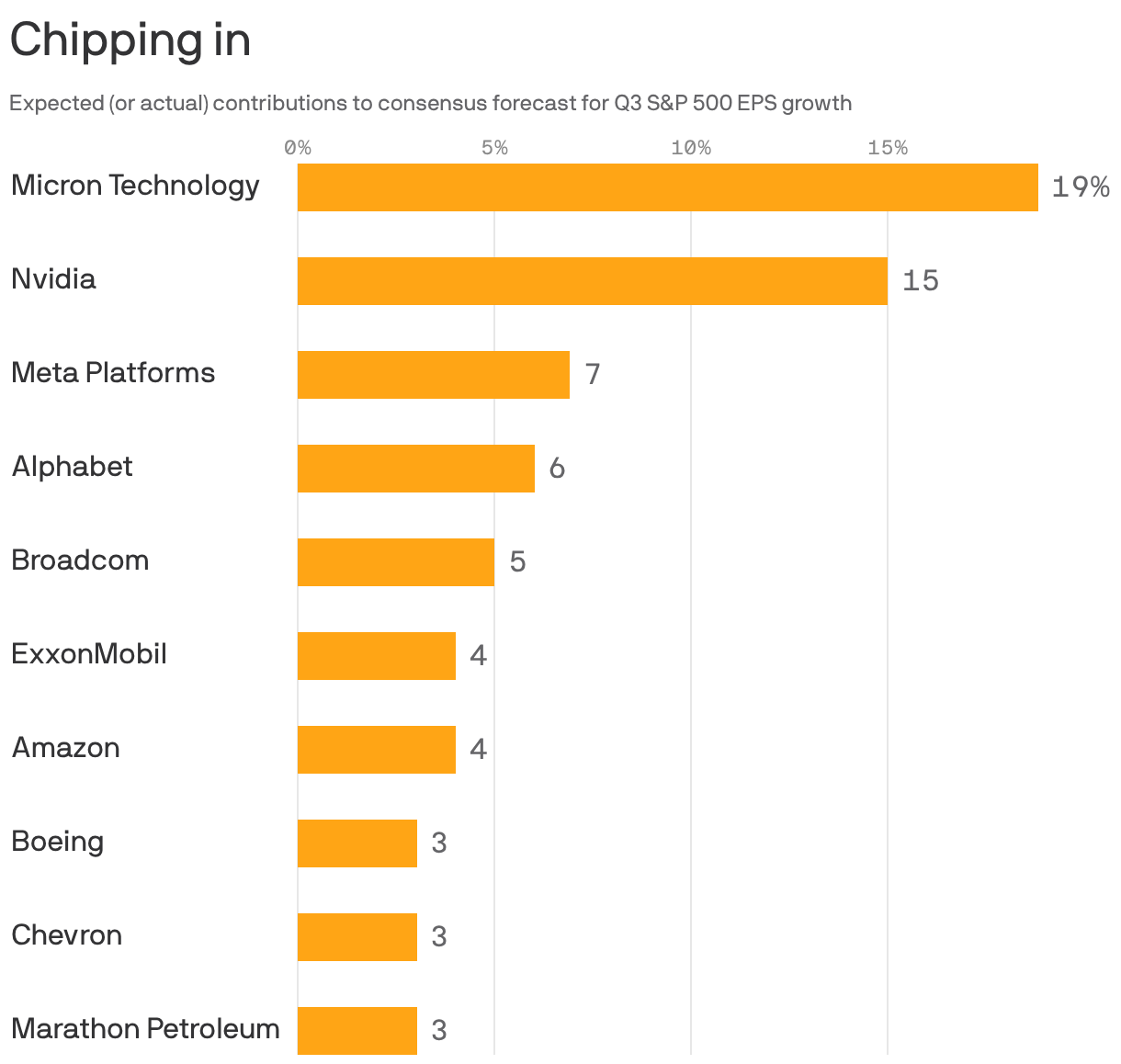
Semiconductor stocks are the clear winners in terms of profiting from the AI buildout, with their results a key to the market's climb this year.
Why it matters: Strong earnings growth is a core reason stocks have been able to stand up to the surge in interest rates over the last few months.
- Earnings per share for the S&P 500 were up roughly 50% annually in the second quarter and are expected to have climbed about 30% in the third quarter, once reporting season is done.
- That growth has enabled stocks to hang on to their gains for the year — about 14% — and even notch a new record high last week.
Yes, but: As we — and others — have pointed out, an outsized share of the market's profitability hangs on a handful of AI chip and hyperscaler stocks.
Case in point: As the above chart shows, chipmakers Micron Technology, Nvidia and Broadcom are expected to provide nearly 40% of third-quarter earnings growth for the entire S&P 500.
The latest: At the same time, chip and chip-related stocks took another tumble yesterday, adding to a surprisingly weak stretch for the sector's shares.
- The SOX chip index slipped 0.2%, its fifth consecutive loss.
- Semiconductor manufacturing equipment maker Applied Materials (down 6.7%) was the second-worst performer in the S&P 500 after announcing plans to spend $5 billion on an advanced R&D center in Silicon Valley.
- Investors and traders seem leery of splashy multibillion-dollar bets on the AI future lately, with Broadcom CEO Hock Tan telling conference goers in Singapore bluntly on Monday that "a lot of investors have no clue what they are investing in" and a lot of AI customers don't get much out of it.
What they're saying: "Most companies out there cannot find any bloody return on investment, I'm telling you," Tan said, according to the Singapore-based Business Times. "People are just wasting money spending tokens."
The bottom line: The comments from the Broadcom CEO baffled some in the markets. (This is coming from one of the biggest winners of the AI boom!)
- Perhaps he is preparing the market for kind of reset after such a record run for the chip sector? In any case, it's not much of a confidence builder.
Axios Markets

Stay on top of the latest market trends and economic insights